110v relay to switch a 24volt load

MaxHeadRoom

Joined Jul 18, 2013
30,681
Maybe after-market versions, but I do not recall ever changing a relay in all the auto's I have owned.
If I had to replace one, I think I would use reputable makes such as Bosch, et-al.
 

Thread Starter

radllc

Joined Oct 15, 2022
8
OK, I get where you are coming from. Personally I would not run with the Songle relays. The reasoning here is most have a habit of not meeting their published specifications and their contacts tend to burn up and weld shut. My project and keeping things simple I would just ru8n with 12 volt coil automotive relays and 12 volt solenoid coils. Automotive relays and their sockets are readily available online and any automotive parts store. Yes, they cost a little more but for your project well worth the additional cost.
I do see plenty of those (12volt input coil automotive relays) but will they switch 120VAC (5 amps for the A/C unit) and up to 30VDC for where I am switching the solenoid valves (which will be 12 volt or 24 volt DC) on the output side. The Songles I noted have the specification right on the relay but am not seeing that on automotive type relays.
 

MaxHeadRoom

Joined Jul 18, 2013
30,681
I have examined them in the past and they do appear that they could be used to switch 120vac, one thing I would do, is if they have it, is open the vent pip to avoid ionization of the sealed interior, if they do not have the 'pip', drill a small hole in one corner.
I don't think they can switch very high inductive loads at 120v as in some, the N/O contacts are fairly close when in the open condition.
 

Attachments

Reloadron

Joined Jan 15, 2015
7,891
Thanks to all your replies I have it figured out. I am designing a glycol chilling system that has three input temperature controls that drive the opening and closure the master chilling unit plus solenoid valves for the various zones. I have decided to go with 12VDC input (I scraped 120VAC input) to trigger 5 relays. Relay 1 - Chilling Unit -120VAC pulling around 5amps max. Relay 2 - Pump (probably 12volts but am still sourcing pumps). Relays 3 - 4 will power the solenoid valves (which will be either 12 or 24 volts). The relay I am currently planning to use is a Songle srd-12vdc-sl-c, which should cover all devices. I will probably drive this with relay boards (they have this relay) as they are common and very low cost - plus pretty much ready to go with all input and output leads. The have a high and low trigger. As such I plan to use the high trigger but will place a 1k resister ahead of the trigger input as is needs much less current to trip the relay. I can also just go with a simple relay (no board), but I would need to find one at a lower cost than the relays boards (and one with that has standard input spades and not pins for a PCB) as I can get 5 boards ready to go for less $10 (and they are easily sourced if I need to replace one). They do make some boards that have multiple relays, but then I am replacing the entire board if have a single relay or zone go bad. That about covers it.
My last response was based on this post.
Relay 1 - Chilling Unit -120VAC pulling around 5amps max.
OK, in the interest of keeping things simple and professional. If you are familiar with DIN Rail mounted components your relay 1 will have a 5 amp current max so I would go with a General Purpose Octal Base DIN rail relay like this type with a 24 or 12 VDC coil.

Relay 2 - Pump (probably 12volts but am still sourcing pumps). Depending on pump load current the same relay can be used.

Relays 3 - 4 will power the solenoid valves (which will be either 12 or 24 volts). Solenoid coils typically are low current and again the same relays may be able to be used.

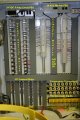
Personally I have used the linked relays for many general purpose applications. Depending on your budgetary constraints there are much less costly relays out there. The link is intended to merely provide some ideas. Here is an example of using relays as control relays. The cabinet design is about 20 years old. I liked using DIN rail for mounting as much as I could. You can have any coil voltage you want.

C2 Cab Inside.jpg

I would use a relay coil voltage to match your solenoid and pump voltages.

I also like very much the suggestions by Max above.

Ron
 

MisterBill2

Joined Jan 23, 2018
27,600
My experience with relay sockets is that they are almost as expensive as the relays, if they are even medium quality.
Certainly DIN rail is a very useful system, and very convenient to attach and remove items. But far from cheap. So if this is a hobby-class of project I suggest that there are also relays available in plastic cases that have tabs that can screw directly to a mounting panel.
 
Top