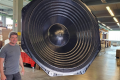
Reminds me of the shaker table in the environmental lab where I had a product tested. Top frequency was only about 2kHz. The base weighed about 5 tons and the top surface of the table was 4 ft square. We bolted our UUT to the table surface. Beneath the table was a magnet and coil setup similar to a large speaker. With its 3 phase 208 powered 33kW amplifier, it was, in effect, a giant bass speaker.
Reminds me of the shaker table in the environmental lab where I had a product tested. Top frequency was only about 2kHz. The base weighed about 5 tons and the top surface of the table was 4 ft square. We bolted our UUT to the table surface. Beneath the table was a magnet and coil setup similar to a large speaker. With its 3 phase 208 powered 33kW amplifier, it was, in effect, a giant bass speaker.
Now that you mention it. We used shaker tables (vibration) for environmental testing and some we lowered a thermal chamber on. Vibe and thermal shock testing. Yep, a gigantic bass speaker.
This is kind of a self-test for me, so I'm not googling the answer ... what I remember is that the low-frequency waveform tends to get clipped at its top and bottom if the speaker's diameter is too small.
This is kind of a self-test for me, so I'm not googling the answer ... what I remember is that the low-frequency waveform tends to get clipped at its top and bottom if the speaker's diameter is too small.
If I recall correctly, from my early-70s audio enthusiast and tinkerer, the key with a speaker are both electrical and mechanical resonances. A larger loudspeaker would have a larger mass and longer throw, to avoid reaching the cone’s compliance limits.
Now, if someone knows better, let’s hear from you.
Not only that, but the neodymium magnets from today are a major improvement over the AlNiCo ones from yesterday. This helps enormously with the cone damping.

 Facebook
 Google
 GitHub
 Linkedin