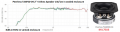
The tiny speaker is a shrieker that has a horrible frequency response that is mainly a 6.5khz whistle, with no low audio frequencies.
The FiiO headphones amplifier produces 0.32W onto 16 ohms with no mention of if it is continuous RMS or peak power and with no mention of distortion.
The bad translation in the spec sheet of the FiiO headphones amplifier says up to 320 million Watts at 16 ohms.
It is powered from 5V USB and has a balanced output which might produce 6.4Vp-p which makes 0.32W into 16 ohms.
Its output might be a little higher at 8Vp-p into 50 ohms producing 0.16W onto the 50 ohms shrieker.
How much distortion??
Why are you so worried about driving the speaker at its full rated power? Normally, you would keep well below the rated power of speaker. And our perception of sound levels is logarithmic, so half the power produces only a small change in perceived loudness.
The tiny shreiker (it sounds like) has such a terrible frequency response that it typically produces only 79dB (or a minimum of 74dB) at 1kHz at 0.5m with an input of its maximum continuous power of 0.3W. It has a +14dB peak at 6.5kHz. See post #15.
Parts Express.com sell many high quality speakers.
Would you like a tiny 2" 10W speaker? Here is one designed in the UK that sounds pretty good.
It produces 85dB at 1W/1m. At 10W/1m it would be very loud at 95dB over most sound frequencies.
Different speakers:
EDIT: the shreiker SPL is at half the distance than normal speakers so the comparison in levels causes its output to be 6dB less than shown on its graph.
Heres a little quick pnp bipolar junction transistor radio setup, but only works good for loud signals, cause the diode doesnt activate if the volts arent high enough on the sig, if u want to use a quiet signal you should just add a bit of dc bias to it instead.
1) DC current through the speaker might cause its voice coil to bash against the magnet structure. A speaker uses AC not DC.
2) The diode does not do anything since the base-emitter of the transistor is already a diode. An AM radio detector?
3) The 1 ohm resistors do nothing.
1. its not dc, its getting modulated by the line out signal.
2. the diode is to short the rarefaction away from the signal input, cause u only want to send one polarity to it, otherwise the counter polarity will destroy the amplification?? (but im not sure.)
3. the 1 ohm resistors help the short away to happen, without the 1 ohm resistors it wouldnt short at all.
heres the dc bias version without that dodgy diode in it, that probably doesnt work yeh....
(I have this version working out of my computer now, running off a battery, with my power supply adding the dc bias)
I need to test different resistors yet tho, because it sounds a little distorted, but its mostly all intact out of the computer.
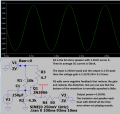
I made a class-A transistor amplifier with all the parts you were missing.
The transistor and speaker pass 58mA DC all the time even when not playing sounds.
The maximum output is only 0.053W.
from my experience, your average little terror transistor can actually take a good 30 watts. but he will die in a day probably maybe, but it will put it through for quite a bit time. maybe its a bit crucifying jesus on the cross tho.
0.053W is one twentieth of one Watt which is less than a headphone level.
The maximum output of the class-A transistor circuit I showed is 2.3V peak which is 2.3V/root of 2= 1.63V RMS. Then the output power into 50 ohms is (1.63V squared)/50 ohms= 0.053W which is 53/1000W.
The power can be increased if a power transistor is used to dissipate the high class-A heat and if the supply voltage is increased and/or the speaker impedance is reduced.
A car radio amplifier channel uses 4 ohm speakers and an amplifier for each speaker wire (bridged amplifiers) producing 7.75V RMS which produces 15W into 4 ohms per channel at low distortion.
Almost all older amplifiers used class-AB that produced low heating when not playing sounds. Most new audio amplifiers use class-D switching that produce low heating when playing or not.
DO NOT connect headphones to the single class-A transistor circuit I posted because the DC current in them will probably fry them and/or overheat the magnets causing low sound levels.

 Facebook
 Google
 GitHub
 Linkedin





 but he will die in a day probably maybe, but it will put it through for quite a bit time.