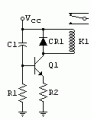
If you are going to use a voltage higher than 12V to power the relay you will need a resistor in series with the relay coil to limit the current through it to a safe value and do not destroy the relay. If you will use a 12V supply connect the relay coil directly to it. In both cases, you will connect the capacitor in parallel with the relay as when the power is switched off the relay will stay energized for a few seconds. The time it will remain energized depends on the capacitors value, the resistance of the relays coil and the pull-out voltage of the relay.
If you measure the resistance of the coil with a multimeter then the time will be approximately equal to:
t=-RC*ln(V/Vm)
where
R=coil resistance
C=capacitance of capacitor
V=pull-out voltage
Vm=initial voltage across the capacitor (working voltage of the relay's coil)
For "C=capacitance of capacitor" is the units μf (microfarads) of F farads ??
im guessing Farads
also - i'm using a 9V battery
so if i add a resistor it would slow it down right?
whats the limit to the size of the resistor i could use??
i don't think the formula takes into account the cut off current
if i had a 50kohm resistor then the formula would=
(-50 000) * 0.001 * ln(1.2 / 9) = 100.745151
Don't think so, think in terms of a 1/10 of a second. 1 RC time constant = R C = 150Ω X 1000μF = .150 sec. I suspect you're going to have to build a timer connected to the relay. I didn't bother figuring a divider circuit. You could even use a transistor to boost the time, it doesn't need to be that fancy.
********************************
Here is something I sketched out. Never built it, but it should work. You may need to use a Darlington transistor to extend the time. R2 will adjust the voltage down where the relay won't fry, and R1 might not be needed at all.
A 555 version will be much more predictable, with a slightly higher parts count. I'd be glad to sketch that up if you want.
The problem is the length of time (5 seconds is a long time in electronics) and the relay (which is pretty low ohmage on the coil, check the specs out). A very rough rule of thumb is the RC time constant (which I showed previous), R X C = Seconds. K in ohms is X1000, and µF is X 0.000001F . The transistors gain increases the apparant resistance on the emitter (the arrow) to increase the RC time constant.
It occurs to me you may not have a clue what I'm talking about. Feel free to ask questions and we'll do our best to answer them.
If you were to make the capacitor 20 to 100 times bigger you would be in the range you're looking for, but 100,000µF is not a small part, in fact it is physically huge.
In a common collector circuit the apparent resistance from the base to ground (through the emitter) is the gain of the transistor (β) X the emitter resistor. Figuring the resistor is around 180Ω and β is 50, this brings the resistance up to 9000Ω. 1000µF X 9KΩ = 9 seconds.
You can read more about common collector transistor layouts here.
Rig,
Just to clear things up,
Do you want the relay to stay on for a while after you switch the power off or you want to switch the power on and the relay to be energized after a while?
It will slowly discharge. If it does it too slowly then we add a resistor across it. The 555 circuit is a lot more predictable, but a bit more complex.
Are you planning on cycling the switch off/on/off/on, or are you thinking in terms of once every hour or so?
Bill's circuit does exactly the opposite, it will let the relay to be energized for a while after you power it and then it will de-energize it. To make it work the way you want you have to flip the position of the capacitor and the resistor connected to the base.
You're not going to be able to use that relay with a 9v "transistor" battery.
Even when brand new, those batteries only put out about 8.6v. They're generally rated at 150mAh, which translates to 15mA over 10 hours.
The relay's minimum pull-in voltage is 8.4v. You might actually get it to work a couple of times if you used a MOSFET to switch the power, but then you'll need a fresh battery.
In a common collector circuit the apparent resistance from the base to ground (through the emitter) is the gain of the transistor (β) X the emitter resistor. Figuring the resistor is around 180Ω and β is 50, this brings the resistance up to 9000Ω. 1000µF X 9KΩ = 9 seconds.
You can read more about common collector transistor layouts here.
Bill's circuit does exactly the opposite, it will let the relay to be energized for a while after you power it and then it will de-energize it. To make it work the way you want you have to flip the position of the capacitor and the resistor connected to the base.
When you say you want the relay to stay energized for a while after the power goes off you mean the entire power supply or just the control signal of the relay?

 Facebook
 Google
 GitHub
 Linkedin