Wiring L.E.D to 12 volts

Thread Starter

JaredNathaniel

Joined Mar 7, 2018
7
So I am using a 12 volt power supply, and from that power supply I have ten wires which go into a plug that has ten connectors. The point of this, is so when every wire i make i plug into the female end of this plug which is wired to the Led. My question is, is how would I connect 10 wires to go to one Led. And what type of resistors would i need if any and how would I go about doing this? Thank you for the help.
 

Thread Starter

JaredNathaniel

Joined Mar 7, 2018
7
Why are you using 10 wires when just 2 will do?
You do need to post more info, and pictures may help.

The wires I am testing go into a component that connect to a pcb board in a product we build. This is for the wiring team to make sure that every time they build one of these cables, that they did it correctly. The easier thing to do would be to give them a multi-meter and have them check for continuity but they seem to be having a hard time with this. So, the thought is they plug this wire into two female connectors, if it is correct it will turn the led on. If not, it wont. But other opinions would be accepted too, and maybe using ten individual bulbs would work better? Thank you for the help.
Sorry for lack of understanding in this. cable.jpg
 

WBahn

Joined Mar 31, 2012
32,823
If you are looking to determine whether the cable was assembled correctly, then you need to do far more than what you are describing. You need a test fixture that ensures that each wire in the cable is not only present, but that it goes between the terminal slot on one end and the corresponding terminal slot on the other end and that it ONLY goes to the corresponding terminal slot (for instance, what if the wire was stripped back too far and is shorting to one of the other wires?)

There are a number of ways of doing it. Since this is to test many cables on a product you are manufacturing, it is probably worth spending just a little bit of time doing it right and making it easy to use (by people that aren't capable of doing appropriate continuity checks).

I'd make a PCB that had both mating connectors on it so that both ends of the cable-under-test can be plugged into it. Then I would have the person push a button to start the test and then I would have the test circuitry cycle through the pins on one end of the cable one at a time taking that pin HI and keeping the others LO. For each pin, it would verify that the corresponding pin on the other end (and ONLY that pin) goes HI. If the test completely passes, a green LED lights up. If the test fails in any way, a red LED lights up. This would give you a GO-NOGO test fixture. If fixing a failing cable is uneconomical, then any cable that fails simply discarded/recycled. If fixing a failing cable is desired, then you can make the text fixture indicate which pins passed and/or which failed to speed repair.
 

dendad

Joined Feb 20, 2016
4,637
How about a 555 driving a 4017. Each output drives an LED and one pin of the cable socket.
The other cable socket has another LED that is placed beside the corresponding first LED.
Then when the lead is plugged in and correctly wired, both LED pairs wink together. Much like an Ethernet cable tester. You could just use one of them if you just had 8 wires.

https://www.ebay.com.au/itm/Multi-N...724698?hash=item4d6196581a:g:vxwAAOSwxbtZmC78

These require the operator to look at it. There is no automatic alarm. But your operators should be able to do that.

As an extra, if each pair of LEDs fed an XOR gate, another LED or beeper could be used to produce an alarm.
Do you think I should suggest this is a good project for The Dreaded Arduino? ;)
Do you need a circuit or can you work it out?
 
Last edited:
This
might come very close to what you want. It will check an 8 conductor Ethernet cable and check for shorts.

I can't think tonight, but you should be able to use a switch of some sort to check the remaining two wires.

The gizmo sequences through the pins and will light a different light if they are out of sequence. It will illuminate two LEDs if they are shorted.

The ends separate.

It's not good for intermittant connections, though. I use another type of tester for that. One that's harder to find.

You can get RJ45's to screw terminals.
 

Sensacell

Joined Jun 19, 2012
3,784
If it's for a production test, you should also test for resistance.
A poorly crimped cable might pass continuity, but fail in the actual product due to high resistance.

See how complicated this gets if you want to do it right?
 

Reloadron

Joined Jan 15, 2015
7,887
The wires I am testing go into a component that connect to a pcb board in a product we build. This is for the wiring team to make sure that every time they build one of these cables, that they did it correctly. The easier thing to do would be to give them a multi-meter and have them check for continuity but they seem to be having a hard time with this. So, the thought is they plug this wire into two female connectors, if it is correct it will turn the led on. If not, it wont. But other opinions would be accepted too, and maybe using ten individual bulbs would work better? Thank you for the help.
Sorry for lack of understanding in this. View attachment 149371
What you are referring to is a cable test. What needs to be defined is what parameters or characteristics of the cable you want to test? A cable test can be very simple or it can get complex. For example:

If it's for a production test, you should also test for resistance.
A poorly crimped cable might pass continuity, but fail in the actual product due to high resistance.

See how complicated this gets if you want to do it right?
So you need to define the parameters you want to test? If you only care about continuity a 10 input AND gate configuration is all you need. If you want line resistance then it gets more complex. Actually a common 2 Input AND gate would work but you get the idea.

Actually if each end were linked and each line placed in series all you need is a lamp at the end. The cable works or it doesn't.

Ron
 
Last edited:

ScottWang

Joined Aug 23, 2012
7,501
You just want to test the connector one by one or you can test them as 5 connectors in one times and check them automatically?
The procedure will be something like below, it depends on how you do it:
1. Write the program.
2. Send(Output) the testing signals from an A Output Port
3. Receive(Input) the testing signals from a B Input Port
4. Comparing the Input signals and Output signals
5. If the connectors are all good then Send a signal to light up a LED to shows that the connectors are "OK".
6. If the connectors has any disconnection then Send the messages which included the "ERR number" as "01", "12", "35" to represent the error pin, if the error pin more than one then flashing the 7-seg LED Display and show the number one by one cycling. (in your case could use four 7-seg LED Display to show as C1 05[Connector 1, pin 5], C3 08[Connector 3, Pin 8]).
7. The original design was used 8051 series, but you can use Arduino Mega 2560 or Pic or other uC to do.
8. You can also show the Error numbers on LCD screen of computer, it depends on how complicated that you want to do, it means that you can buy a digital input/output card and use computer to do the testing job and you can do it more complicated than uC.

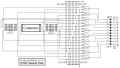
A detector of 40 pins connector -- for 89C2051,89C2041,8951,8952, pic, arduino, etc...
 

AnalogKid

Joined Aug 1, 2013
12,126
As above, comprehensive wire harness testing is more complex than you think. However, the nature of your wire harness reduces some of the complexity.

I agree with dendad in post #7. A simple scanner that relies on a person to make a decision rather than a large wad of electronics should be effective and relatively simple.

ak
 

128ITSH

Joined Jul 20, 2017
101
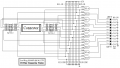
There is another simple way that the circuit shown below, use the AND gates as 74HC08 or you can choose by yourself.
View attachment 149750
Isn't the connection between the connectors drive the AND gates to a voltage of 2.5V?
I can see a resistor voltage divider forming when they get connected, but maybe I'm just missing something here.
2.5V can be fine for TTL levels but not for CMOS.
 

ScottWang

Joined Aug 23, 2012
7,501
Isn't the connection between the connectors drive the AND gates to a voltage of 2.5V?
I can see a resistor voltage divider forming when they get connected, but maybe I'm just missing something here.
2.5V can be fine for TTL levels but not for CMOS.
Thanks, your are right.
I didn't used the original value, because I forgot that when the connector connected then the inputs of AND gate will be become a voltage divider, but it's easy to fix it, R11~R20 = 1K, R21~R30 = 20K.

10PinConnectorWiresTester-02_ScottWang.png
 
Top