Wire Strippers

Thread Starter

biferi

Joined Apr 14, 2017
541
I have a Battery Pack that hold 4. Dabble A Batteries.

The Wire Leads that come off of it are thinner then a 22 AWG. Wire.

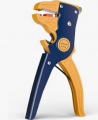
I have an Automatic Wire Stripper that you hold and put the Wire in the size Teeth and then Squeeze and it Strips the Wire.

I thought the smallest whole what do it because it grabs the Wire very good but it just slips out.

What would I need?
 

WBahn

Joined Mar 31, 2012
33,274
A pair of dykes (or similar) and a steady hand.

Just pinch the insulation where you want to make the cut and pull. The insulation will break at that point. Just be careful not to squeeze so much that you cut the insulation and nick the wire.
 

MrChips

Joined Oct 2, 2009
35,245
Before I was able to afford proper tools, I used a nail clipper to strip wire.
You just have to practice to learn how much to squeeze the nail clipper, or you can make a small hole at the cutting edge to match the size of the wire.
 

WBahn

Joined Mar 31, 2012
33,274
Before I was able to afford proper tools, I used a nail clipper to strip wire.
You just have to practice to learn how much to squeeze the nail clipper, or you can make a small hole at the cutting edge to match the size of the wire.
Forgot about that -- I did that for a long time. They work well. When I was doing a large breadboard project in grad school and needed to strip several hundred wires I took a piece of sheet metal that was just thicker than the wire and drilled a hole in it so that I could take the clipper apart and install it and bent the sides to hold it in place with the end sticking just out of the mouth of the clippers to make a stop. That allowed me to very quickly and easily strip wires.
 
I have a Battery Pack that hold 4. Dabble A Batteries.

The Wire Leads that come off of it are thinner then a 22 AWG. Wire.

I have an Automatic Wire Stripper that you hold and put the Wire in the size Teeth and then Squeeze and it Strips the Wire.

I thought the smallest whole what do it because it grabs the Wire very good but it just slips out.

What would I need?
I use and recommend these:

https://www.amazon.com/Stripper-Str...67091:2637801011&rnid=2637795011&sr=8-10&th=1
 
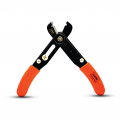
I have been using a set like this for as long as I can remember. I absolutely hate the kind you have to make sure you are in the correct notch each time.

I believe the last pair I bought was at All Electronics. (out of business)

Most of the time I don't even bother to set the adjustment.

1791989549946.png
 
I have used wire strippers as shown in post #9 for quite a few years, MOSTLY they are adequate, but not always.
For some wire stripping situations I use my solder pencil/iron to melt the insulation instead of cutting it. That works well but it is very messy. BUT for some types of very fragile wire it is the only choice that works.
 

WBahn

Joined Mar 31, 2012
33,274
This is the first kind that I used, because they were what my dad gave me. I think he bought them in the 1940s or 50s. As someone else mentioned, I never adjusted them and just did it by feel, because they were a pain to get right.
1792018103151.png

The first ones that I bought were virtually identical but had the rotary size selector.
1792018302783.png
Those worked beautifully for thirty-plus years and they'd still be my go-to strippers if I hadn't lost them somehow. The only thing I didn't like about them was that the selector tended to move to a different position that what I had set it to without me noticing, but I addressed that by putting a spot of modeling clay on the edge of it for #24 wire, which was what I was almost always stripping. Probably could have tapped down the rivet to tighten it up, too, but the clay was a quick fix that worked just fine from that point on.

I've had (have) lots of the really cheap ones that are primarily crimpers have have strippers on the inside of the handles, usually because they came in kits with lugs and connectors that I was actually interested in. Sometimes they worked okay, and sometimes they were so poorly made that they didn't work at all.

I bought one of these when I was in college (different brand, I think I got it at Radio Shack):
1792018223801.png
It worked pretty well, but started giving me problems after a decade or so.

My advice is to not spend much money at all of a wire stripper. If you were stripping wire for a living or doing specialty wire, like network or ribbon cables, on a regular basis, that's one thing. But if you just a hobbyist or it's only an occasional thing, spend your money on other things.
 
I also have an "IDEAL" brand wire stripper that is much more complcatd, with one side that closes to grip the wire and the other side closes with the insulation cutting die, and then more squeezzing with the handle swparates the two, pulling of a small section of insulation. That stripper is only for the wire sizes marked on the stripp die.
 

SamR

Joined Mar 19, 2019
5,542
In addition to the standard Ideal electrician's stripper (10-18AWG), I also have a pair of Italian made C.H.P. model CSP-30-1 very similar ones but 20-30AWG. So, between the 2 pair I am well covered. I also have some "Auto" wire strippers but unless I'm doing a bunch of identical wire stripping to the same exact length, I just grab the others as they are a lot handier for use.
 
I have a variety of strippers such as others here have shown or linked to. They all work well. Something NOT mentioned is a thermal wire stripper such as This: It's quite expensive and needlessly so. It has two stoppers, one has a tapered wedge used to limit the amount of closure of the hot blades, the other is just a depth stop to insert the wire the same depth consistently. This is not the kind of stripper a home hobbiest would want or use, but it's out there should you have a need to strip a ton of wires like that.

One drawback of thermal strippers is that they can tend to burn the insulation leaving an ugly black charred lump where the stripping was performed.

The other three basic types of strippers are what I have in my arsenal for wire stripping. When all else fails I use an exact knife to score the insulation, bending and breaking the rest of the insulation, working my way around the cut till the wires are free of the insulation. Great care is needed so as to not cut through wire strands. It's not for the novice. It takes experience and a steady hand. Also - you could slip and cut a finger. I've done that.
 
The serious issue with wire stripping is usually possible damage to the copper conductor. THAT is a big-deal because any nick focuses bending at that point, possibly leading to conection failure. THAT, in turn, is a "very big deal" with expensive "crimp-on" connector inserts.
 

wayneh

Joined Sep 9, 2010
18,175
The serious issue with wire stripping is usually possible damage to the copper conductor.
That's why I'm surprised to the see the advocates here of the "one size fits all" type of stripper. Yes, you can usually do a pretty good job, by feel and experience, of cutting the insulation just enough without damage to the conductors. But your first cut on unfamiliar wire is prone to mistakes. I used one like that for years and tossed it the moment I graduated to the luxury of the pre-sized one.
 

SamR

Joined Mar 19, 2019
5,542
Experience is the key to success! Even the pre-marked "Ideal" types will bite the copper if not careful. Which is why I usually start with a wire gauge bigger on the cutter than the wire. Even then... Cutting cable jackets is even trickier! With many years of experience, I have yet to find the perfect wire stripper and doubt it even exists.
 
Certainly SAM is correct, although I would add that understanding and focus are also important. AND a lot also depends on PATIENCE, especially for some types of wires and cables.
 
Top