Why is Vos on a differential amp not zero, or close to?

Thread Starter

NomadAU

Joined Jul 21, 2012
46
Hi

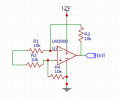
I recently posted about measuring a series of LiFEPO4 battery cells using op amps and MUX. I'm now testing out a simplified circuit using an LM3900 quad amp chip. Having done some basic reading about op amps, I thought that if I (refer to diagram)
a) used identical resistors for R1 and R2
b) used identical resistors for R3 and R4
c) shorted both op amp inputs
then I should expect a differential voltage on the output of almost zero. Various op amp specs suggest Vos of microAmps.

However, my testing using all 10K resistors gives me a much higher output, almost 500mV. This reading appears to be constant regardless of the source voltage (have tried 12V down to around 5V).

Is there something wrong with my op amp, or is there some other reason why I am getting such a high reading?

Thanks for any insights,
Mike
 

Attachments

atferrari

Joined Jan 6, 2004
5,011
Shouldn't be both inputs submited to a common voltage, whether zero or higher?

Having them shortcircuited, is it enough for that test? For me they are just floating.

IIRC, to correct voltage offset at the output you apply zero volts to both inputs.

/EDIT to add
The resistors, are they more or less matched?
Swap two of them and see if the output is still the same.
EDIT/
 
Last edited:

OBW0549

Joined Mar 2, 2015
3,566
The LM3900 is not a regular op amp and cannot be used in conventional op amp circuits such as yours; it is a current-differencing amplifier, not voltage-differencing. As this application note explains, it has a completely different means of operation and requires completely different operating circuits.

You cannot simply drop an LM3900 into a conventional op amp circuit and expect it to work-- which is why you're getting the results you're getting.
 

MisterBill2

Joined Jan 23, 2018
27,504
The LM3900 is not a regular op amp and cannot be used in conventional op amp circuits such as yours; it is a current-differencing amplifier, not voltage-differencing. As this application note explains, it has a completely different means of operation and requires completely different operating circuits.

You cannot simply drop an LM3900 into a conventional op amp circuit and expect it to work-- which is why you're getting the results you're getting.
TOTALLY CORRECT!! The LM3900 is not symetrical inside at all. I would not even call it an op-amp. Also,it is a quite old design, far better ones are now available. You should look at the online selection guides and see what they show in the Low offset voltage category.
 

ronsimpson

Joined Oct 7, 2019
4,690
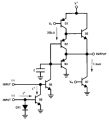
The LM3900 is not a "op-amp". Look at how the front end is built. There is a Base-Emitter to ground on the inputs. They can not be pulled much above ground. (1 diode drop) This part is for a different purpose. It might have the same symbol as a op-amp or a voltage comparator.
1588512405910.png
 

DickCappels

Joined Aug 21, 2008
10,661
I had been tasked with the design of a precision signal processing circuit (raster rotation using linear deflection amplifers) right at the time the LM3900 came out. I was excited because this was the first quad opamp I had seen (should have waited for the LM324), and designed a few of them in because a lot of opamps were needed. This was for a demonstration at WESCON (remember those?). The circuit worked -rotated the raster very nicely, the only problem is that the LM3900's were not intended for that kind of precision work and I had to constantly readjust the offsets in the circuit to keep everything centered and symmetric.

Now, 45 years later, there are many quad opamps that are much "better" than the ancient LM3900.
 

Thread Starter

NomadAU

Joined Jul 21, 2012
46
Why did you use the LM3900 instead of a standard opamp or differential instrumentation amp?
Good question crutschow. Simply because that's all I could find in my limited collection of parts!
From the many comments, it's pretty obvious to me now that the LM3900 is not a typical op amp and not suitable for measuring voltage differences. That was the big mistake I made.
 

Thread Starter

NomadAU

Joined Jul 21, 2012
46
Thanks to all of you who gave me good feedback on this. So I have exposed my lack of knowledge on op amps by assuming that they all kind of behave the same...and this is patently not true. So, I will head down to Jaycar and see what other op amps they have that might be more suitable for use as a voltage differential measuring component.
Really great and quick answers from everyone, so a big thankyou.
Cheers,
Mike
 

OBW0549

Joined Mar 2, 2015
3,566
So, I will head down to Jaycar and see what other op amps they have that might be more suitable for use as a voltage differential measuring component.
You might try finding an LM324; it's a general-purpose op amp that many people use because of its wide availability and low cost. The 324 is a quad; for the dual (8 pin) version, there's the LM358.
 

Thread Starter

NomadAU

Joined Jul 21, 2012
46
Thanks for suggesting alternative op amps.
When I select the op amp, I will pay particular attention to
  • operating voltage, single supply, must be able to operate up to around 30V DC. The op amp will be powered by the 8 cell battery, so around 28V.
  • low Vos, e.g. 1 mV
  • capable of rail to rail operation. Cell 1 inputs will be GND and around 3.6V, while the inputs for cell 8 will be around 25V and 28/29V (i.e. battery Max)
I appreciate the points made about RRIO - I was pretty much concentrating on Vcc max and Vos, but need to ensure RRIO capability.
Thanks

PS : I've just done a quick LTSpice simulation for the LM324 and at first blush, it appears to work ok for the cell 8 measurement.
 
Last edited:

MisterBill2

Joined Jan 23, 2018
27,504
The LM3900 was given a great deal of fanfare when it was introduced . It was touted as a current gifferencing
The LM324 does not common mode to the positive rail, so might, depending
on design, be suitable. Just look for a RRIO capable part to be on safe side.

View attachment 206181

A tool - https://www.analog.com/en/design-center/interactive-design-tools/adi-diffampcalc.html

Regards, Dana.
TRUE, but if you use a 15 volts supply you can have 10 volts easily. AND if you use a +- 15 volt supply you can have 20 volts peak to peak easily. That is worth being aware of.
 

MrAl

Joined Jun 17, 2014
13,702
The LM3900 is not a "op-amp". Look at how the front end is built. There is a Base-Emitter to ground on the inputs. They can not be pulled much above ground. (1 diode drop) This part is for a different purpose. It might have the same symbol as a op-amp or a voltage comparator.
View attachment 206113
I think it is still considered an op amp just not a voltage mode op amp.
They have also been called Norton amps because they are current mode if i remember right.

Wow, it's been years and years since i worked with one of these or even heard anyone talking about them. One of the features was higher bandwidth at the time and certain circuits were already designed that used them.
 

MrAl

Joined Jun 17, 2014
13,702
Hi

I recently posted about measuring a series of LiFEPO4 battery cells using op amps and MUX. I'm now testing out a simplified circuit using an LM3900 quad amp chip. Having done some basic reading about op amps, I thought that if I (refer to diagram)
a) used identical resistors for R1 and R2
b) used identical resistors for R3 and R4
c) shorted both op amp inputs
then I should expect a differential voltage on the output of almost zero. Various op amp specs suggest Vos of microAmps.

However, my testing using all 10K resistors gives me a much higher output, almost 500mV. This reading appears to be constant regardless of the source voltage (have tried 12V down to around 5V).

Is there something wrong with my op amp, or is there some other reason why I am getting such a high reading?

Thanks for any insights,
Mike

Hi,

I believe that is referred to as a Norton Amplifier. It has special biasing needs for one thing.
The more common voltage mode op amps depend on the VOLTAGE difference at the input while the Norton amplifier depends on a differential CURRENT. That makes its operation different.
For example for a voltage follower you dont connect the output to the inverting input like you do with voltage mode op amps, you have to use a resistor from output to input because it is looking for a current on the input not a voltage. The output of both types however is a voltage.
The static response then would look something like this:
Vout=aol*(iP-iN)
where iP is the current into the non inverting input and iN is the current into the inverting input. aol is the open loop gain. Vout is the output voltage.
This is in contrast to a voltage mode op amp which would look like this:
Vout=aol*(vP-vN)
where vP and vN are the voltages at the two inputs.

Try the LM358. The input offset is around 2mv so with a gain of 1 the output will be around 2mv only. Chopper stabilized op amps will have much lower output offset usually at the cost of frequency bandwidth.

There are other reasons why you might not get 0v at the output. Another reason is the saturation voltage of the output transistor if you dont use a negative supply along with the usual positive supply voltage.
 
Last edited:

MisterBill2

Joined Jan 23, 2018
27,504
I think it is still considered an op amp just not a voltage mode op amp.
They have also been called Norton amps because they are current mode if i remember right.

Wow, it's been years and years since i worked with one of these or even heard anyone talking about them. One of the features was higher bandwidth at the time and certain circuits were already designed that used them.
Yes, it was touted as a "current differencing op amp", which many folks did not understand. It has a different pinout and unfortunately it does not allow replacement with any of the hundred standard pinout quad opamps. And it was much less common. So one immenselypoular circuit for a VOX,(voice operated switch) has been around over ten years, and all the poor folks ho tried a real opamp instead are disappointed. And the gain calculations are so different that redoing it for an LM324 is a challenge. That VOX was really good, otherwise, since it iused that IC and a 555 timer IC.
 
Top