A 15 stage binary divider will produce 1Hz from the 32.768 KHz crystal. And a 32.768 KHz crystal is a fairly good frequency for a stable crystal cut.
It works out well.
If you are designing you very own RTC, you can use any frequency you like. If you use somebody else's RTC you have to use what the datasheet calls for. If you use something else, it may not work as you expect.
For the reasons above, you want a frequency that is a binary multiple pf 1 Hz. After that, it is a tradeoff between the size and cost of the crystal versus the cost of the divider stages. A smaller crystal is cheaper to produce and more accurate, but also higher frequency, requiring more divider stages.
Note that a 32 kHz crystal is not a crystal in the traditional sense; it is a little itty-bitty tiny tuning fork.
When using with a micro based clock etc, The TMR1 can be clocked by a 32,768hz xtal. (power of 2)
If pre loading the TMR with 8000h it will rollover every second.
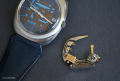
The 350 introduced a frequency of 32,768Hz, with an advertised accuracy within about 0.164 seconds per day. This accuracy blew its competition out of the water and set the frequency standard for decades.
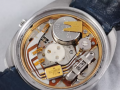
The information provided to me by Girard-Perregaux about this movement is as follows: “[This] Model [is] from 1971. [It was the] First watch with the quartz oscillating at 32,768 Hz, a frequency adopted since then as a universal standard.
The GP-350 movement was equipped with an integrated circuit produced by Motorola, bringing together the equivalent of 300 transistors within an area equivalent to 5 mm2. Its consumption was reduced to 4 micro-amperes, enabling sufficient battery life. This was the first time that quartz wristwatches passed the static and dynamic tests (impacts, magnetism, temperatures) at the Neuchatel Observatory. After 38 days of tests, the GP quartz watches certified by Neuchâtel Observatory for the year 1971-1972 had proven their extraordinary accuracy and their reliability.”
obtaining desired time reference by dividing from higher frequencies is possible and done.
the higher initial frequency is, the more stages would be needed. but each stage consumes power so for ultra low power consumption, such as wristwatch, you want to use rather low initial frequency.
The DS3231 designed to use 32.768 xtal it's frequency timing accuracy least division like the DS12885. You can compare it to an Arduino.
The Arduino itself was designed to use a much faster crystal to clock it's system. The Arduino architecture allows many time clock functions via software and I/O ports. When combined the output of the RTC the Arduino can easily adapt a display. The RTC on the other hand can operate by itself for a year on small battery and it can remain awake until it is time to wake up sleeping circuits that need intervals or wake up time without display.
This allows the Arduino to facilitate display and emulate other functions while testing and designing and later the arduino can be removed.
The video demonstrates the time / date display but the rest of the video is 8 minuets of how to make it. There are a lots of wires and programming.
Some of the stuff today is just made that way to keep up with the old and established standard.
You'll see some super duper clocks now at that frequency that have very low drift even after a year.
It's amazing how far they have come really.
If you try to do this with a regular 10 parts per million crystal you will soon see the difference. Even taht accuracy isnt that good for long term time keeping, which is a special case in a class of it's own.
OF course there is always the GPS clocking, which is the best aside from lab clocks.
But of interest is that you will never, ever, see a real time clock that is perfectly accurate because it was recently proved that it would take an infinite amount of energy to keep perfect time, strange as that sounds.
The accuracy keeps getting better nonetheless though, with quantum effects.

 Facebook
 Google
 GitHub
 Linkedin