Why Don't MOSFET Resistance Values Hold Up With This Circuit?

Thread Starter

evansste10

Joined May 25, 2024
16
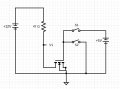
I've designed a basic MOSFET circuit that's supposed to control the voltage of a node, based on whether certain switches are closed. I've attached a schematic of this circuit. The MOSFET has a part number of NTE490. I've attached the datasheet.

As you can see, the circuit is quite simple. When S1 is open and S2 is closed, I expect V1 to be about 12 volts. This is because the MOSFET is supposed to act like an open circuit. When S1 is closed and S2 is open, I expect V1 to be zero volts. This is because, in that scenario, the MOSFET is supposed to act like a short circuit. However, after building this circuit, I've discovered that this isn't what happens.

With my actual circuit, When S1 is open and S2 is closed, V1 is equal to about 0.8 volts. When S1 is closed and S2 is open, V1 is equal to about 0.5 volts.

I recognize that the MOSFET isn't a perfect switch. I've tested it, and have learned that, when no voltage is applied to the gate, there is a resistance of about 4M ohms between the source and drain. When 5 volts is applied to the gate, there is a resistance of about 2 ohms. With these values, it should work well enough to produce values that are close to what I was expecting.

0.5 volts is close to 0 volts. So that's what I would expect. However, 0.8 volts is nowhere near 12 volts. Does anyone have any insight on why this circuit is behaving in such an unexpected manner?

Thanks for your time. I appreciate any insight, or advice, that anyone is able/willing to provide.
MOSFET Circuit.png
 

Attachments

Last edited:

Thread Starter

evansste10

Joined May 25, 2024
16
Right after posting this, I took another look at the datasheet, and noticed the diode, that is connected between the source and drain. This may explain why this circuit is behaving this way.

I'll go back, and swap the source with the drain, and the drain with the source. If I'm correct, doing so should solve the problem, and allow the circuit to work as expected.
 

dl324

Joined Mar 30, 2015
18,220
Right after posting this, I took another look at the datasheet, and noticed the diode, that is connected between the source and drain. This may explain why this circuit is behaving this way.

I'll go back, and swap the source with the drain, and the drain with the source. If I'm correct, doing so should solve the problem, and allow the circuit to work as expected.
There's always a parasitic diode between the source and drain. There are actually 2 and the one on the source is shorted in a 3 terminal device.

Try drawing your schematic more conventionally. You have the MOSFET rotated 90 degrees from the normal orientation and have the batteries drawn upside down. You're also letting the gate float when both switches are open.
 
Last edited:

Thread Starter

evansste10

Joined May 25, 2024
16
I just confirmed that, swapping the drain and source, solved the problem.

Thanks for your tips and suggestions, dl324. After reading your post, I can see why the diode would be parasitic. Even though an N-channel is created, during enhancement, there will always be a PN junction between that channel, and the body. I didn't really think about that, until you mentioned it being parasitic.

I, also, want to thank you for the tips on making a better schematic. I don't, generally, design with MOSFETs. I had to pull out my textbook, from nearly 30 years ago, to be reminded of the schematic symbol, as well as their basic, physical construction.

This was, also, the first time I've ever used an online tool to draw a schematic. My lack of experience, clearly, shows. I just pasted most of the symbols, without even thinking of orientation. Thanks for letting me know that the batteries are upside down, and that the MOSFET should be rotated.

As for the switch, I do have a minor defense. My actual circuit uses a SPDT switch. However, the online tool didn't offer such a device. So, I had to make due with two simple switches.

In any case, I'm glad that the circuit is working, and that I have a better understanding. Thanks for your suggestions.
 

dl324

Joined Mar 30, 2015
18,220
there will always be a PN junction between that channel, and the body. I didn't really think about that, until you mentioned it being parasitic.
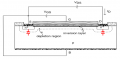
This cross section is from a free on-line MIT course. I added the parasitic diodes.
1724530087150.png
When the device is packaged in a 3 terminal device, the diode on the source is shorted, leaving the one from the substrate to the source.

Note that the course material uses the "new" MOSFET symbols where they don't indicate enhancement mode with the dashed line and they reversed the direction of the arrow. It seems to me that academics have nothing better to do than cause confusion...
As for the switch, I do have a minor defense. My actual circuit uses a SPDT switch.
You can add a dashed line between the switches to indicate they're ganged, and label them something like S1a and S1b.
 

Attachments

Last edited:

WBahn

Joined Mar 31, 2012
32,703
I've designed a basic MOSFET circuit that's supposed to control the voltage of a node, based on whether certain switches are closed. I've attached a schematic of this circuit. The MOSFET has a part number of NTE490. I've attached the datasheet.

As you can see, the circuit is quite simple. When S1 is open and S2 is closed, I expect V1 to be about 12 volts.
How can any node in your circuit ever be 12 V when the highest voltage in your entire circuit is 0 V?
 

Thread Starter

evansste10

Joined May 25, 2024
16
Thanks, Dennis. Ironically, that picture is almost identical to the one that's in the old textbook that I went back to reference. The book is entitled "Electronics: A Top-Down Approach to Computer-Aided Circuit Design". The author is Allan R. Hambley, and it was published in 1994. When I took that course, many years ago, I knew it was a good, detailed book; which is why I held onto it. The picture, that you've shown, is nearly identical to those on pages 244 and 245.

I haven't looked at any of the newer books. Perhaps, the fact that it was published in 1994, is a benefit.
 
Top