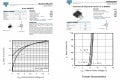
Hi pager48, I am not sure the threshold voltage is of that great a significance, so long as it is well within the range of the op-amp output. As for the on resistance, the higher the value the less sensitive the amplifier has to be, so the less susceptible to noise. See for example the transfer characteristics of 2 MOSFETS I grabbed at random
But you also need to take into account how much current and heat the mosfet will have to dissipate.
By definition, a linear current source is never going to be "efficient".
As long as you have enough voltage available to get the FET fully turned on, the gate threshold is almost irrelevant in this design, so is the RDson figure.
Neither Vgs(th) or Rds(on) are inherently relevant in that type of circuit.
However, in a circuit intended to operate from a low supply voltage, a large Vgs(th) will cause trouble if the voltage across the sense resistor plus the MOSFET's Vgs at the desired current exceeds the op amp's maximum output voltage. Using a MOSFET with a lower Vgs(th) can alleviate this problem.
i thought it had something to do with switching loss or a particular region which the opamp might throw the MOSFET into for a specific constant current value. which is why I thought a low gate threshold voltage part might be more efficient.
No.
The transistor power dissipated is simply the current through it, times the voltage across it (V * I).
The gate threshold voltage has nothing to do with that.
It just determines when the MOSFET turns on.
I am not sure why the gate capacitance is so important for this application as the voltage on the gate will only be change slowly anyway, you will not be producing pulses with the variable resistor that sets the reference voltage on the Opamp.
Just give it a go and see how it works!!
The OpAmp control loop forces the Voltage on the 1 ohm to be same as Vpot wiper,
thereby setting current thru mosfet.
So no matter what the supply V to MOSFET or its drain load is doing its gate is adjusting
to keep the I thru load adjusted so that current thru it is fixed at Vref / 1 ohm.
This occurs at low frequency Vref and because of high Aol of OpAmp.
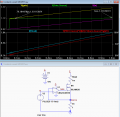
Below is the LTspice simulation of your circuit which may help you understand its operation.
Note that the high gain of the op amp rapidly increases the gate-source voltage (green trace) to the MOSFET threshold value, where is starts to conduct current.
Above that point the Vgs increases only slightly as the current increases (about 80mV from start to end), as determined by the MOSFET transconductance gain.
The MOSFET power dissipation (red trace) increases linearly with the current (blue trace), as expected.
Note the ringing instability at the start of the ramp, that danadak in post #4 mentioned might happen.
That will likely require additional compensation and/or a better op amp.
You can try a small amount of series R in the MOSFET gate, say 20 to 50
ohms, as a way of decoupling the MOSFET C from the 324. Its tricky as
that adds phase shift in the control loop, above and beyond what is already
added due to OpAmp finite Zout. Way to look is scope , and feed a step,
square wave; to current source input and watch the transient response.
If added R aggravates response you will have to comp the 324 another way,
like add a zero in fdbk path, or use an OpAmp that can handle a lot of Cload.

 Facebook
 Google
 GitHub
 Linkedin