What servo motor is this?

Thread Starter

MrMeaner

Joined Jan 20, 2018
13
Hello,

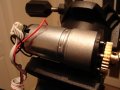
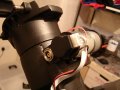
Not sure if this is the right place for this but I need some help identifying a servo motor from a telescope mount. It has a 4-wire encoder and a reduction gearbox at the front. The gearbox can be removed. Any ideas? The telescope mount manufacturer won't reveal its identity.

Thanks.
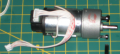
motor.png
 

Thread Starter

MrMeaner

Joined Jan 20, 2018
13
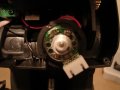
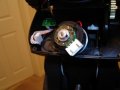
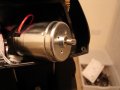
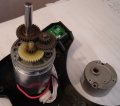
Thanks all. Here are some more pics, some with the gearbox removed, and one inside the gearbox. The reduction ratio is about 55:1. I guess the gearbox could be bespoke but perhaps the motor itself is generic.

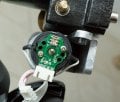
I looked in the encoder and it said "E8300 Rev.A RoHS" on the PCB. The gearbox has a label saying "No.20150924" but it seems to date made.

The speed seems to vary very slightly over a single revolution... any reason for this? This happens at 1 rev/11 seconds. Or this to be expected?

dec_motor.JPG encoder_1.JPG encoder_3.JPG motor_wo_gbox_1.JPG motor_wo_gbox_2.JPG motor2.jpg
 

beatsal

Joined Jan 21, 2018
425
Please post a pic showing details.
Also I have a question - where can I get a winding diagram for a 18VDC 2-POLE 3-coil motor?
 

LesJones

Joined Jan 8, 2017
4,511
Some background information would be helpfull. Are you trying to buy a replacement motor ? Is it faulty and you are trying to repair it ? When you say on post #4 "The speed seems to vary very slightly over a single revolution..." Is this with it connected to the unit is part of so it's speed is being controled by feedback from the encoder or is it just driving the motor part from a stable constant voltage supply ?
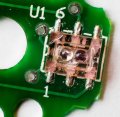
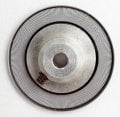
Are there components mounted on both sides of the encoder disk ? There are normally two IR emitters on one side and two IR detectors on the other side so that the lines on the encoder disk interrupt the IR beam between the emitter and sensors.

Les.
 

AlbertHall

Joined Jun 4, 2014
12,619
There are normally two IR emitters on one side and two IR detectors on the other side so that the lines on the encoder disk interrupt the IR beam between the emitter and sensors.
It could be a reflective sensor which would need to be on only one side of the board.
 

LesJones

Joined Jan 8, 2017
4,511
Hi Albert,
I would have thought that a reflective sensor would not work with the encoder lines being so close together. But looking at the picture again you are probably correct as the position of the IR device would not provide the two channels required for a quadrature encoder. One other thing that supports your theory is that one device in the package is clear and one is tinted so one is probably the emitter and one the detector.

Les.
 

AlbertHall

Joined Jun 4, 2014
12,619
I was wondering if it was a simple speed sensor (one channel) rather than quadrature but the sensor appears to have at least 5 PCB tracks connecting to the rest of the circuit which doesn't fit with a one channel sensor.
 

LesJones

Joined Jan 8, 2017
4,511
Hi Albert,
Yet another good point. The sensor assembly could be fitted at a slight angle to a radial line so that the siganls were 90 degrees apart. (360 deg being one cycle of encoder lines not one revolution.)

Les.
 

MaxHeadRoom

Joined Jul 18, 2013
30,557
That is a common quadrature encoder, with 4 terminations it will be power pair and A & B phases, squared up.
Although if no conditioning IC, the output would be two sine waves.
The out put can be push-pull RS485 or simple open collector, it should be easy to reverse engineer for the four connections.
About a 1200 pulse/rev by the look of it.
Max.
 

Thread Starter

MrMeaner

Joined Jan 20, 2018
13
Yes I am looking to place the motor if possible... there are 2 motors in the mount and the one in question does sound rougher than the other so I will swap the motors around and see if that makes a difference. I don't think it's problem with the electronics. Maybe cleaning the motor brushes/commutator might help. It would be nice to identify the motor itself, i can always move the encoder over to a replacement motor.

Thanks again for all your input.
 

Thread Starter

MrMeaner

Joined Jan 20, 2018
13
When you say on post #4 "The speed seems to vary very slightly over a single revolution..." Is this with it connected to the unit is part of so it's speed is being controled by feedback from the encoder or is it just driving the motor part from a stable constant voltage supply ?
The speed seems to vary over a single revolution in a sinusoidal fashion, repeating every rev (11 sec). Yes, with the encoder controlling the motor. Can the condition of the brushes/commutator cause such behaviour?
 
Top