What power supply will fit with a... strange generator?

Thread Starter

drema66

Joined Sep 25, 2017
4
A generator was created for the windmill, on permanent magnets. So, this generator have uncontrolled excitation.

As a result, a voltage oscillating from 800 to 1500 volts, with frequencies of 55-80 hertz, and no-load currents of 0.52 / 0.62 Amperes.

So, the question is: Which voltage converter can be used, to drop from voltage from 800 to 12 ?

And, I draw your attention to the fact, that the wire of coils, is a 0.09 millimeter... perhaps, conventional transformers do not fit, cause the winding will burn (under load)... Is it possible to use a switching power supply in this case? And how to calculate it?
 

tcmtech

Joined Nov 4, 2013
2,867
Who designed and built the generator to put out such a high and thus largely unusable voltage?
Ideally it should be taken apart and rewound with a much larger wire in a vastly lower turns ratio if you want it to work properly reliably and safely.

Reason being that unless it was specifically and properly built for having that high voltage present on its windings it will cause it to short out at some point.

As for transformers, three common 480 VAC to 12 or 24 VAC step down units in series would work with that input voltage and frequency range to which their output could be put in parallel and rectified then stabilized and smoothed with a normal and cheap buck type DC - DC converter unit.
 

Thread Starter

drema66

Joined Sep 25, 2017
4
Thank you very much for the answer and advice. I'm certainly aware of the existing problem. But to be honest, the technology for constructing this type of generator is too crude, mostly empirical. As a result, what is obtained is obtained ;)

I apologize for the repeated question: for checking the load current, it is necessary to break it into parts, lower, straighten, smooth and sum up? Or is there switching power supplies for such a high voltage? (sorry for my bad english...)
 
As a result, a voltage oscillating from 800 to 1500 volts, with frequencies of 55-80 hertz, and no-load currents of 0.52 / 0.62 Amperes.
Why do you even have a no load current. No load means 0 current.

Frequency has to depend on wind speed, right?

You need a way to park the windmill, right?

Transformer with taps to reduce voltage. Rectify.

wide range DC to DC to DC;
 

Thread Starter

drema66

Joined Sep 25, 2017
4
The wind generator is one of the possible applications of this type of generator. I am in such conditions that I do not have a team and there is no possibility to collect it. I am a physicist, but not a practitioner. Frankly I am working on this problem for over 10 years.

The result is a patent in Greece, which describes the technology of this type of generator.The basic idea is to create an autogenerator. It may seem delusional, but I believe in my idea.

And now, about what I have:

I start the generator with a screwdriver, it consumes about 300 watts. At the output, I have four circuits (circuits, from series-connected coils). Two contours in phase. I have technical flaws, i know it... but now, cant fix them. Therefore, such a strong stress dispersion.

Information of the contours:

1. 1200-1450 Volts 50-70 Hz, the no-load current is 0.4-0.62 A
2. 1250-1450 Volts 50-70 Hz, the no-load current is 0.4-0.62A
3. 750-860 Volts 50-70 Hz, the no-load current is 1.2-1.5 A
4. 800-940 Volts 50-70 Hz the no-load current is 0.4-0.62 A


If to connect in pairs in series the circuit, I will receive a two-phase voltage above 2000 volts. I just dont know what to do next, how to lower and straighten it. The idea was to use one or two circuits to get a 300W for screwdriver, the rest is a useful efficiency. But such voltages, with a thin wire that i used... i was pazzled. Maybe it's not a big deal, but for a linear transformer strong scatter. I confess, I'm not an electronic engineer and ask for advice. With what i can do some experiments, in your opinion?
 

dendad

Joined Feb 20, 2016
4,634
I'm sorry, your explanation make no sense to me.
It almost sounds like you are trying a free energy machine and that is impossible.
What do you mean
I start the generator with a screwdriver, it consumes about 300 watts. At the output, I have four circuits (circuits, from series-connected coils). Two contours in phase. I have technical flaws, i know it... but now, cant fix them. Therefore, such a strong stress dispersion.
???
It may be a language barrier but a lot of that I can't work out what you are talking about.
Are you driving a rotary alternator with a motor of some kind? It it the motor current that you are referring to as "the no load current"?
Any no load current is by definition zero. If there is no load, there is no circuit for current to flow so it must be zero. If this is current somewhere else, you need to be more specific. Is this the current of your driving motor for example?
A diagram or pictures will be a good help.
 
Last edited:

Thread Starter

drema66

Joined Sep 25, 2017
4

It is not so simple...

It's not just a generator on free energy, it's a real device, with real characteristics. Yes it is very crude technology. Ten years ago and the windmills did not have the same power as now =/

As for the screwdriver: Yes, I use it to rotate the rotor. It is easier to measure the power of screwdriver. So, I need to compare how much is spent and how much is received at the output. That's how much it at the output, how to measure it?

The measurements described above were carried out by the Fluke 179 multimeter. No-load current, it's a specific phenomen in the generator design :) Simply, the Fluke 179 is connected to the generator clamps, in alternating current mode.

Sorry, but what's bothering you? Voltages, or, that such generator can be? (And yes, a language barrier annoying...)))
 

tcmtech

Joined Nov 4, 2013
2,867
I just dont know what to do next, how to lower and straighten it. The idea was to use one or two circuits to get a 300W for screwdriver, the rest is a useful efficiency. But such voltages, with a thin wire that i used...
The only real fix is to rewire it with heavier wire of far less turns in order to reduce the voltage. There is no other practical solution that will work long term. If it was crudely built then the coils were also not properly designed to operate at that high of voltage and will likely short out when operated for a while.
 

dendad

Joined Feb 20, 2016
4,634
It sounds like you are measuring short circuit current, not no load current. The multimeter is the load and the load is basically a short circuit so in stead of no load, it actually is maximum load.
And one thing that is bothering me is that a free energy generator cannot work. You claim to be a physicist?
If this device would work, you would not have to turn it to start as it would spontaneously start rotating and your real problem would be how to stop it over revving and flying to pieces when there is no load attached to remove the "free energy".
As for the screwdriver: Yes, I use it to rotate the rotor. It is easier to measure the power of screwdriver.
and how do you measure the power of a screwdriver?
And as with most of these free energy devices, the designer keeps details secret with no real pictures or helpful info claiming it is under development and will release it when it has made them a fortune.
 

strantor

Joined Oct 3, 2010
6,875
@dendad I think you are misinterpreting. I think he is just using the drill ("screwdriver") to turn the generator at a known speed and torque for testing.

Also if the generator were shorted, he would not be measuring any voltage.
 

strantor

Joined Oct 3, 2010
6,875
@drema66 they make inverters for electric vehicle conversions which take high voltage DC from the car's main battery and steps it down to 12V for the car's original 12V circuits. These are designed to accept a wide range of high voltage depending on the main battery's charge state. Maybe if you rectified the generator's output and feed it to one of these, it would help.
 

dendad

Joined Feb 20, 2016
4,634
@dendad I think you are misinterpreting. I think he is just using the drill ("screwdriver") to turn the generator at a known speed and torque for testing.

Also if the generator were shorted, he would not be measuring any voltage.
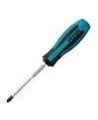
You may well be correct. I hadn't thought of the "screwdriver"screwdriver.jpg being a drill (or power screwdriver).power screwdriver.jpg
That is why I'd really like to see some pictures and diagrams to help clarify things. As they say, a picture is worth a thousand words, and it would help clear up some language problems. Often it is very hard to convince the TS to post more real info for some reason.
Unfortunately, I am one of those single language people. It would be great to be bi-language or multi-language but I only have English.

And I hope I have not offended the TS with my comments. That is not my intention, I just want some clarification and really like to help if I can.
 
Last edited:

strantor

Joined Oct 3, 2010
6,875
I also suspect that the "no load current" he is measuring is between windings in parallel.

I experienced this when rewinding microwave transformers. For one project i wanted 3 transformers in parallel. I found that even with the same number of turns on the secondary of each, since they were not identical iron cores and probably not identical primaries, they would put out fractional volts difference and the one with the higher voltage would try to overcome the other two, resulting in "no load current."

I suspect the crude windings when placed in parallel are not generating identical voltage.
 
Top