What killed my mosfet

Thread Starter

DP27

Joined Nov 22, 2017
4
Hello All,

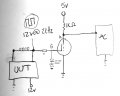
I am using a mosfet as a means of isolation/level shifter between a unit under test solenoid driver and a microcontroller. The gate receives a 12V 2kHz squarewave. This signal appears very clean, the unit under test has internal snubber diodes.

2 mosfets failed 3 months into service and I don't really know why. I'm wondering if I mis-interpreted the data sheet for maximum gate voltage.

I am using a FQP30N06L mosfet (because its what was laying around) and VGss states an absolute maximum of +/- 20V. Am i correct in assuming a 12V square wave is safe?

Thanks in advanced
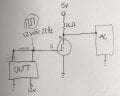
mosfet_circuit_DP27_801x640.jpg
 

wayneh

Joined Sep 9, 2010
18,087
My hunch is there are transient spikes from the inductor still getting to the gate. Instead of a MOSFET there you might consider an optoisolator. The LED in that might be less sensitive to such brief transients.

The simplest solution to level shift would be a resistance voltage divider, plus perhaps a zener to protect the micro’s input. But I would maintain the isolation until you solve this. Otherwise you’ll be replacing the micro instead of the MOSFET.
 

Thread Starter

DP27

Joined Nov 22, 2017
4
My hunch is there are transient spikes from the inductor still getting to the gate. Instead of a MOSFET there you might consider an optoisolator. The LED in that might be less sensitive to such brief transients.

The simplest solution to level shift would be a resistance voltage divider, plus perhaps a zener to protect the micro’s input. But I would maintain the isolation until you solve this. Otherwise you’ll be replacing the micro instead of the MOSFET.
I was thinking the same thing about transients, I just wanted to verify that I didnt have a fundamental misunderstanding of the +/- 20V specification in the datasheet. The unit I was looking at didn't have any noticeable transients, but perhaps others do.

Unfortunately the UUT is very sensitive to external current draw, even the smallest amount of current draw messes with the driver. So I needed a high impedance means of measurement which eliminated an opto-isolator. I could potentially use a very large value voltage divider, I didn't really consider this, but it may be worth a shot. This current draw sensitivity also made me skeptical of a zener clamp, although I have not tried it yet either. This was a prototype that kind of got pushed out the door haha.
 

Thread Starter

DP27

Joined Nov 22, 2017
4
We have had the same issue with the op amps we have, so that is what pushed me towards the mosfet. I think moving forward I am going to go with a different mosfet. I found some with built in zener clamps on the gate so that would make the build easier since this is a one-off circuit. Hopefully the clamp circuit will not impact the UUT.

Does anyone have a mosfet they would recommend? Or any other IC that may work better?
 

Thread Starter

DP27

Joined Nov 22, 2017
4
Trying to adds two zener diodes to cut off the higher voltage which may damage the Vgs from conduct.
View attachment 141593
I ended up needing another interface board faster than expected, so I built this circuit except I only had 5V and 15V zeners so I used 15V zeners on the gate. It doesn't seem to affect the UUT so that's good. Time will tell if that was the issue or not.

Also, something I forgot to mention was that the 5V is coming from a 7805 voltage regulator which is powered by a 12V bus inside the test prototype. The 12V bus is switched by a relay during every test. I don't think this contributed to the failure, but I moved the interface board power to a constant 12V supply just to be safe.

I appreciate everyone's input.
 

GopherT

Joined Nov 23, 2012
8,009
I ended up needing another interface board faster than expected, so I built this circuit except I only had 5V and 15V zeners so I used 15V zeners on the gate. It doesn't seem to affect the UUT so that's good. Time will tell if that was the issue or not.

Also, something I forgot to mention was that the 5V is coming from a 7805 voltage regulator which is powered by a 12V bus inside the test prototype. The 12V bus is switched by a relay during every test. I don't think this contributed to the failure, but I moved the interface board power to a constant 12V supply just to be safe.

I appreciate everyone's input.
15V should be fine (15.6V total with two back to back). Most MOSFET gates have absolute max voltage of 20V.
 

ScottWang

Joined Aug 23, 2012
7,498
I ended up needing another interface board faster than expected, so I built this circuit except I only had 5V and 15V zeners so I used 15V zeners on the gate. It doesn't seem to affect the UUT so that's good. Time will tell if that was the issue or not.

Also, something I forgot to mention was that the 5V is coming from a 7805 voltage regulator which is powered by a 12V bus inside the test prototype. The 12V bus is switched by a relay during every test. I don't think this contributed to the failure, but I moved the interface board power to a constant 12V supply just to be safe.

I appreciate everyone's input.
If you have the O'scope then you can measure the Vgs, if the spike already cutoff less than 15V then it should be ok.

Normally the people will use 12~15V zener diode to protects the Vgs, but I prefer the 12V zener, and I used the 9.1V in that circuit, because I checked the datasheet and found out that when the Vgs=5V (FQP30N06L) and the Id still can get the big current as Vgs=10V just the Rds a little higher, so I tried to selected the combined voltage close to 10V.
 
Top