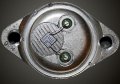
Do we get any clues?
What is it out of?
How big is it?
Does it have any wires attached to the back? If so, how many?
What is it made of?
Have you made any electrical measurements on it?
Is this part of something?
Did it have a cover on it?
Do we get any clues?
What is it out of?
How big is it?
Does it have any wires attached to the back? If so, how many?
What is it made of?
Have you made any electrical measurements on it?
Is this part of something?
Did it have a cover on it?
Sorry Keith.
So its out of an ignition module for small engine. It has a mega ohm resistance beween the two solder points, that drops to k ohm with heat. Could it be a overheating sensor resistor? It has a thin copper plate as a base...
Here's one in a TO-3 case. The TO-3 case is the collector so having the whole backside of the die being the collector means you can mount one to another for the best electrical and thermal conductivity.
Here's one in a TO-3 case. The TO-3 case is the collector so having the whole backside of the die being the collector means you can mount one to another for the best electrical and thermal conductivity.
Hold a TO-3 in your hand with the leads up towards your face, with the mounting hole closest to the leads towards you. Call that mounting hole "home."
Now run to first BASE.
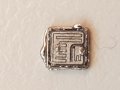
Sometimes you can tell by the wire bond size as the base doesn't need to carry a tenth of the current of the emitter. About. Here both wires are the same size as the aluminum wires used don't cost enough to justify a secondary operation.
Anyway, the smaller feature on the lower side is the base, emitter the rest of the top, and the collector is on the bottom.

 Facebook
 Google
 GitHub
 Linkedin
 541.8 KB Views: 40