When I got started in electronics, I had a hard time understanding the use of the word "clamp" in most circuit explanations that I studied. It wasn't until I learned that those components where actually performing a "short circuit", or rather became almost fully conductive after a threshold voltage was reached that I realized they were meant to absorb a momentary spike in voltage and transform it into heat. It also allowed me to understand that there's a limit (or a duty cycle) to the amount of energy that they can dissipate over time.VR1 and D6 clamp flyback overshoot because of leakage inductance in the transformer and slow recovery time on the output rectifier 110V to protect the output MOSFET in the power supply chip.
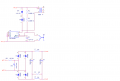
D1, D2, D3, and D4 form a full wave bridge rectifier.
R2,3 are high value resistors upto 4M to enable shutdown for under voltage in less than 0.5 second,what is the use of resistor R2,R3 and capacitor C3
according to datasheet they have mentioned C3 is use to pick the current limit, according to the designer.
that is not variable resistor it is an mov 275 VacI want to know the purpose of that variable resistor across the AC. (Figuring somebody will ask that anyway![]()
what is the purpose of capacitor c3 and RF1 resistorR2,3 are high value resistors upto 4M to enable shutdown for under voltage in less than 0.5 second,
RF1 prevents damage to the bridge diodes when the power is turned on at a peak of the input voltage: the filter caps would look like a short at that point.what is the purpose of capacitor c3 and RF1 resistor