What is Prepreg and Core ?

Thread Starter

uhdam

Joined Jan 24, 2013
23
Hello Everyone,

I would like to know each and every question which I have mentioned below,

Prepreg:

1) What is Prepreg ?
2) Why it is using in the multi layer boards ?
3) What is the purpose to use ?
4) In which layer we suppose to use in the multi layer boards ?

Core:
1) What is Core ?
2) Why it is using in the multi layer boards ?
3) What is the purpose to use ?
4) In which layer we suppose to use in multi layer boards ?

In some other posts they mentioned that in 6 layer PCB's, it has 2 cores and 4 prepregs. So, why should use these combination and why not other combination ?


Please can you answer me clearly as soon as possible.
 

hp1729

Joined Nov 23, 2015
2,304
Hello Everyone,

I would like to know each and every question which I have mentioned below,

Prepreg:

1) What is Prepreg ?
2) Why it is using in the multi layer boards ?
3) What is the purpose to use ?
4) In which layer we suppose to use in the multi layer boards ?

Core:
1) What is Core ?
2) Why it is using in the multi layer boards ?
3) What is the purpose to use ?
4) In which layer we suppose to use in multi layer boards ?

In some other posts they mentioned that in 6 layer PCB's, it has 2 cores and 4 prepregs. So, why should use these combination and why not other combination ?


Please can you answer me clearly as soon as possible.
WHAT IS PREPREG?
Prepreg is a term assigned to various base materials (carbon, fiberglass, kevlar, etc.) that have been "pre-impregnated" with a resin system, typically an epoxy-based system. Prepregs are most commonly tacky to the touch, like the back of masking tape. They provide great benefit in processing as the resin content is highly controlled, and the application is generally very clean, requiring little to no cleanup, unlike more commonly known "wet-layups."


http://www.google.com/patents/US5962348
Method of making thermal core material and material so made
US patent 5962348 A
Abstract
The present invention discloses a method a method of making a material for thermal cores and the material so made. In particular, the present invention disclose a method including the steps of applying thermally conductive particles over at least a portion of a fiber layer, providing another fiber layer upon the fiber layer, and repeating the above steps as desired. In another aspect of the present invention is disclosed a method of making a thermally conductive material including applying thermally conductive particles upon at least a portion of a fiber prepreg layer, providing another fiber prepreg layer upon the fiber layer, repeating the above steps as desired, and bonding the fiber prepreg layers, including the thermally conductive particles, together. The material in accordance with the present invention includes a plurality of layers made of thermally conductive fibers bonded by a resin, and a plurality of interposed layers of resin having a high concentration of high conductivity particles therein.

Google, or search, on "prepreg" + "core" + "printed circuit board" for more info. The terms also apply to new armor on tanks so you need to search for articles that include all three terms, specifically.
 
Last edited:

pradikrc

Joined Jan 21, 2017
2
Prepreg

1) What is Prepreg?

Prepreg (pre-impregnated) is a fiberglass impregnated with resin (resin is pre-dried but not hardened, so that when it is heated, it flows and sticks)

3) What is the purpose to use Prepreg?

Prepreg is used to stick the core layers together and to stick core and copper foil together.

Core

1) What is Core?

The core-layers being FR4 with copper traces above and below.

The layer stack (multiple of: cores, prepreg & copper foil) is pressed together at temperature to the required board finish thickness.


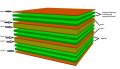
It is clear from the above diagram that for 6-layer PCB stack up, we need 2-cores, 2-copper foils & prepregs at 3 places (each place can have more than one layer to achieve the required thickness).
 

Tonyr1084

Joined Sep 24, 2015
9,744
During the construction of PCB's there are usually 2 feducials (targets) on opposite corners. They're used to align the layers. Precise layup is important because once the board is fabricated (pressed and baked) then the board is drilled. After drilling and washing they're coated with an electrolus copper (fluid based copper) which is very thin. It coats the entire board (top and bottom). Then using electrolysis they deposit another layer of copper over the entire thing. This results in copper plating through the holes and bonding with inner layers. Then the board is typically final masked and etched. After final etch, if there's gold plating to be done (such as gold fingers / edge connectors) they then plate a thin layer of electrolus nickel. Then plate the gold onto that. Gold won't stick to the copper, hence the need for nickel.

Gold plated fingers are typically 50 microns (or are supposed to be). There have been few times when I inspected boards I found as little as 25 microns gold plating.
 

kubeek

Joined Sep 20, 2005
5,796
AFAIK holes are drilled and plated after the whole stack is laminated together.
To correct myself, that is if you are not using blind and buried vias, microvias etc. Then things are a lot more complicated and it must be PITA to get things lined up properly for lamination, which is why you pay a lot extra for these.
 

ebp

Joined Feb 8, 2018
2,332
registration pins to the rescue

There may be compelling reasons to do the build differently. If you want "blind" vias (from a surface layer to an adjacent inner layer) the build would be normally be different from that if you wanted "buried" vias (from inner layer to inner layer, not extending to the surface). Blind vias, within reason, can be done by laser drilling so they can be added after the stack is built and cured. Generally only the most sophisticated of the board houses can do this. It is not uncommon to have thick copper for inner layers for low resistance and high current carrying capacity and thin copper on the surface to allow fine pitch (narrow traces and spaces).

I've been told handling the copper sheets used is like handling giant razor blades that are sharp on all edges.

It is always best to consult the board manufacturer for advise before you do a layout if you want anything out of the ordinary, though trying to get decent info out of some board houses about what they can and can't do "easily" seems to be rather difficult. The best experience I had was with essentially a broker. Many board houses will say they can do something, but don't bother to tell you it will increase your cost by 30%.

Cost can be as much dictated by the time processes take as the technical difficulty. Heavy copper costs more because it ties up the plating line longer. Complex routing for cut-outs and "blanking" ties up the routing machine. In days gone by if you wanted too many different hole sizes it would cost extra because the tool racks in the drilling machines weren't big enough and had to be manually swapped at some point. Past a certain diameter holes are routed instead of drilled. Unplated holes range from trival to a nuisance. Very small drilled holes cost more because the feed rate of the drill has to be lowered to keep from breaking drills (solid carbide drills are extremely brittle). Thick boards cost more to drill because they can't get stack as many for drilling. If holes must overlap for any reason, expect a phone call from the board house to be sure you really really want that.
 
Top