I never paid for caller ID until the spam/robocalls started. Now they spoof who and where the call originates. Even the "legitimate" political advertising and polling companies. Yes, many are offshore but they are facilitated by companies here in the US. A very few of those have been prosecuted and a few persons behind the companies have been prosecuted more than once and were still doing it. Why pass any law that has no teeth and no enforcement? Stupid, feel-good, knee-jerk, and useless... At least India has been tracking down and closing some of its perpetrators. Although it's probably like the whack-a-gopher game.
Since the list is available to spammers, I nicknamed it the "please call list, my time is important." Nothing at the government level works. Court is out of the questions. The hurdles are way too high. Reporting abuses is useless. But, salvation is nigh.
A few years ago, I bought a "call blocker" cheap from Asia. It worked for a few days, then starting blocking everything. In the trash it went.
About 5 months ago, I bought a reasonably priced* call blocker by Panasonic (same brand as my household phones): Model KX-TGA710 -- the identical device is sold under various model numbers. There are newer/other versions available. It had 2000 pre-programmed blocked numbers, and user can add up to 1000 more numbers. I am already up to 80.
The Good:
1) A blocked number doesn't even ring.
2) Calls calls dropped from 3 to 5 per day to less than 1 per day -- maybe 3 or 4 a week at most. Some weeks none.
3) It is very easy to add new numbers to it.
The Bad:
1) You cannot review the pre-programmed numbers.
2) So far as I know, you cannot download an updated list of pre-programmed numbers.
3) Reviewing user-added numbers has to be done one at a time.
The Fix:
1) Have a USB or similar connection or memory card so one can review pages of numbers, download new lists, etc.
There are people who robocall EVERY possible number in a call area just to see if it answers. Then, sell the active call number list to robo advertisers. Blocking no longer works since most call-from numbers are now spoofed. They have also "socially engineered" the computer-generated voice calls to the point that most on initial answering appear to actually be a real person. Worse than annoying... Don't even have anyone to cuss out!
Absolutely right. If someone is naive enough to pick up a call from someone they don't know, but it has a local number and name attached to it, it is likely a dead line. They are just checking to see if your number is active.
One of Charles Schwab's outgoing numbers is blocked on my phone. I told my "advisor" on several occasions that I didn't pick up anything without a caller ID. Well, Schwab doesn't attach a caller ID to many of its calls. So, one of its number is now blocked. If you are a Schwab client, you know that it shies away from email advice. Now it has learned, I want an email, if it wants my business. (The question had to do with an investment rule, not a tax issue per se, for which I can understand Schwab's reluctance to advise.)
That's why I like my phone's feature that I don't get disturbed by anyone who is not on my list. However, should YOU call ME - you're not on my list, my phone doesn't ring. But you CAN leave a message. Or text. That's why I made it clear in my outgoing message that legitimate callers (and I didn't use that phrase) can leave messages. I still get the occasional message from that "High" hotel, telling me I've been selected for something free. Maybe I have. But I surely don't "NEED" something free. I'd rather caution on the side of error. Or I mean error on the side of caution. Fortunately I don't get too many spam texts. My wife started getting messages that were very sexual. She changed her number.
One common text we receive is someone wants to buy our house. That went on for a while - until I responded with "Phuck Off!" I don't recall having gotten one of those messages in months.
Many services offer a phone "privacy" enhancement at a price. My provider is Armstrong. Its version requires the caller to enter some number, such as "8" to get through, Sounds great, right? Blocks robocalls. What if you do online banking, don't have a smartphone, and rely on a call-back code to get access or register your device? Those automated calls can't dial "8." I have asked it to allow me to subscribe to "nomorobo" (https://www.nomorobo.com/ ). It claims its equipment is not compatible.
Armstrong doesn't seem to understand that fallacy. On the other hand, it labels calls as "spam" or "fraudulent, but still lets them ring though for countless rings. Great help that is. That's just one reason I like my call blocker. No noise.
No perfect remedy. I'm not a cell phone user although I have one. It stays in a drawer turned off unless I'm leaving the property. IF I need a robo access code I take it out and turn it on since the call blocker on the landline won't work. Every time I take it out and turn it on it goes crazy popping up "Missed Calls" and "Text Messages". Typically, none of which have anything to do with me. I can still remember when people took their landline off the hook to not be disturbed. Then they added the high pitch warble to alarm people that the handset was off-hook which pretty much ended that possibility. Screeing calls with the answering machine, Caller ID, and now the Notice and press 1 to continue have all been tried and at least now on the landline has been fairly successful. Surprised robocallers haven't figure out the press 1 trick as yet since It's been a couple of years now since the phone company added it to my landline. Apparently, it's not very widely used or available.
Sounds like my situation. I have a prepaid cell from Verizon and have well over $500 in unused time. On the rare occasion that I make a call, it's hilarious to hear how many minutes of unused time I have. On many occasions, Verizon has just renewed my service for 6 to 12 months without adding money. The only reason I have it is that pay phones disappeared a long time ago. If your car breaks down, and you don't have a cell, you have a very long walk.
I accused my wife of giving me one just so she could call and bug me wherever I was at any time... I never had to use it to call for help for me but several times to report traffic hazards or blotto drivers.
I ignore the obviously spoofed numbers, but I do need to answer calls from numbers I do not know because they may be new clients, and since I do not call to search for them I let them call me. And that is how the business grows.
and in a typical day we get a dozen or more calls from spoofed numbers, many of them trying to sel me a better credit card rate or a warranty extension on my car. The new scams are about medicare.
My solution would be to cut off internet access from the countries where the calls originate from. A total cutoff would force those governments to take action. Right now the FCC could mandate that the phone companies have to block all spoofed caller IDs, and that would stop it in just a few hours. Consider that there is no legitimate reason to spoof a caller ID. If somebody wants to block it, that is fine, but faking it has no decent application.
I didn't see a response in my quick scans of the replies as to what those tones are used for (originally).
Back in the "early days" of automated calling, those tones were sent to indicate a not in service phone number, and the automated calling device would immediately hang up and call the next number. It was designed to save time for the automated calling machines. Back in the 80's or 90's I believe, someone even marketed a "tele-zapper" which played those tones on every first ring on your phone, to get the robo-calling machines to hang up. Also, when the calling machines hear those tones, they (usually) automatically drop that number from their lists for future calls.
Besides the tones, there usually is a voice message after, to let "humans" know the number is not in service, assuming humans do not understand that 3 tone message.
I don't know if this concept is still used by automated calling systems, nor if those scammers using VOIP phone systems even respond to those tones any longer. It would be interesting to find out.
Maybe someone could put those tones at the start of their answering machine message and see what happens? Mind you, it may kill automated messages from places you may want to hear from, like automated appointment reminders
I didn't see a response in my quick scans of the replies as to what those tones are used for (originally).
Back in the "early days" of automated calling, those tones were sent to indicate a not in service phone number, and the automated calling device would immediately hang up and call the next number. It was designed to save time for the automated calling machines. Back in the 80's or 90's I believe, someone even marketed a "tele-zapper" which played those tones on every first ring on your phone, to get the robo-calling machines to hang up. Also, when the calling machines hear those tones, they (usually) automatically drop that number from their lists for future calls.
Besides the tones, there usually is a voice message after, to let "humans" know the number is not in service, assuming humans do not understand that 3 tone message.
I don't know if this concept is still used by automated calling systems, nor if those scammers using VOIP phone systems even respond to those tones any longer. It would be interesting to find out.
Maybe someone could put those tones at the start of their answering machine message and see what happens? Mind you, it may kill automated messages from places you may want to hear from, like automated appointment reminders
My plan is to put those tones on my answering machine AND to have a box that answers and plays them when I see a spoofed number show up.
The device that would be fantastic would be a device that detects when the caller ID is spoofed and Sends the tones, or better yet, starts a computer program that simulates a human and wastes a lot of their time. Sending a "1" during the recorded part usually gets the human trying to do the scam, and with credit card scammers I keep asking how they will get my present card to give up on the monthly interest payment. They can never answer that one.
How many readers here remember The Blue Box? I remember them well as a techie type teen of the 60s. Actually still have a few rotary dial pulse phones in the basement. Growing up NYC I went to the 1964 / 1965 Worlds Fair many times. I remember using the Bell Telephone Labs "Picturephone" with a friend. From drum beats to Telstar, pretty cool stuff.
Hopefully Mr. Bill will let us know how things play out.
I used to use the bosses phone to make LDC's (Long Distance Calls). He had a lock on the phone - you couldn't "Dial" any number higher than a 4. The way around that was to tap the receiver hook 9 times to dial a 9, 10 times to dial a 0 - and so on. Not long after that he would lock the phone in his desk. But I knew back then how to pick the cheaply made drawer locks. Gosh that was fun - until I got fired for breaking into his desk and using his telephone to phone my girlfriend in the next circuit over.
Back then you could live next door to someone in the next circuit, and dialing their number meant getting a LDC charge. Today with a cell phone you can call anywhere for any length of time (that I know of) without incurring any additional charges. However, the devil is in the details; you could be using VOIP, and exceed your allotted amount of bandwidth for the month. Then they really hit you.
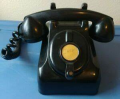
They actually still had hand crank telephones here when I was a child. They were like a standard rotary dial table model except instead of a dial there was a crank handle. I don't know how many trunk lines there were but they were all party lines. My grandparents "number" was two long and one short which would be about 2 turns of the crank for long and less than a full turn for short. To make a long distance (anywhere outside our counties private phone company) you'd crank 4 or 5 times and wait for the operator to pick up and make the connection. Since they were party lines the phones rang for every party on the line when cranked. Back then, not very often, only a few times a day but everyone sat up and listened to see if it was for them. To call them long distance the operator would have to call the Darien operator and have them ring the call through and connect it.
This should be what you are looking for. I tried setting them up in Audigy and they sound right. Note the duration is 330 mSec for all three tones and the frequencies are 950, 1400 and 1800 Hz. Will try and attach the .wav file. It won't let me.
The uploaded file does not have an allowed extension. The following extensions are allowed: .7z, .asc, .asm, .stl, .asy, .c, .cir, .csv, .djvu, .doc, .docx, .epub, .fzz, .gif, .hex, .inc, .jpe, .jpeg, .jpg, .lbr, .lib, .ods, .odt, .pdf, .png, .py, .rar, .sch, .sub,
The .7z file extension is for a program called 7zip which is free open source and I use for the compression of files and works like winzip which isn't free to use.
In the US, when I dial an inactive phone number, get a loud three tone sequence followed by an announcement that "this number is not in service". The tones do not seem to match the touch-tone frequencies.
I want to try using those tones to discourage the constant barrage of scam callers. Maybe if their computer gets that message they will take me off the list. At least is seems like it is worth trying.
So does anybody know what those tone frequencies are? If I create a circuit to generate that sequence I will share it with everybody.
The only problem I see with your idea is you may stop getting calls from everyone including friends and relatives unless you call everyone and tell them what you are doing so they know to stay on the line and leave a message on your answering machine for you to call them back. I get 30-50 of those calls everyday. I thought about leaving my old fax machine on to answer those calls. If those computers thought they were getting a fax machine they would hang up but that fell apart when I started using up all my paper and ink getting useless advertising faxes so that didn't work. The problem with the do not call registry is that those scammers don't care.they are sporting someone else's local number and these are usually foreign in origin where they can't be prosecuted anyway.. No easy way to stop them but they usually don't bother to leave a message so leaving b the answer machine all the time is the best I can do so far. Thinking I might try your idea once I can't take all that phone ringing anymore.
I will keep getting calls because after the tones I will still have my voice and my message. The computer calling will not know the difference, it does not understand speech. But the tones will convince it that the number is not in service.

 Facebook
 Google
 GitHub
 Linkedin



 I remember them well as a techie type teen of the 60s. Actually still have a few rotary dial pulse phones in the basement. Growing up NYC I went to the 1964 / 1965 Worlds Fair many times. I remember using the Bell Telephone Labs "Picturephone" with a friend. From drum beats to Telstar, pretty cool stuff.