Wall Warts

Thread Starter

Macnerd

Joined May 22, 2014
67
I've retired & I want to take up electronics as a hobby.

I'm wondering what I can use as a power supply. There are batteries, wall warts & modified PC power supply.

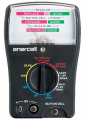
I have 4 spare wall warts. One is 12 volts DC & 3 are 5 volts DC. The 12 volt one has a coaxial connector. Two of the other 3 have mini-USB connectors. The 3rd has a I-don't-know-what-kind of connector. It's rectangular. I haven't bought a multimeter yet. I do have a battery tester. I set the tester on 22.5 volts. I stuck one of the test leads into the inner connector & quickly tapped the outer connector with the other lead. The needle didn't move. I reversed the leads & tried again. Same thing - the needle didn't move. I set the battery tester on 9 volts & tested a 9 volt battery & the needle moved.

It would seem to me that the battery tester would work since the wall wart outputs DC & the 9 volt battery outputs DC also. Other than the obvious possibility that the 12 volt wall wart is dead, why wouldn't the battery tester show 12 volts?
 

AlbertHall

Joined Jun 4, 2014
12,619
Some of those coaxial connectors have a metal tube inside and it is easy to make contact with a wire, but some just have two springs and they are harder to connect to. Try it again but moving the wire around inside the tube and see if you can get a contact.
 

dl324

Joined Mar 30, 2015
18,220
What is the model number of the battery tester?

If you're in the US, get a coupon for a free (with purchase) DVM at Harbor Freight. It's not a terrific meter, but it's good enough for a lot of measurements. I keep one in the tool kits in some of my cars; though I prefer analog meters that don't need a battery to measure voltage that I have in a couple of the kits.

For $20-30, you can buy a decent meter. I use a $40 Centech for most of my measurements; no discernible difference from my Fluke meters.
 

Thread Starter

Macnerd

Joined May 22, 2014
67
What is the model number of the battery tester?

If you're in the US, get a coupon for a free (with purchase) DVM at Harbor Freight. It's not a terrific meter, but it's good enough for a lot of measurements. I keep one in the tool kits in some of my cars; though I prefer analog meters that don't need a battery to measure voltage that I have in a couple of the kits.

For $20-30, you can buy a decent meter. I use a $40 Centech for most of my measurements; no discernible difference from my Fluke meters.
It's a Radio Shack battery tester.

Theoretically, at least, wouldn't a battery tester show "Good" when connected to the wall wart?
 

Thread Starter

Macnerd

Joined May 22, 2014
67
Some of those coaxial connectors have a metal tube inside and it is easy to make contact with a wire, but some just have two springs and they are harder to connect to. Try it again but moving the wire around inside the tube and see if you can get a contact.
I'll try jiggling the lead inside.

It's a coaxial connector. I wikied coaxial connector & there are a bunch of different sizes. I want a way to connect the wall wart to a bread board. I'm thinking either banana plug or 1/8 inch stereo plug or RCA phono plug.
 

ChrisTheEE

Joined Feb 23, 2017
5
I'll try jiggling the lead inside.

It's a coaxial connector. I wikied coaxial connector & there are a bunch of different sizes. I want a way to connect the wall wart to a bread board. I'm thinking either banana plug or 1/8 inch stereo plug or RCA phono plug.
Just cut the connector off, strip the wires, and connect to your breadboard.
 

Thread Starter

Macnerd

Joined May 22, 2014
67
Some of those coaxial connectors have a metal tube inside and it is easy to make contact with a wire, but some just have two springs and they are harder to connect to. Try it again but moving the wire around inside the tube and see if you can get a contact.
I inserted the positive lead into the connector & jiggled it around while I held the negative lead on the connector with my thumb. The needle didn't move. Then I inserted the negative lead into the connector & jiggled it around while I held the positive lead on the outer connector with my thumb. The needle didn't move.

Shall I assume that the wall wart is dead? If I did have a multimeter, wouldn't I follow the same procedure?
 

Thread Starter

Macnerd

Joined May 22, 2014
67
Just cut the connector off, strip the wires, and connect to your breadboard.
That's the eventual plan. I want to have consistent connectors on all of the wall warts. So, I'm thinking banana plug or RCA phono jack or 1/8 inch stereo jack or just plain old bare wires. At least the banana plugs come in 2 colors. The phono jack & the stereo jack don't.

Radio Shack sells cheap 12V incandescent lamps.
 

MrAl

Joined Jun 17, 2014
13,667
Hi,

Wall warts have been known to die. You can get cheap ones online if you need one though.
There's also the possibility that it wont put out anything with no load.
There is also a possible broken wire inside the cable if it is an old one.

You should get a meter even if a cheap one to start with. If you are going to do electronics, you'll need a meter anyway.
I dont recommend the 5 dollar (USD) ones, spend at least 20 dollars. Make sure it goes down to 2v and up to maybe 200v, and has an AC scale, and has at least an Ohms test. Probably should also have a current test, at least 200ma.

Today you can get regulated wall warts that are pretty cheap. They come in various voltages like 5v, 10v, 12v, 15v, 19v, 24v, etc. You can even get one with multiple output settings with a slide switch. The regulated ones put out a voltage that is usually close to the stamped value on the body of the wall wart.

Hey, i wish you all the luck with your new hobby. One good thing is it never gets old because there's always something new to learn or part to try out :)
 

Thread Starter

Macnerd

Joined May 22, 2014
67
You can't always rely on that when it is an older linear wall-wart that is unregulated and relies on 300ma to bring it down to 12v!;)
Max.
Radio Shack sells 12V incandescent bulbs. I clip off the connector & strip the wires & see if the bulb lights up. If it doesn't, then circular file the 12 V wall wart. Do the same with the other 3 wall warts. I would think that a 12V bulb would light dimly with 5 volts.
 

Thread Starter

Macnerd

Joined May 22, 2014
67
Hi,

Wall warts have been known to die. You can get cheap ones online if you need one though.
There's also the possibility that it wont put out anything with no load.
There is also a possible broken wire inside the cable if it is an old one.

You should get a meter even if a cheap one to start with. If you are going to do electronics, you'll need a meter anyway.
I dont recommend the 5 dollar (USD) ones, spend at least 20 dollars. Make sure it goes down to 2v and up to maybe 200v, and has an AC scale, and has at least an Ohms test. Probably should also have a current test, at least 200ma.

Today you can get regulated wall warts that are pretty cheap. They come in various voltages like 5v, 10v, 12v, 15v, 19v, 24v, etc. You can even get one with multiple output settings with a slide switch. The regulated ones put out a voltage that is usually close to the stamped value on the body of the wall wart.

Hey, i wish you all the luck with your new hobby. One good thing is it never gets old because there's always something new to learn or part to try out :)
I've watched YouTube videos about the Harbor Freight multimeters. They don't have fuses. I'd actually be scared to use a Harbor Freight multimeter for other than battery testing. I don't want to spend a fortune on a Fluke meter. I want to keep the cost under $100.

I believe that laptop AC adapters are around 19 volts. I can see having a passel of wall warts of varying voltages in my toolbox. PC power supplies have regulated 12V, 5V & 3.3V outputs. That can be a future project to modify a PC power supply.
 

AnalogKid

Joined Aug 1, 2013
12,049
If the 12 V wart weighs more than the 5 V warts, it probably is an older linear supply. In that case the output voltage could be over 15 V unloaded. USB warts are small switching power supplies that are regulated to within around 10%.

You don't show your location. If there is a Harbor Freight nearby, they have an excellent, low cost, starter DVM.

ak
 

AlbertHall

Joined Jun 4, 2014
12,619
Wall warts seem to be generally more reliable than the things they power, judging by the small mountain of them that I have from gadgets that have 'crossed the rainbow bridge'.
 

dl324

Joined Mar 30, 2015
18,220
the Harbor Freight multimeters. They don't have fuses.
Why does this matter? If you know what you're doing, you'll know how to use the meter correctly. If you don't know what you're doing, learn before you destroy anything and learn from your mistakes.
I'd actually be scared to use a Harbor Freight multimeter for other than battery testing.
Why?
I don't want to spend a fortune on a Fluke meter. I want to keep the cost under $100.
You don't have to spend $100. You were already told that $20 will get you a decent meter.
 

AnalogKid

Joined Aug 1, 2013
12,049
I believe that laptop AC adapters are around 19 volts. I can see having a passel of wall warts of varying voltages in my toolbox. PC power supplies have regulated 12V, 5V & 3.3V outputs. That can be a future project to modify a PC power supply.
Both PC power supplies and 16 or 19 V laptop supplies require a minimum load current to maintain regulation. While there is a ton of information on the web about turning these into bench supplies, neither was designed for it and a bench supply has unique requirements.

ak
 

dl324

Joined Mar 30, 2015
18,220
I do have a battery tester. I set the tester on 22.5 volts.
If this is what you're using:
upload_2017-2-24_11-7-1.png
I don't know if it will work. I couldn't find a schematic.

My guess is that it puts a load on the battery being tested and uses the current draw to determine battery strength. Not knowing what current is considered good for a 22.5V battery, can't say if a 12V power supply would register as anything other than bad.
 
Top