Very low frequency sine

Audioguru again

Joined Oct 21, 2019
6,826
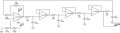
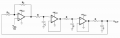
Is the circuit sensitive to "C" and "R" tolerancies? Can I use a pot in series with one "R" to set the needed frequency, say +-10%? What for "Ref" is needed?
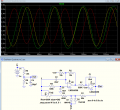
It is a Phase Shift oscilator. The three RC filters set the oscillator frequency.

REF is half the single supply voltage.
 

crutschow

Joined Mar 14, 2008
38,515
Is the circuit sensitive to "C" and "R" tolerancies?
Of course.
Their values are what determines the oscillator frequency.
Can I use a pot in series with one "R" to set the needed frequency, say +-10%?
Yes, but that changes the loop gain, so you would also need a pot in series with R2 to adjust the gain to keep it operating properly without clipping.
What for "Ref" is needed?
Ref is to bias the circuit at 1/2 the supply voltage so the circuit can operate with the output not clipped when operating from a single supply voltage.

It's not needed if you have dual supply voltages for the op amp.
 
Last edited:

AnalogKid

Joined Aug 1, 2013
12,139
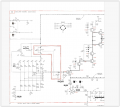
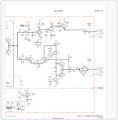
I think @Audioguru again uses the Lancaster circuit followed by a switched-capacitor filter so that the filter tracks the frequency being generated.
I've done something similar in two different projects, both very successful. One was for a speech and hearing research project that needed bolt-down frequency stability. A similar but different counter-plus-resistors waveform generator followed by an 8-pole switched filter, with both clocks derived from the same crystal oscillator.

For this thread, I vote for the phase shift oscillator. Reasonable parts count, easily tunable over a small range, built-in amplitude stability. Personally, I like the version that uses opamp voltage followers between the R-C stages, with 3 (standard) or 4 (Bubba) stages. 1 LM324 does everything.

https://en.wikipedia.org/wiki/Phase-shift_oscillator

This section from a previous link covers the Bubba Oscillator: https://sound-au.com/articles/sinewave.htm#s561

Much lower loop gain, lower distortion, better amplitude stability, especially with tuning. The tuning range available by varying only one resistor is much smaller than with the 3-stage version, but the circuit's sensitivity to component tolerances also is lower.

ak

1713450399994.png

1713450226317.png
 
Last edited:

LesJones

Joined Jan 8, 2017
4,511
Last edited:

Pyrex

Joined Feb 16, 2022
502
Of course.
Their values are what determines the oscillator frequency.
Yes, but that changes the loop gain, so you would also need a pot in series with R2 to adjust the gain to keep it operating properly without clipping.
Ref is to bias the circuit at 1/2 the supply voltage so the circuit can operate with the output not clipped when operating from a single supply voltage.
It's not needed if you have dual supply voltages for the op amp.
Thank you for the answer.
I' like to ask two more questions.

If real capacitors are used in place of C1, C2, C3 , say, 220nF with tolerance +-10 %, so C1=200nF, C2=210nF, C3= 230nf, and real resistors used in place of R6, R3, R5 , say 82 kOhm +-5 %, and those are not equal too, will the THD remains below 1% ?

Is it posssible to use another technique to stabilize the amplitude instead of diodes, as their parameters change due to temperature changes?
 

LvW

Joined Jun 13, 2013
2,029
Is it posssible to use another technique to stabilize the amplitude instead of diodes, as their parameters change due to temperature changes?
As I have mentioned in post#15 - when using two classical opamp-based integrators in a closed loop (one inverting and the 2nd one non-inverting) you need no diodes (or other additional nonlinear parts) at all for a THD which fulfills your requirements.
In this case, it is best to use two different time constants for the integrators.

The oscillation frequency is wo=1/SQRT(T1*T2) with T1=R1C1 and T2=R2C2

In this case, the integrator with the smallest time constant T1 reaches the amplitude limit (power rail) with negligible clipping only - and the other one (larger time constant T2) with the smaller gain at w=wo delivers a filtered signal with low THD.
 

AnalogKid

Joined Aug 1, 2013
12,139
Is it possible to use another technique to stabilize the amplitude instead of diodes, as their parameters change due to temperature changes?
There is very little current through the diodes, and the self-heating from internal power dissipation is minuscule. When using a diode as a temperature sensor, the change in Vf is only around 2 mV per degree C. Unless this circuit is outdoors, I don't think that is an issue.

ak
 

crutschow

Joined Mar 14, 2008
38,515
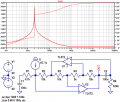
Below is a quadrature oscillator that allows easier tweaking of the frequency to compensate for component tolerances:
Shown is the frequency change for the Fadj pot wiper settings of 0% 50% and 100%:

1713458745242.png
 

crutschow

Joined Mar 14, 2008
38,515
you need no diodes (or other additional nonlinear parts) at all for a THD which fulfills your requirements.
In this case, it is best to use two different time constants for the integrators.
So the integrator time-constant determines the output amplitude, thus the amplitude will deviate as determined by the time-constant tolerance (which likely is tolerable).
 

Danko

Joined Nov 22, 2017
2,169
As I have mentioned in post#15 - when using two classical opamp-based integrators in a closed loop (one inverting and the 2nd one non-inverting) you need no diodes (or other additional nonlinear parts) at all for a THD which fulfills your requirements.
In this case, it is best to use two different time constants for the integrators.
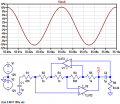
Good circuit. THD=0.16%.
Voltage of power supply can be changed from ±12 V to ±6 V. It still works fine with ± 4.3 V OUT amplitude.
1713472096055.png1713471800699.png

ADDED:
One more circuit:
1713481514556.png
 

Attachments

Last edited:

MisterBill2

Joined Jan 23, 2018
27,537
If you read Don Lancaster's original paper it tells you that the circuit eliminates the first n harmonics, where n is the number of stages. The first harmonics is the clock freequency. Don Lancaster adds a Sallen & Key filter to remove the higher harmonics, which is great for a fixed frequency sinewave but not so good if you want it variable.
I think @Audioguru again uses the Lancaster circuit followed by a switched-capacitor filter so that the filter tracks the frequency being generated.
This is a good general paper on the topic of sinewave generation.
If the load is a solenoid or something else very inductive, then the steps won't matter.The inductor will be its own filter.
I was commenting on the circuit that was shown., not what could possibly be attached to it . I am not a master mind reader!!
 

LvW

Joined Jun 13, 2013
2,029
So the integrator time-constant determines the output amplitude, thus the amplitude will deviate as determined by the time-constant tolerance (which likely is tolerable).
Yes - in this respect, the GIC-based resonator as mentioned in post#15 and #30 is preferrable.
 

MisterBill2

Joined Jan 23, 2018
27,537
I just came across an article about a solid state version of the classic "twin T" RC oscillator, That version used diode clamping to control the amplitude and a 741 opamp. The frequency for that model went down to 0.01Hz, still a good sine wave, not in need of serious filtering.
 

MisterBill2

Joined Jan 23, 2018
27,537
The Twin Tee circuit I saw today used an op-amp, and the feedback signal into the inverting input was clamped with a diode. so the amplitude stayed constant.
 
Top