Vacuum brush motor quit

Thread Starter

robismod

Joined Sep 22, 2015
351
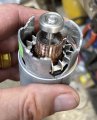
I have a Shark top/line vacuum machine and the motor that powers the floor brush quit. As luck would have it, I had a complete new head assembly that I put on and was back in business. Any other time I’d likely just found a matching motor online and replaced. Before I trash this old unit I thought I’d look it over. I believe the motor went bad just because turning the gear/armature produced a “lope”, not smooth. Possibly about 4-5 lopes in one rotation. Should be smooth turning, right? It has two brushes on the sides but I haven’t gotten to them yet—appears they are held in place with a drop of solder…
 

MaxHeadRoom

Joined Jul 18, 2013
30,658
Maybe best to take the motor apart and check a few things, one would be the bearings for one.
I have one of those sharks too, and they do a good job.
 
Last edited:

Thread Starter

robismod

Joined Sep 22, 2015
351
Maybe best to take the motor apart and check a few thinks, one would be the bearings for one.
I have one of those shrks two, and they do a good job.
I got the brushes out and they were fine. And it still “loped” when turning by my fingers. Weird how it feels a little “rubbery” when it comes up against one of these little “segments”, slight pressure, and then release. I would think it would feel totally metallic. My mind is envisioning bearings of tiny rubber balls…LOL (still fuzzy from waking in the wee hours to pee)
 

MisterBill2

Joined Jan 23, 2018
27,510
Usually, if there is not physical damage to the motor in the form of a bent shaft, then lint winding into the shaft bearings is the cause of friction that varys as the shaft is rotated. That is the probable cause of variable friction. I have also come across a single loose commutator segment as a failure condition, but in that case the symptom was a very large amount of sparking visible as the motor was running. Carefully removing all of the wound-on lint from the bearing and shaft should restor free rotation. The exception being if the motor stalled and overheated to the point of burn-out, since the heat may have melted some of the material that is used to hold the windings in place.

Lint fibers winding up in bearing areas is always an issue with even the best quality of products because of the application location enviroment. Unfortunately the problem is worse in the better quality machines because typically they have closer bearing clearances. So an occasional disassembly and lint removal is needed.
 

Thread Starter

robismod

Joined Sep 22, 2015
351
Usually, if there is not physical damage to the motor in the form of a bent shaft, then lint winding into the shaft bearings is the cause of friction that varys as the shaft is rotated. That is the probable cause of variable friction. I have also come across a single loose commutator segment as a failure condition, but in that case the symptom was a very large amount of sparking visible as the motor was running. Carefully removing all of the wound-on lint from the bearing and shaft should restor free rotation. The exception being if the motor stalled and overheated to the point of burn-out, since the heat may have melted some of the material that is used to hold the windings in place.

Lint fibers winding up in bearing areas is always an issue with even the best quality of products because of the application location enviroment. Unfortunately the problem is worse in the better quality machines because typically they have closer bearing clearances. So an occasional disassembly and lint removal is needed.
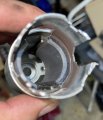
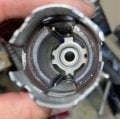
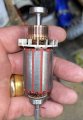
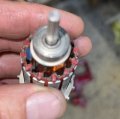
Hmmm…oddly, when I separated the armature from the field (that correct? (my mind not at half capacity this morning ) I didn’t see anything foreign—lint or otherwise, and nothing obvious. But one bearing on one end was very smooth and free, while the other end was resistant, but not seized, nor felt bad when turned with fingers. I’ve destroyed it getting apart, which I knew would happen, but I just had to dig in and look. I’m still perplexed—I expected to see something obvious, as if the armature was wobbling and rubbing against maybe 4 places as it rotated. But, this “loping” was pretty precise—as if taking “steps”, timed at same points…maybe that resistant bearing was the problem, being so small it wouldn’t take much of an issue inside to cause this “stepping”?
Anyway, thanks again for trying to help me in my odd rabbit holes…LOL
 

MisterBill2

Joined Jan 23, 2018
27,510
Are the motor bearings actual BALL BEARINGS??? It does not require much foreign stuff in a ball bearing to add a great deal of drag to the rotation. Ifthe TS "destroyed " the bearing while disassembling it then certainly it was a ball or roller bearing, and even a ver small amount of stuff in a ball bearing will cause a large rotational torque requirement.
With the bearing damaged there is no way to do an accurate evaluation.
"Good Luck Now"!
 

MisterBill2

Joined Jan 23, 2018
27,510
Certainly a worn-out brush will prevent a series motor from running. no question about that. The worn brush may also cause a serious reduction in motor performance before the motor stops running completely.
HOWEVER, the main cause of problems in a motorized floor brush is lint in the bearings, matched only by connection failures in the motor power connection. So when there is a problem with the motor driven brush drive, the second step is to check that the motor power connections are correct. Then clear out all if the lint and threads wound up in the mechanical drive portion of the system.
 
Certainly a worn-out brush will prevent a series motor from running. no question about that. The worn brush may also cause a serious reduction in motor performance before the motor stops running completely.
HOWEVER, the main cause of problems in a motorized floor brush is lint in the bearings, matched only by connection failures in the motor power connection. So when there is a problem with the motor driven brush drive, the second step is to check that the motor power connections are correct. Then clear out all if the lint and threads wound up in the mechanical drive portion of the system.
Also dust + moisture can glue up the graphite in the brass railing that house the brushes and they get stuck. The spring that pushes them is very weak so in case of any friction in the railing, it cannot push the brushes to contact the commutator.
If the motor's commutator makes a lot of blue sparks, it means either worn out brushes or some sort of dust related glitch. The blue-red sparks mean burnt windings.
 

Thread Starter

robismod

Joined Sep 22, 2015
351
Are the motor bearings actual BALL BEARINGS??? It does not require much foreign stuff in a ball bearing to add a great deal of drag to the rotation. Ifthe TS "destroyed " the bearing while disassembling it then certainly it was a ball or roller bearing, and even a ver small amount of stuff in a ball bearing will cause a large rotational torque requirement.
With the bearing damaged there is no way to do an accurate evaluation.
"Good Luck Now"!
I don’t know if they have balls—so small, about the size of a little finger end. Sealed. I’m not sure I’m projecting an accurate representation of what it was doing. Let me try again…
With the motor out of the roller brush attachment…grabbing one end between two fingers and turning. Slowly. About every eighth of a turn you feel this resistance that feels like it’s going to stop. And then it passes that point freely, and then same thing. About an eighth of a turn regularly. Just before getting to that near-stop point, you feel the resistance build up to it. So in the course of one revolution you feel that bump about eight times. It doesn’t feel like metal to metal. It almost feels soft or rubbery at that bump. I’ll post some pics here shortly.
 

MisterBill2

Joined Jan 23, 2018
27,510
Iam guessing that it is a permanent magnet field on the motor and so there is a constant magnetic flux. So there are sections with more magnetic drag and less magnetic drag. But actual mechanical friction will feel a bit sifferent.
BUT in that location in that application what I suspect is lint wrapping in the bearing s and causing binding. If not inside the motor, in some part of theroller/brush drive, overloading the motor and making it run hotter than what it was intended for, leading to failure.
 

Thread Starter

robismod

Joined Sep 22, 2015
351
Iam guessing that it is a permanent magnet field on the motor and so there is a constant magnetic flux. So there are sections with more magnetic drag and less magnetic drag. But actual mechanical friction will feel a bit sifferent.
BUT in that location in that application what I suspect is lint wrapping in the bearing s and causing binding. If not inside the motor, in some part of theroller/brush drive, overloading the motor and making it run hotter than what it was intended for, leading to failure.
Whoa—your mention of “…more and less magnetic drag…” THAT strikes me as maybe that’s what I’m feeling with the resistance sections…
 

MaxHeadRoom

Joined Jul 18, 2013
30,658
Ah yes the floor brush motor would make sense to be a shunt field motor, I was thinking of the vacuum motor in the head.
If you feel or detct 'bumps' when turning the armsature , especially with no brushes, seems to point to a short in the armature?
 
Top