Using 74HC4052 with 3.3V MCU

Thread Starter

Pepe333

Joined Feb 12, 2018
86
Hi all,
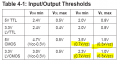
I ordered some analog multiplexer CD4052 in order to work with a 3.3V MCU but it didnt work. Reading the CD4052 datasheet, it says the HIGH level is 3.5v for a VCC = 5v.
I found the 74HC4052, and the datasheet says the HIGH level is 1.5v for a VCC = 2v.

Does this mean I can use the 74HC4051/52/53 IC with a 3.3V MCU?
 

dl324

Joined Mar 30, 2015
18,330
If the part is operating at the same Vcc as the MCU, yes.

CD4052 is spec'ed to operate from 3-18V, but they only give parameters for 5, 10, and 15V.
 

djsfantasi

Joined Apr 11, 2010
9,237
Sorry guys, I am confused.

If the CD4052 spec is 3.5V for a high, how can a 3.3V μC output ever be seen as anything other than low?

UPDATE: the chart is nice...
 

dl324

Joined Mar 30, 2015
18,330
I just tested the CD4052 on a protoboard, with 3.3v VCC and it works fine, so I must have a problem in my custom PCB.
But look at this answer from TI:

http://e2e.ti.com/support/switches-...57?CD4052B-CD4052-Any-issues-using-3-3-V-vih-
You seem to be confused. If you operate the CD4052 at the same voltage as the MCU, they'll have compatible voltages for logic levels. Problems arise if you try to operate CD4052 at 5V, for example, while the MCU is operating at 3.3V. In those cases, you employ some sort of level shifting. If you don't, you can force enough current through the input diodes to damage the part. Latch-up shouldn't be a problem these days, but most parts specify the maximum current you can force into an input or output without causing problems.
 

MrChips

Joined Oct 2, 2009
34,817
You might be confusing Vcc operating voltage versus logic switching threshold voltage.
Basically, the threshold voltage for CMOS logic is ½Vcc. Of course, there will be a gray area so you want to add a margin of error to stay out of the gray area. That is why they quote 0.3Vcc to 0.7Vcc as the gray area. That translates to 1V-2.3V range which you want to avoid.
 
Top