Facebook
 Google
 GitHub
 Linkedin

Hi, all.
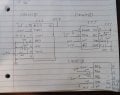
A few years ago, I go I put on Circuit 1 from the image on a breadboard. I have drawn only the first timer, but I assembled both timers on the 556. This is supposed to bring the output high when the input (discharge) goes low, and the output stays high as long as the input goes low. I don't remember where I got this circuit from, but this was a few years ago, and I can't understand it now. The circuit is on the breadboard and it's working as intended. What confuses me the most is how control and reset seem to be swapped... I tried to replicate this circuit using a 555 and it doesn't work. However, Circuit 2 in the image works exactly as Circuit 1.
Can someone explain how Circuit 1 works and how come I'm unable to replicate it on a 555? I swear I checked, and double checked, and triple checked and what I put on a breadboard a few years ago and still works as intended is Circuit 1.
And another question. I'm trying to replicate the behavior of the circuit on a 558. I put Circuit 3 on a breadboard, but it doesn't do exactly what I want. When the input (trigger) goes low, the input goes high, but only for the time determined by RC (10K and 10uF). I want the output to stay high while the input is low. How can I do that? By the way, the output of the 558 is pulled up by a 10K resistor that I forgot to include in the schematic!
Thanks!
A few years ago, I go I put on Circuit 1 from the image on a breadboard. I have drawn only the first timer, but I assembled both timers on the 556. This is supposed to bring the output high when the input (discharge) goes low, and the output stays high as long as the input goes low. I don't remember where I got this circuit from, but this was a few years ago, and I can't understand it now. The circuit is on the breadboard and it's working as intended. What confuses me the most is how control and reset seem to be swapped... I tried to replicate this circuit using a 555 and it doesn't work. However, Circuit 2 in the image works exactly as Circuit 1.
Can someone explain how Circuit 1 works and how come I'm unable to replicate it on a 555? I swear I checked, and double checked, and triple checked and what I put on a breadboard a few years ago and still works as intended is Circuit 1.
And another question. I'm trying to replicate the behavior of the circuit on a 558. I put Circuit 3 on a breadboard, but it doesn't do exactly what I want. When the input (trigger) goes low, the input goes high, but only for the time determined by RC (10K and 10uF). I want the output to stay high while the input is low. How can I do that? By the way, the output of the 558 is pulled up by a 10K resistor that I forgot to include in the schematic!
Thanks!