Universal motor speed control using commutator frequency as feedback.

MrAl

Joined Jun 17, 2014
13,709
I want this to work with any off-the-shelf corded tool (routers, table saws, drills, grinders, vacuums, etc) using universal motors, without modification (including adding slotted disk). Just plug the tool into it and it senses RPM of the tool automatically by counting the brushed motor's commutation pulses present in the current drawn by the tool.
Hi I just saw this reply.

To get the back EMF method to work with any tool, you probably have to have a way to adjust the sensing circuit where you would have that "Rx" as in my previous post. That needs to be adjusted close to the armature resistance value (with proper scaling).

The thing that is different about a speed "adjuster" and a true speed "regulator" is the adjuster just needs to change the power getting to the motor, and that would be considered a manual feed forward method. The true regulator uses a feedback method which is different, and so one of the parameters has to be adjusted to fit the case. It would not be insane to implement this as a secondary adjustment, but I don't think you can do that automatically without the measurement unless you can also have the circuit measure the armature resistance. That could be hard to do though because it would be the dynamic resistance to be measured not the static resistance, although there could be a relatively decent correlation.

Bringing a microcontroller into the mix changes everything because you can do a lot more with that.
 

Thread Starter

strantor

Joined Oct 3, 2010
6,875
Hi I just saw this reply.

To get the back EMF method to work with any tool, you probably have to have a way to adjust the sensing circuit where you would have that "Rx" as in my previous post. That needs to be adjusted close to the armature resistance value (with proper scaling).

The thing that is different about a speed "adjuster" and a true speed "regulator" is the adjuster just needs to change the power getting to the motor, and that would be considered a manual feed forward method. The true regulator uses a feedback method which is different, and so one of the parameters has to be adjusted to fit the case. It would not be insane to implement this as a secondary adjustment, but I don't think you can do that automatically without the measurement unless you can also have the circuit measure the armature resistance. That could be hard to do though because it would be the dynamic resistance to be measured not the static resistance, although there could be a relatively decent correlation.

Bringing a microcontroller into the mix changes everything because you can do a lot more with that.
What you described here and in the previous post about Rx needing to match the motor's resistance I think is why off the shelf DC drives have "plug in resistors" for matching the motor. So that back EMF speed sensing can work.

This becomes an issue in manufacturing plants where there is an issue and maintenance guys start blindly swapping parts. Change the motor, change the drive, now "the machine is going crazy" and "we can't get it adjusted properly." I know that the plug ing resistor must match the motor but I never knew technically why. I think you just enlightened me.

Most of those industrial DC drives are designs that haven't changed in 40 years, no microcontroller. So as you indicated, adding one could open doors, maybe a back EMF scheme could work for multiple motors by reading the motor's resistance at power-up.

Assume there will be a microcontroller. Which solution do you think would be more reliable; one that counts commutation spikes or one that measures back EMF?
 

Thread Starter

strantor

Joined Oct 3, 2010
6,875
Ok I think I have answered my question. The reason why the commutator spike feedback thing doesn't exist is because corded tools don't generate these spikes. At least not in any consistently detectable way. Probably on purpose.

I tested several brushed tools with an active AC/DC current clamp on my oscilloscope and none of them created any measurable spikes. Thinking maybe the spikes were too fast for the clamp I then re-tested across a shunt resistor. I tested with AC supply and DC supply. Nothing. Or, not nothing, but nothing consistent. Holding a powered drill stalled with a wrench and letting it advance one commutator section at a time, I could feel the "cogging" as I let it slowly go around, and I could see spikes that sometimes correlated with the cogging/jerks, but not always, and some of these spikes were smaller than those of the ever-present noise from other devices in my shop.

Even the cheap harbor freight ones I assumed would be noisy, created no consistent "smoking gun" spikes. I assume because there are filtering components inside the tool. They would probably wreak havoc on nearby devices if they didn't. I could start opening tools to confirm the presence/absence of filtering components but that would be a waste of time; removing the filters would be among the modifications I don't want to do to the tools and would be a bad idea anyway. The idea is dead.
 

MrAl

Joined Jun 17, 2014
13,709
Ok I think I have answered my question. The reason why the commutator spike feedback thing doesn't exist is because corded tools don't generate these spikes. At least not in any consistently detectable way. Probably on purpose.

I tested several brushed tools with an active AC/DC current clamp on my oscilloscope and none of them created any measurable spikes. Thinking maybe the spikes were too fast for the clamp I then re-tested across a shunt resistor. I tested with AC supply and DC supply. Nothing. Or, not nothing, but nothing consistent. Holding a powered drill stalled with a wrench and letting it advance one commutator section at a time, I could feel the "cogging" as I let it slowly go around, and I could see spikes that sometimes correlated with the cogging/jerks, but not always, and some of these spikes were smaller than those of the ever-present noise from other devices in my shop.

Even the cheap harbor freight ones I assumed would be noisy, created no consistent "smoking gun" spikes. I assume because there are filtering components inside the tool. They would probably wreak havoc on nearby devices if they didn't. I could start opening tools to confirm the presence/absence of filtering components but that would be a waste of time; removing the filters would be among the modifications I don't want to do to the tools and would be a bad idea anyway. The idea is dead.
Hi,

Oh I didn't know about the DC drives probably because I never had to buy one or design one.

You may be right about some filtering components or something because now I remember working on a small project with a friend who wanted to measure the RPMs of his fan motor. We did it first with a laser and pin photo diode and that 'counted' the times the fan blades broke the light beam. Then, we switched to measuring the current and we could detect the current changes as the motor went around and that gave us the frequency too.
It was not really 'spikes' though it was a relatively smooth change in current as the motor turned because of the varying way the motor draws current as the poles rotate around. Amplifying this signal gave a signal that was good enough to detect. I had forgotten about that.

The thing is though, maybe not all motors react in the same way. That fan gave us a useable signal, but maybe another fan would not. At most I would say we tried two different fans, that's about it. If there are filtering components then that could mess up the whole scheme royally making it fail to work properly.
This experiment was some time ago and I can't remember all the details, but I am sure we used an op amp (like the LM358) amplifier to amplify the current waves in order to detect them with a microcontroller.
 

Alec_t

Joined Sep 17, 2013
15,121
Even the cheap harbor freight ones I assumed would be noisy, created no consistent "smoking gun" spikes. I assume because there are filtering components inside the tool.
I don't think it's due to filtering. I ran a simulation of commutated rotor coils in series with a field inductor and all you see, for practical RPMs, is small amplitude fluctuations of the sinusoidal motor current waveform. This ripple looks erratic because the rotation frequency isn't related to the mains frequency. The erratic nature would make any analysis of the current for back-emf determination difficult.
Here's my theory for the lack of commutation spikes.
Consider a typical multi-pole universal motor. Each commutator segment contacts a brush which has a dimension (in the direction of rotation) nearly equal to that of the segment. Hence the brush can bridge two segments for most of the time, resulting in two rotationally-adjacent rotor coil-pairs (pairs because diametrically-opposite poles are paired) being energised at a time. For the remaining time, one coil-pair is energised. If the rotor coil inductance is smaller than the field coil inductance the latter dominates the total inductance, which doesn't change much whether one or two rotor coil-pairs is energised.
Anyone have any typical figures for rotor inductance vs field inductance?
 

Alec_t

Joined Sep 17, 2013
15,121
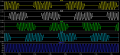
Here's the simulation result. The top four traces show the current in respective coil-pairs of an 8-pole rotor. The bottom trace is total mains current, showing hardly any ripple.
Universal.png

Edit:
I 've just spotted an error in my sim, so the top four traces above aren't accurate, although they do show the expected pulse overlap. Sim now revised and results further down this thread.
 
Last edited:

Thread Starter

strantor

Joined Oct 3, 2010
6,875
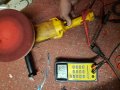
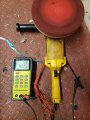
In order to test the inductance of a tool (total) and (rotor only) without disassembling the tool, it must have both externally accessible brushes and a trigger circuit/mechanism simple enough that a full trigger pull is a mechanical electrical connection bypassing all variable speed circuitry. It turns out I had only one tool like that. Here are the measurements I got from it:

20230905_113001.jpg

20230905_112837.jpg

At the time I did not think to check whether 2 commutator sections were contacting the brushes, or 3, but the probability is higher that it was 3.

It seems half your hypothesis was correct; the brushes do indeed contact two or 3 sections at a time. But the other half (that rotor inductance is negligible compared to stator inductance), at least as it applies to this tool, seems false if my measurements are valid. Rotor inductance was nearly half of total, and if 3 poles were being measured at the the time, it would mean that rotor inductance is actually more than double stator inductance. Although I question if my measurements are valid; if it is valid to measure overall and subtract rotor to get stator, or if stator must measured alone and rotor alone. Maybe there is some kind of cancelation effect by measuring overall?
 

Thread Starter

strantor

Joined Oct 3, 2010
6,875
Consider a typical multi-pole universal motor. Each commutator segment contacts a brush which has a dimension (in the direction of rotation) nearly equal to that of the segment. Hence the brush can bridge two segments for most of the time, resulting in two rotationally-adjacent rotor coil-pairs (pairs because diametrically-opposite poles are paired) being energised at a time. For the remaining time, one coil-pair is energised. If the rotor coil inductance is smaller than the field coil inductance the latter dominates the total inductance, which doesn't change much whether one or two rotor coil-pairs is energised.
Anyone have any typical figures for rotor inductance vs field inductance?
I don't think the above description is consistent with the below simulation.
Here's the simulation result. The top four traces show the current in respective coil-pairs of an 8-pole rotor. The bottom trace is total mains current, showing hardly any ripple.
View attachment 302140
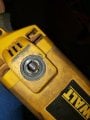
I say that not to detract but to make sure we are "on the same page." I suspect maybe the text description was an earlier revision of the idea and the simulation was refined after looking closer at brush assemblies? The simulation makes sense to me after looking at the brush assembly on my buffer/grinder but the description seems to be in terms short of one commutator segment. For clarity this is what I can observe through a brush holder:

2 sections:
20230905_113501.jpg

3 sections:
20230905_113551.jpg
 

Alec_t

Joined Sep 17, 2013
15,121
Hmm. So it looks as though the brush is about as wide as two commutator segments. I'll modify the sim and take your inductance measurements into account. Motor coil inductance and resistance values rarely seem to appear in motor ads I've come across, so those measurements are a handy reference.
I had guessed that the field winding, being physically much larger than a rotor winding, would have had a significantly greater inductance. Bad guess :).
 
Last edited:

Thread Starter

strantor

Joined Oct 3, 2010
6,875
Hmm. So it looks as though the brush is about as wide as two commutator segments. I'll modify the sim (probably some time tomorrow)
But that's why I pointed out what I interpret as an inconsistency. I think the sim is already correct. I see in your waveforms that at any given time current is probably flowing in 3 poles with brief periods of being only in two. I want to make sure I understand what you're saying.
 

Thread Starter

strantor

Joined Oct 3, 2010
6,875
I couldn't leave it alone. I 100% expected to see commutation in the supply current and I couldn't shake the feeling that my inability to find it was an error on my part. I was right in suspecting my own stupidity. The shunt resistor I was using to measure current was far too low value. I didn't even check it. Turns out it's a 500A/75mV (1.5mΩ) resistor. So the current feedback it was giving me was so low that that it was hidden in noise. I made a 1.0Ω resistor out of nichrome and then was able to see the commutation. As you said @Alec_t it isn't spikes but a ripple. I made a couple of quick videos:

https://drive.google.com/drive/folders/109uGCf-wg6w88p7nVEc-_LEUV8hTu1wI
 

Alec_t

Joined Sep 17, 2013
15,121
Ok. The sim mod for a 60Hz supply, your measured inductances and with three coil-pairs energised most of the time gives this as the total current. I expanded a bit of the trace to show the ripple more clearly.
Universal2.png
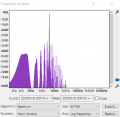
The spectrum of that waveform is:
1693942598712.png

Any commutation effects seem to be 40dB or so down from the main 60Hz peak.
 

MisterBill2

Joined Jan 23, 2018
27,570
Monitoring the speed of a brush type motor powered by DC can be done, and it works, but it is a bit tedious. It was done on a small fuel pump in a test stand about 25 years ago.. The problem is that the commutation frequency and brush noise frequency are both present.
So to obtain a reasonably accurate speed reading you need to run the motor on DC. That is not a big deal problem. The power source needs to have a high enough internal resistance to allow the commutation frequency to be seen back at the power source. That is not so difficult. Filtering out the brush noise from the commutation signal takes some effort, but then you have a motor RPM signal that can be used for speed control feedback.
Using the DC motor counter-EMF can also be used for speed control, that circuit scheme has been published long ago. It gives a fair amount of speed control, but not an excellent amount of control.
 

schmitt trigger

Joined Jul 12, 2010
2,091
About 15 years ago, the Australian “Silicon Chip” magazine had such a design.
It ha been way too long ago for me to remember the details, but I do recall that the authors used back-EMF, where the uC’s ADC would read during the PWM’s off-time as the feedback signal.
The commutator signal was way too noisy to be a reliable feedback.
Of course, I could be missing some important details. My brain has a lot of bad sectors and has severe “fragmentation” issues.
 

MisterBill2

Joined Jan 23, 2018
27,570
About 15 years ago, the Australian “Silicon Chip” magazine had such a design.
It ha been way too long ago for me to remember the details, but I do recall that the authors used back-EMF, where the uC’s ADC would read during the PWM’s off-time as the feedback signal.
The commutator signal was way too noisy to be a reliable feedback.
Of course, I could be missing some important details. My brain has a lot of bad sectors and has severe “fragmentation” issues.
It is not cost effective to use the commutator brush frequency unless an exact speed reading is required. So back EMF is indeed usually the best choice.
 

MrAl

Joined Jun 17, 2014
13,709
Hello,

I agree that back the EMF technique is a good idea for use with most power tools as you can get that "tapered" power drag feeling feedback when using it, the same as you get with a non-speed control when digging into the work, yet with a more consistent speed.
 

Mswice

Joined Jan 6, 2024
1
I'm using a 120V die grinder for some non-standard grinding operations and i need to control the speed. I have been using a "router speed controller" for this purpose but it isn't great because the speed difference between loaded and unloaded motor is more drastic than optimal. I've been thinking of rolling my own speed controller using some speed feedback. There isn't a good way to mount an encoder or sense gear teeth so thought "what about measuring the commutation frequency?" That would actually be pretty great because I could use it with any brushed universal motor tool, just plug it into the controller, and the controller automatically has speed feedback to use for regulation of speed under changing load, no modifications needed for any of the tools.

But if it were that simple, this would be something I could just buy. But I don't see anything like it. When I search for it I just find a bunch of open-loop devices like the one I'm already using.

So what's the gotcha? Why doesn't this exist?
I was using my variable speed 4.5 inch 120v grinder last night when it suddenly jumped to full 10,000 rpm and the dial had no effect. This particular grinder has soft start, and the variable speed compensates under a load. Upon placing the grinder on a work surface it will quickly throttle up to maintain rpm, and throttle back when lifted. I slipped the rear cover off to examine, the speed controller has 5 wires. (This unit has brushes). 2 wires are directly from the switch, one wire goes to the motor, and 2 wires go to a small plastic box that is held directly over the rear motor shaft end, quite certain a pickup. Sliding this box up out of its pocket, there was substantial grinding residue that would dance around when I turned the motor by hand. I haven't performed any testing because the grinder is still under its 1 year warranty, I slid the sensor back and cover.
I understand you are wanting to design a controller without any additional components, but it does seem this grinder is performing how you are describing. I looked diligently online to see if a speed controller with any type of rpm pickup was available in case I am outside of the warranty, no luck. Found plenty of dial controllers for grinders, all having 2 or three wire connectors and nothing to count rpm, except for stepper motor controller.
Anyway, thought I would share about this grinder, the name brand is Core by sparks and arcs. It is 120v, 12 amp variable speed from 2800 to 10000. I've used everything from Metabo to DeWalt, this little grinder outperforms all, and is less than $100 !
 

MisterBill2

Joined Jan 23, 2018
27,570
As in post #2, the feedback is a small slotted disc on the rear of the motor to TDA1085 tach input.
The speed measure is to the tach input from a ~6 slot wheel using an opto.
The stepped control rate was modified from the Motorola print in order to use a pot speed control .
This was many moons ago now, but I still have my notes on file.
If the disk grinder is like any of my three disc grinders, adding anything will be a monster sized project, because they are very tightly built. Hence commutation noise pickup would be the choice. Running the universal motor on DC would work, but it may affect brush life. I could live with that.. Filtering the current noise signal to get motor speed is certainly possible. Using that speed signal to control the drive voltage can certainly work. Can not use PWM control because of already using current noise to sense motor speed.
How much does the back EMF change with load? When I am doing steel cutting with my one grinder the speed varies a great deal with load, So the back EMF may also vary with load, I never checked on that. Does anybody actually KNOW?? No guesses, please.
 

MaxHeadRoom

Joined Jul 18, 2013
30,674
The TDA1085C based controller was also purchased with a Universal motor from a surplus dealer, both were originally used by a Treadmill manuf.
This particular version did rectify the output to DC for the Universal motor.
In this instance, the low-res tach feedback was adequate to control and maintain constant RPM. for my Band Saw.
 
Top