Facebook
 Google
 GitHub
 Linkedin
Hi --
For a simple audio amp:
I can see how a push pull works when it is by itself and fed by a simple AC sine wave -- Q1 on, Q2 off when the base input is positive and Q2 on, Q1 off when the base input is negative.
But now...
I feed my Push Pull with a common emitter amp.
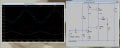
I no longer have a sine wave going through negative/positive because my CE amp is biased -- now my input to my Push Pull is a sine wave that is always in positive territory (see Vb on my simulation).
What I don't understand is why, since my inputs are now always in positive territory, does my Push Pull still work (see Vout in my simulation)?
Since Vb (see simulation) input to both transistors is always positive, why then do the transistors turn on and off instead of just Q1 always on and Q2 always off?
I realize it has to do with C2 but I don't understand the mechanism. What is C2 doing for us here in terms causing the transistors to turn on/off?
Note: I see the crossover distortion and I know I need biasing for the Push Pull but I left it off here to make the test case easier for me to see.
Note: This is all just hobby fun. I played with this years ago now now hoped to pick it up again. I have the simulation working (see attached) and I see a nice little Class AB amp. From studying articles on the web about CE and Push Pull, and how to set them up, they make sense when standing alone. But I'd like to understand this lingering part of how it works when I put them together as a complete amp before going to a bread board and seeing if I can hear some sound out of it!
Thank you!
For a simple audio amp:
I can see how a push pull works when it is by itself and fed by a simple AC sine wave -- Q1 on, Q2 off when the base input is positive and Q2 on, Q1 off when the base input is negative.
But now...
I feed my Push Pull with a common emitter amp.
I no longer have a sine wave going through negative/positive because my CE amp is biased -- now my input to my Push Pull is a sine wave that is always in positive territory (see Vb on my simulation).
What I don't understand is why, since my inputs are now always in positive territory, does my Push Pull still work (see Vout in my simulation)?
Since Vb (see simulation) input to both transistors is always positive, why then do the transistors turn on and off instead of just Q1 always on and Q2 always off?
I realize it has to do with C2 but I don't understand the mechanism. What is C2 doing for us here in terms causing the transistors to turn on/off?
Note: I see the crossover distortion and I know I need biasing for the Push Pull but I left it off here to make the test case easier for me to see.
Note: This is all just hobby fun. I played with this years ago now now hoped to pick it up again. I have the simulation working (see attached) and I see a nice little Class AB amp. From studying articles on the web about CE and Push Pull, and how to set them up, they make sense when standing alone. But I'd like to understand this lingering part of how it works when I put them together as a complete amp before going to a bread board and seeing if I can hear some sound out of it!
Thank you!
Attachments
-
 77.7 KB Views: 9