Understanding digital RGB LED strips..

Thread Starter

oddballmotorsports

Joined May 23, 2016
7
Ok,
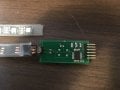
So I'm working on creating an interactive light display wrapped around a hand drum, which once I get it the way I want it, will be able to listen for certain frequencies, and trigger the lights and functions depending on what beat is played on the drum. here is what I'm working on just doing what it does, with no interaction or manipulation.


from my limited knowledge, it looks like where the power comes in there is one chip, that has no markings, that sends commands or signals to the rest of the slave chips (marked gs1903, 1717) to create the effects over a serial bus? on each 15 rgb strip there is + - and DI and DO which I can assume is data in and data out. with one of the GS "slave" chips controlling 2 RGB leds. also once separated from the original strip with the one "extra" no marking chip, and power is applied to them, all lights light up with no effects at all.

so can anyone explain to me how this works exactly, and most importantly provide a schematic? and possibly suggest how I can identify the "no name" chip. I have tons more questions, but are irrelevant until I can understand just exactly how this thing works...
 

BobTPH

Joined Jun 5, 2013
11,484
I would guess that these are WS2812B strips.

They work by sending 24bits of data for each LED in the strip. The data is sent to the first LED in the strip, which then sets its color and brightness according the the 24 bit RGB data, and once it is set, will forward the next data to the next LED. So, if you have a 60 LED strip, you will send out 60 X 24 bits of data. The first set of data goes to the first LED (one closest to the controller) and the last set goes to the last LED.

Holding the the data line low for a defined period will reset the strip, which means it holds the current data, but waits for the next update.

The way to control these strips is a microcontroller. It needs only that one chip.

Here is a controller I designed an built for such strips:

ws2812b.JPG
Bob
 

Thread Starter

oddballmotorsports

Joined May 23, 2016
7
ok, just to clarify my rgb leds do not have an embedded chip there are 2 rgbs which are wired in parallel to one chip. so what the controller is doing is sending 24bits x however many chips there are? and do the chips have unique identifiers? like nodes? so essentially the controller is sending out packets in a stream and then repeating? or no? like how do the listening chips know that its a sequence vs lighting in unison? do they take the packet look at it, say this is for me then do something, or ignore the info and pass it along? and by holding the data line low, you mean grounded? what I'm hoping to do, is take the leftover strips with no controller and reuse them with my own controller. since there going to be sound activated, hopefully control with an Arduino also since I've cut them short, can I T off with 2 strips at a union in a Y? or what if I mix and match the strips, can I do that? will the sequence change? what will happen then?
 

Sensacell

Joined Jun 19, 2012
3,780
They are similar to shift-registers, the data goes into one end, and comes out the other, 24 bits are stored in each LED.
A global trigger causes the data to be latched into the LED drivers.

The harder part of your project will be separating frequencies in a satisfactory manner, not easy to pull off.
 

Attachments

BobTPH

Joined Jun 5, 2013
11,484
It might help if you showed us a picture of the strip. I have not seen any that had a chip + 2 RGB LEDs, and I don't know exactly how those would work. Can you also send us a link to the strip?

One question, though, there are exactly 3 wires leading to the strip right, not four? If there are 4, it probably means one is R, one G, one B and the other is common, which means the entire strip would be the same color always.

They are sometimes referred to as individually addressable, but that is not really the case. As I stated, the first 24 bits you send goes to the first LED on the strip (nearest the input), the next 24 bits goes to the second LED, and so on. So it is not really like a shift register either. In a shift register the first bits you sent would end up in the last LED after you had sent data for all of them.

To get motion effects, you resend the data to all of the LEDS at a short interval, maybe 1/100th of a second.

Bob
 

Thread Starter

oddballmotorsports

Joined May 23, 2016
7
yes definitely 3 wires total. (+/- DI and DO respectively)

http://www.ebay.com/itm/2811-Waterp...e=STRK:MEBIDX:IT&_trksid=p2057872.m2749.l2649

I'm guessing it operates as the "cheap" version of the chip embedded led's and I know for sure its 3 leds per chip as they operate in unison. I understand the addressing I think now, but how does the first led not respond to the command meant for the 2nd led and so on and so on?
 

BobTPH

Joined Jun 5, 2013
11,484
Yes, the WS2811 works the same way as the as The WS2812B, but the LEDs are external,

The reset state of the chip is waiting for 24 bits. One it sees that data, it goes into the pass through state, where it sends all data on to the next chip, while keeping its data and PWMing its three LEDs.

Bob
 

Thread Starter

oddballmotorsports

Joined May 23, 2016
7
so it will do so until it gets the data low reset signal, then waits for further instruction again? that about right? so from a physical standpoint, changes will only travel outward towards the end of the strip? granted I know this is happening at 100ths of a second, but just wanna make sure I understand this..
 
Top