UART vs 422 vs 485 ..#2

Thread Starter

Hareesh_7

Joined Apr 11, 2024
1
Last edited by a moderator:

nsaspook

Joined Aug 27, 2009
16,321
Today, you can simply use a transceiver chip to convert digital logic levels to physical interface levels.

For this controller project there are three uarts (and one can bus controller) being used. At the controller level, 5 volt logic is used for tx/rx.

UART1: 9N1 proprietary interface with 24vdc loops for charge controller communications. Using AN25M optocoupler. https://www.onsemi.com/pdf/datasheet/4n37m-d.pdf
UART2: RS-485 MODBUS interface differential fo remote power analyzer communications. Using a ADM3095 transceiver chip. https://www.analog.com/en/products/adm3095e.html
UART3: TTL serial interface single-ended, direct from the controller to a ttl uart to USB module for host communications. Direct connect
CANBUS: TCAN330G transceiver chip. https://www.ti.com/product/TCAN330G

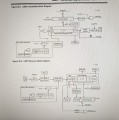
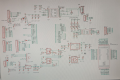
1712853521411.png
1712853943345.png
1712854245786.png

1712853877343.png

https://www.ti.com/lit/an/slla322/slla322.pdf
Comparison of Differential-Mode Noise Immunity of RS-485 Receivers With 3.3-V Supply

Noise Immunity
Noise immunity for this discussion is defined as the ability of a communication system to send and receive
correct binary data in the presence of unwanted electrical noise. The noise source in any real application
depends on the environment around the network. It may be due to power supplies, high-current
machinery, radio-frequency coupling, or any number of other sources. See the TI application report
SLLA057 A Survey of Common-Mode Noise. In most RS-485 (or similar RS-422 or CAN-based) systems,
twisted-pair cables and balanced differential signaling are used to reduce the influence of external noise
on the network signaling.
RS-485 is by nature of its balanced circuits and twisted-pair media, relatively immune to common-mode
noise. However, conversion of common-mode noise to differential noise is possible in all real systems,
due to unintended imbalances in the cabling, loading, and circuit parameters. Because common-mode
noise is especially pervasive in industrial environments, some differential noise can be expected.
Designers should consider immunity to differential noise as well as immunity to common-mode noise.
 
Top