Facebook
 Google
 GitHub
 Linkedin

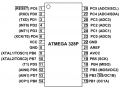
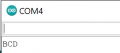
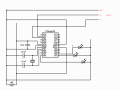
i am just starting with microcontrollers so i don't know much about them to begin with.but as of now i am learning to configure uart hardware registers for serial communication and i seem to be stuck with weird strange characters being printed on my serial terminal. I am using avr328p-pu(extracted from an arduino uno board) with an external 16mhz oscillator and a usb to ttl converter(5V) for usb to serial conversion. I'm not using the power supply that comes with the usb-ttl adaptor instead i am using the powerline pins on arduino board as for the circuit diagram i will upload it and the code that i am using as well.
Initially i thought that my baud rate is messed up somehow because of that i hardcoded the baud rate in the registers using a baud rate calculator for 16mhz clock cycle you will see that in the code. could it be that i am using long jumper wires which could cause some noise?
can anyone help with this another thing that i noticed was when i unplug the power from the board the chip is still powered from the usb-ttl adaptor even though i am not using it's 5V power supply pin can anyone look at the circuit and explain that to me as well.
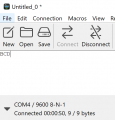
i am using coolTerm for serial Terminal and it is set to 9600

Initially i thought that my baud rate is messed up somehow because of that i hardcoded the baud rate in the registers using a baud rate calculator for 16mhz clock cycle you will see that in the code. could it be that i am using long jumper wires which could cause some noise?
can anyone help with this another thing that i noticed was when i unplug the power from the board the chip is still powered from the usb-ttl adaptor even though i am not using it's 5V power supply pin can anyone look at the circuit and explain that to me as well.
i am using coolTerm for serial Terminal and it is set to 9600
serialCom.c:
#include<avr/io.h>
#include<util/delay.h>
#include "USART.h"

int main(void){
    char serialcharacter;

    DDRB|=(1<<0)|(1<<1)|(1<<2);
    initUSART();


    while(1){
        serialcharacter = receiveByte();
        transmitByte(serialcharacter);
        PORTB=serialcharacter&(255>>5); /*get the 3 most significant bits*/
    }
}
USART.h:
/* Functions to initialize, send, receive over USART

   initUSART requires BAUD to be defined in order to calculate
     the bit-rate multiplier.
*/

#ifndef BAUD                          /* if not defined in Makefile... */
#define BAUD  9600                     /* set a safe default baud rate */
#endif

                                  /* These are defined for convenience */
#define   USART_HAS_DATA   bit_is_set(UCSR0A, RXC0)
#define   USART_READY      bit_is_set(UCSR0A, UDRE0)

/* Takes the defined BAUD and F_CPU,
   calculates the bit-clock multiplier,
   and configures the hardware USART                   */
void initUSART(void);

/* Blocking transmit and receive functions.
   When you call receiveByte() your program will hang until
   data comes through.  We'll improve on this later. */
void transmitByte(uint8_t data);
uint8_t receiveByte(void);

void printString(const char myString[]);
             /* Utility function to transmit an entire string from RAM */
void readString(char myString[], uint8_t maxLength);
/* Define a string variable, pass it to this function
   The string will contain whatever you typed over serial */

void printByte(uint8_t byte);
                  /* Prints a byte out as its 3-digit ascii equivalent */
void printWord(uint16_t word);
        /* Prints a word (16-bits) out as its 5-digit ascii equivalent */

void printBinaryByte(uint8_t byte);
                                     /* Prints a byte out in 1s and 0s */
char nibbleToHex(uint8_t nibble);
char nibbleToHexCharacter(uint8_t nibble);
void printHexByte(uint8_t byte);
                                   /* Prints a byte out in hexadecimal */
uint8_t getNumber(void);
/* takes in up to three ascii digits,
converts them to a byte when press enter */
USART.c:
#include <avr/io.h>
#include "USART.h"
#include <util/setbaud.h>

void initUSART(void) {                                /* requires BAUD */
  UBRR0H = 0x00;                        /* defined in setbaud.h */
  UBRR0L = 0x67;
#if USE_2X
  UCSR0A |= (1 << U2X0);
#else
  UCSR0A &= ~(1 << U2X0);
#endif
                                  /* Enable USART transmitter/receiver */
  UCSR0B = (1 << TXEN0) | (1 << RXEN0);
  UCSR0C = (1 << UCSZ01) | (1 << UCSZ00);   /* 8 data bits, 1 stop bit */
}


void transmitByte(uint8_t data) {
                                     /* Wait for empty transmit buffer */
  loop_until_bit_is_set(UCSR0A, UDRE0);
  UDR0 = data;                                            /* send data */
}

uint8_t receiveByte(void) {
  loop_until_bit_is_set(UCSR0A, RXC0);       /* Wait for incoming data */
  return UDR0;                                /* return register value */
}


                       /* Here are a bunch of useful printing commands */

void printString(const char myString[]) {
  uint8_t i = 0;
  while (myString[i]) {
    transmitByte(myString[i]);
    i++;
  }
}

void readString(char myString[], uint8_t maxLength) {
  char response;
  uint8_t i;
  i = 0;
  while (i < (maxLength - 1)) {                   /* prevent over-runs */
    response = receiveByte();
    transmitByte(response);                                    /* echo */
    if (response == '\r') {                     /* enter marks the end */
      break;
    }
    else {
      myString[i] = response;                       /* add in a letter */
      i++;
    }
  }
  myString[i] = 0;                          /* terminal NULL character */
}

void printByte(uint8_t byte) {
              /* Converts a byte to a string of decimal text, sends it */
  transmitByte('0' + (byte / 100));                        /* Hundreds */
  transmitByte('0' + ((byte / 10) % 10));                      /* Tens */
  transmitByte('0' + (byte % 10));                             /* Ones */
}

void printWord(uint16_t word) {
  transmitByte('0' + (word / 10000));                 /* Ten-thousands */
  transmitByte('0' + ((word / 1000) % 10));               /* Thousands */
  transmitByte('0' + ((word / 100) % 10));                 /* Hundreds */
  transmitByte('0' + ((word / 10) % 10));                      /* Tens */
  transmitByte('0' + (word % 10));                             /* Ones */
}

void printBinaryByte(uint8_t byte) {
                       /* Prints out a byte as a series of 1's and 0's */
  uint8_t bit;
  for (bit = 7; bit < 255; bit--) {
    if (bit_is_set(byte, bit))
      transmitByte('1');
    else
      transmitByte('0');
  }
}

char nibbleToHexCharacter(uint8_t nibble) {
                                   /* Converts 4 bits into hexadecimal */
  if (nibble < 10) {
    return ('0' + nibble);
  }
  else {
    return ('A' + nibble - 10);
  }
}

void printHexByte(uint8_t byte) {
                        /* Prints a byte as its hexadecimal equivalent */
  uint8_t nibble;
  nibble = (byte & 0b11110000) >> 4;
  transmitByte(nibbleToHexCharacter(nibble));
  nibble = byte & 0b00001111;
  transmitByte(nibbleToHexCharacter(nibble));
}

uint8_t getNumber(void) {
  // Gets a numerical 0-255 from the serial port.
  // Converts from string to number.
  char hundreds = '0';
  char tens = '0';
  char ones = '0';
  char thisChar = '0';
  do {                                                   /* shift over */
    hundreds = tens;
    tens = ones;
    ones = thisChar;
    thisChar = receiveByte();                   /* get a new character */
    transmitByte(thisChar);                                    /* echo */
  } while (thisChar != '\r');                     /* until type return */
  return (100 * (hundreds - '0') + 10 * (tens - '0') + ones - '0');
}