Tvs and microcontrollers

Thread Starter

MarcoR81

Joined Mar 26, 2024
2
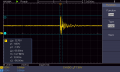
Hi everyone. I'm new to the forum. My name is Marco, and I'm an enterprise software developer. However, more importantly, in my free time, I'm a maker! I would like to discuss TVS signals and microcontrollers. I've developed many PCB prototypes, and I keep "big TVS" under control using transil diodes. However, I've noticed that very short TVS spikes are not suppressed regardless. I've chosen to ignore them, and my devices are still functioning fine. Now, I've decided to investigate further. Do you think that such short spikes can be dangerous for an MCU? For example, this one is generated by a relay switch (without load) and is mesured across mcu vcc and gnd pins. Does anyone have knowledge about this kind of problem? Thanks in advance for your attention
 

Attachments

Papabravo

Joined Feb 24, 2006
22,082
Hi everyone. I'm new to the forum. My name is Marco, and I'm an enterprise software developer. However, more importantly, in my free time, I'm a maker! I would like to discuss TVS signals and microcontrollers. I've developed many PCB prototypes, and I keep "big TVS" under control using transil diodes. However, I've noticed that very short TVS spikes are not suppressed regardless. I've chosen to ignore them, and my devices are still functioning fine. Now, I've decided to investigate further. Do you think that such short spikes can be dangerous for an MCU? For example, this one is generated by a relay switch (without load) and is mesured across mcu vcc and gnd pins. Does anyone have knowledge about this kind of problem? Thanks in advance for your attention
There are things to try if you are concerned about them. Are you familiar with differential and common-mode chokes? That along with additional bypass capacitors might be helpful. I wish I could say this will be cheap and inexpensive.
 

MrChips

Joined Oct 2, 2009
34,807
Do you think that such short spikes can be dangerous for an MCU?
No and yes.

The first question one needs to ask, what is the environment of the MCU? Is it in a noisy industrial environment?

There are two approaches to this problem. One can assume that it is in a moderately noisy environment (household, commercial, industrial) and apply all commonly accepted means to mitigate transients. This should be applied in every design.

The second approach is to assume the worst-case scenario where the MCU will be in an extremely harsh industrial environment. In this case one has to apply all the necessary safeguards to avoid failure.
 

ronsimpson

Joined Oct 7, 2019
4,690
Printed Circuit Board layout is critical. Long traces and long leads and bad grounds are a problem. Noise can jump from one trace to another. Beads, chokes help remove the high frequency parts.

Try to short out the signal and return the current back to where it came from. (diodes and Zener diodes and MOV)
Try to open up the line so the signal does not reach the micro. A bead is open to high frequencies. Add a resistor to lower the power coming down the wire.
 
Last edited:

DickCappels

Joined Aug 21, 2008
10,661
You can also try improving the bypass capacitor. Use a low value (.01 or .001 uf) high quality ceramic capacitor directly across the power supply pins on the chip about which you are worried.

Probably not a problem.
 

Thread Starter

MarcoR81

Joined Mar 26, 2024
2
Are you familiar with differential and common-mode chokes? That along with additional bypass capacitors might be helpful
No, I'm not. I will investigate about it and I will do some test, thank you very much

The first question one needs to ask, what is the environment of the MCU
They are all in home environment. But it is enough the relay inside board to create noise (like the one of image attached)

Printed Circuit Board layout is critical
You hit the target, aren't printer board, are protoboard, with some track but
also with many wires.... They are, in some way, shit. I will try with all your suggestions, thank you everyone.
 
Top