Transistor amplifying without bias ?

Thread Starter

iinself

Joined Jan 18, 2013
98
Request help in understanding why this circuit works. The input is from a tube preamp. The transistor gets its 35V from a walwart via dc booster.
My understanding is that the transistor needs to be biased properly before it can work, but this circuit works, actually very well and for both channels.
Thanks.
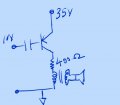
question1.jpg
 

AnalogKid

Joined Aug 1, 2013
12,128
If the input signal amplitude is small, as in 0.1 V or so, then...

No matter what the DC component of input is, audio has a net average value of 0 V. So the input DC level (0 V, 20 V, whatever) minus 34.4 V appears across the capacitor as a DC value. Actually, is is 34.4 V minus the peak signal voltage. If you consider the base-emitter junction as a perfect diode, then the capacitor charges through that diode until the base reaches 34.4 V, at which point all current flow stops. If the audio is 0.2 V p-p centered at GND, then the cap charges up to 34.4 - 0.1 = 33.3 V. The positive peaks at 34.4 V are where conduction stops.

BUT - a real transistor has a conduction range of around 0.4 V to 0.8 V for a small signal device like a 2N4403. So once the positive peaks stop conduction at around 0.6 V b-e, the negative peaks cause more and more collector current as the signal increases. So as long as the audio signal value is completely within the Vbe conduction voltage range, the transistor will act as a wide-open linear amplifier. Note that the Hfe (gain) curve is nowhere near linear, causing harmonic distortion.

ak
 

DickCappels

Joined Aug 21, 2008
10,661
Most likely what keeps the capacitor from charging to the peak voltage and staying there, which would prevent the signal from making is past the base of the transistor is leakage current. The 2N4403's collector-base leakage is probably not significant. The capacitor then becomes suspect. If you measure the DC current through the capacitor you might find confirm that it is the source of bias.
 

crutschow

Joined Mar 14, 2008
38,504
As noted, there has to be a bias source since current can only go in one direction through a transistor base-emitter junction.
One source of that is a leaky capacitor (or possibly a reverse connected electrolytic).

The only other way to get reverse base current is if the base-emitter voltage is driven positive enough to cause the junction to break down and conduct in the reverse direction.
 

Thread Starter

iinself

Joined Jan 18, 2013
98
Thanks for the replies. It looks like a faulty capacitor. I was able to introduce a different capacitor after the faulty one and the transistor did not amplify, till the bias was provided. Thanks.
 

ian field

Joined Oct 27, 2012
6,536
Request help in understanding why this circuit works. The input is from a tube preamp. The transistor gets its 35V from a walwart via dc booster.
My understanding is that the transistor needs to be biased properly before it can work, but this circuit works, actually very well and for both channels.
Thanks.

View attachment 121017
Once or twice I've seen guitar effects pedals doing this - apparently some germanium transistors were so leaky you could get away with no bias.

Most germanium transistors were PNP.
 

ian field

Joined Oct 27, 2012
6,536
That may be true too, this one I am using is 2SB817.
That's a silicon part - if it conducts without bias; bin it!

2SC & 2SD parts are invariably silicon, but 2SA & 2SB numbers include devices made with both materials.

2SA are usually PNP and 2SC are usually NPN - 2SB tend to be PNP and 2SD tend to be NPN, but I'm pretty sure I remember some departures from that.
 

OBW0549

Joined Mar 2, 2015
3,566
Ah, those pesky Internet acronyms. Confusion abounds. Back in the early 1990's when I started online I thought YMMV meant, "You Make Me Vomit." Took me a while to get it right.
 

ian field

Joined Oct 27, 2012
6,536
Ah, those pesky Internet acronyms. Confusion abounds. Back in the early 1990's when I started online I thought YMMV meant, "You Make Me Vomit." Took me a while to get it right.
Everyone does it and this is where it ends up - hey ho, when in Rome.....................
 
Top