Transient Suppression

Thread Starter

MB107

Joined Jul 24, 2016
400
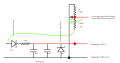
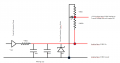
I have a circuit I would like to implement to control an Automotive Fan using an Arduino 33 BLE. I actually have this fan running for about a month now without any transient suppression and it seems to run well for at least a month. But I have been advised "life can change without notice". I want to add to my current project the 2KΩ and 500Ω resistors so I can sense when the engine is running via voltage threshold on one of the input pins shown. And while I'm remaking this design I would like to add the 15V zener diode as well for transient suppression as well. But from what I have read the transient suppression zener diode will require a current limiting resistor, which I have labeled as TBD in the diagram below. But I fear that that TBD resistor will interfere with the voltage I am trying to measure at the analog pin on the Arduino.

In this case the Zener diode only comes into play during transient events when the Zener threshold is exceeded. I can select Zeners anywhere from 15 to 18V as the Arduino will take up to 20V. So in that case is there really a need for a resistor, especially if the circuit is fused to say 1 amp or less.
1650142846032.png
 

ericgibbs

Joined Jan 29, 2010
21,396
hi MB,
The TBD resistor will create a voltage drop from the supply source to the Nano, depending upon the current drawn by the Nano.
So it will affect the Vadc voltage reading, also there will be a voltage drop across the polarity protection diode.

Who has suggested this circuit.?
E
 

ronsimpson

Joined Oct 7, 2019
4,649
To measure engine voltage, look directly at the voltage not after D1 and R_tbd.
I would make R500 & R2000 about 10x larger to reduce the power into the Analog pin if things go wrong. (spike)
Car voltage can get very high or even negative.
Add a cap on Analog pin to remove high frequency noise.
1650196164026.png
 

LowQCab

Joined Nov 6, 2012
5,101
It's not really possible to give any kind of a definitive solution without the
entire Circuit and all Components that are expected to be used,
as well as the Specifications of all those Components.
And preferably, a proper Data-Sheet for every Component,
and, of course, the purpose, and all of the needed functions, of the whole project.

Sometimes, when a project starts to reveal potential odd problems,
it may be worthwhile to consider redesigning the entire project, or larger parts of it.
.
.
.
 

Thread Starter

MB107

Joined Jul 24, 2016
400
hi MB,
The TBD resistor will create a voltage drop from the supply source to the Nano, depending upon the current drawn by the Nano.
So it will affect the Vadc voltage reading, also there will be a voltage drop across the polarity protection diode.

Who has suggested this circuit.?
E
Thanks for the reply. I kind of suspected that. That's why I'm asking. Who suggested it? Me but I'm not an electrical engineer. I only know when something looks fishy.
 

Thread Starter

MB107

Joined Jul 24, 2016
400
To measure engine voltage, look directly at the voltage not after D1 and R_tbd.
I would make R500 & R2000 about 10x larger to reduce the power into the Analog pin if things go wrong. (spike)
Car voltage can get very high or even negative.
Add a cap on Analog pin to remove high frequency noise.
View attachment 265293
That would eliminate the transient only to the Nano Vin. Wouldn't the analoge input pin also need to be protected. If I used bigger resisters the voltage difference would be reduced and I would loose resolution. It might not be an issue but I would be trying to read a 5% voltage change over a smaller percentage of the usable range.
It's not really possible to give any kind of a definitive solution without the
entire Circuit and all Components that are expected to be used,
as well as the Specifications of all those Components.
And preferably, a proper Data-Sheet for every Component,
and, of course, the purpose, and all of the needed functions, of the whole project.

Sometimes, when a project starts to reveal potential odd problems,
it may be worthwhile to consider redesigning the entire project, or larger parts of it.
.
.
.
 

ronsimpson

Joined Oct 7, 2019
4,649
Wouldn't the analoge input pin also need to be protected.
The capacitor on the analog input eats up anything fast. There are input protection diodes on the IC that will clip the voltage to a safe level. Some where in the data sheet is the max current for the input protection diodes.
 

Thread Starter

MB107

Joined Jul 24, 2016
400
It's not really possible to give any kind of a definitive solution without the
entire Circuit and all Components that are expected to be used,
as well as the Specifications of all those Components.
And preferably, a proper Data-Sheet for every Component,
and, of course, the purpose, and all of the needed functions, of the whole project.

Sometimes, when a project starts to reveal potential odd problems,
it may be worthwhile to consider redesigning the entire project, or larger parts of it.
.
.
.
This system is currently being re designed, so not adverse to making changes. However the stuff that works at the moment I would prefer to keep as its somewhat proven.

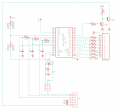
Connector J1 is the ~14V input from the battery and ground

In this circuit three thermisters are connected to connector J2. Coolant temp sensor Delphi 12146312 is connected across pins 3 and 7. Under hood temp Delphi 25036751 is connected across pins 1 and 5. Condenser temp, Little Fuse USP7766 is connected across pins 2 and 6. Also on connector J2 is the PWM signal to the fan.

Connector J3 it used for LED outputs to blink out temperature and troubleshooting codes. I haven't used these on the car at this time. This connector and its associated resisters may be eliminated if I can get the BLE function of the Nano to work successfully.

I have attached all the data sheets except for the resistors, capacitors and transistors. I can provide them if required. I do not have a data sheet for the Mercedes PWM motor as that stuff is proprietary and unavailable.

What I do know about the motor is that it is a 600W motor with 4 wires on it. 2 large gauge wires power the motor and ground. A third small ~18 ga wire is used for the PWM signal and connects to pin 8 of connector J2. A 4th ~ 18 ga wire is used to supply 12V DC to the motor. The fourth wire does not go through my circuit board at all. It is completely external and it is there in the event that a PWM signal is not provided by the third wire. This will run the fan at 100% speed emergency mode. Concequently the PWM signal runs between 10% and 90% duty cycle at all times that the key is on otherwise the system goes into emergency mode via the 12DC from the 4th wire. It is interesting to note that the 4th wire need not be present for the fan to run up to 90% speed just using the 3rd PWM wire.


Here's the circuit diagram.

1650765898004.png
 

Attachments

Last edited:

Thread Starter

MB107

Joined Jul 24, 2016
400
The capacitor on the analog input eats up anything fast. There are input protection diodes on the IC that will clip the voltage to a safe level. Some where in the data sheet is the max current for the input protection diodes.
OK but if that's true do I need the 15V zener diaod at all? Wouldn't the 2 stages of capacitors on the input take care of all of it. By the way this is the way its running now, without a zener diode. No problems so far but limited time on it. And I do not have the voltage divider circuit going to the analoge input installed at this time.
 
Last edited:

Thread Starter

MB107

Joined Jul 24, 2016
400
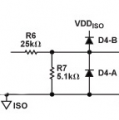
This is a typical circuit. The diodes in the IC are only good for 10mA or something small. External diodes are much stronger.
View attachment 265727
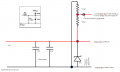
OK I think I'm starting to understand this. By increasing the resistance of both resistors I keep the voltage at about 2.5V but limit the current to the analog pin to ~2ma. So the way I understand this, integrating your circuit, is as shown and no need for a TBD resistor for the Zener diode? I still have the caps in place?

1650849503165.png
 

Thread Starter

MB107

Joined Jul 24, 2016
400
To minimize the current through the input diodes on the protected device, use Schottky diodes for the two shown in the diagram.
I was able to find 15V Schottky diodes but not 3V Schottky. There are also Zener Schottky diodes, but none available in 15V or 3V? I have only checked Digikey so far.

OK I forgot, if they are not Zener diodes voltage doesn't matter. So I have this selection of 30V Schottky diodes from Mouser

1650850244571.png
 
Last edited:

Thread Starter

MB107

Joined Jul 24, 2016
400
@ericgibbs @Yaakov @ronsimpson @LowQCab @crutschow

In doing some research on transient suppression, I came across this document describing a TVS diode which appears to some kind of zener diode or modified zener diode. The funny thing about this document is it shows what I was calling the TBD resistor in place when using a bidirectional TVS diode but no resistor in place when using a unidirectional TVS diode. For the reasons ericgibbs stated in post #2, It would be best if I could get ride of the TBD resister.

So the first question is, how do I know if I need the resistor?
Second question is, do I need bidirectional protection or unidirectional?
Third question is, if I am protecting the circuite at the ~14V level is there a need for protection at the 3V level?

The forth question:
I found two datasheets on these diodes from the Littelfuse company. In looking at the sheets and the recommendations presented in the linked document, it would appear that I need a TVS diode that has a Reverse standoff voltage of Vr > 15 V, because I don't want it to modify the voltage when its below 15V. That would give me a maximum clamping voltage of 24.4V if I used either of the Littelfuse selections. 24.4 Volts is above the 21V maximum for the Arduino but as a transient would that be acceptable. Keep in mind I did put an additional 350 miles on the car yesterday without any transient protection at all aside from the two capacitors.

Your thoughts are welcome.

https://components101.com/articles/how-to-use-tvs-diodes-for-transient-voltage-suppression
 

Attachments

Top