Tractors are computerized now.

Thread Starter

strantor

Joined Oct 3, 2010
6,875
Computerized... not sure if that's a real word or not, but it sounds like something the POTUS would say.

Anyway, I bought a tractor brand new off the lot and within an hour of unloading it at home I had all the panels off and was examining the complex network of wires, plugs, modules, etc. I found an ECU, several other magic black boxes, and last but not least, ... an OBD-II port buried inside. I connected my Bosch scanner to it. Bosch scanner doesn't speak tractor apparently, but my $12 Amazon ELM327 OBD dongle does, and the Torque app shows loads of PIDs for it. I had a nerdgasm.

I went online and read up on it, apparently farmers worldwide are up in arms about it. They no longer have the ability work on their own machinery in most cases. Those with the tech savvy to connect a computer to a tractor and modify parameters, tune the systems, get more power out of their machines, do so at the expense of their warranty. No more turning adjustment screws to get the most out of what you paid for. John Deere takes it a step further and claims their software under DMCA, so if you connect to YOUR tractor (their tractor) and modify any programming, you didn't just void the warranty, you broke the law.
https://www.wired.com/2015/04/dmca-ownership-john-deere

I got the 40hp model (LS XR4140H) which is the "least powerful" of a line of midsize/compact tractors that go up to 55hp. All the tractors in the line are exactly the same as far as I can tell from looking at them and researching them. Same engine, same drivetrain, same everything. There may be a difference in the fuel rail system, not confirmed. But the obvious differentiatiator is price tag and software. It may be possible for me to realize a 38% increase in HP by sucking the program out of a 55hp model and dumping it into my tractor. I have a lot of reading to do before I seriously consider doing it. I don't know if it's legal, smart, or possible yet, but I have 6 years to figure it out. Pretty good warranty on this machine.

I can't believe how sophisticated these machines are these days. It's a tier 4 turbo diesel and it does all kinds of weird "Regeneration" cycles and stuff for improved (dubious) emissions. It's a farm implement LOL. I don't know how effective the emissions controls are, but I had it running inside my shop (with the bay door open) for 30-45 minutes and didn't die, so there's some anecdotal evidence in favor of it.
 

jpanhalt

Joined Jan 18, 2008
11,087
Congratulations on your new toy.

You may also be interested in this: https://www.ftc.gov/news-events/pre...panies-it-illegal-condition-warranty-coverage

The FTC has reigned in to an extent companies voiding warranties when repairs are made. The history for that goes way back, at least to the 1970's in my experience. Nice to see it applied outside my particular field.

I am leery of turbo'd stuff if not really necessary. My Case DX45 compact utility tractor is non-turbo. I can shut it down and re-start as much as I want to without cool down. I have a New Holland machine with a turbo-diesel, and I worry about potential problems when I do the same type of abuse. But, when working alone, it is a pita to get out of it while it is running.
 

shortbus

Joined Sep 30, 2009
10,050
I am leery of turbo'd stuff if not really necessary. My Case DX45 compact utility tractor is non-turbo. I can shut it down and re-start as much as I want to without cool down. I have a New Holland machine with a turbo-diesel, and I worry about potential problems when I do the same type of abuse.
Most "modern" turbos don't need the 'cool down' that older ones needed. Ceramic bearings, and better oil have changed turbos big time. The big reason for the old cool down was because the oil would "coke up" in the bearings and passages of the turbos.
 

jpanhalt

Joined Jan 18, 2008
11,087
How new is modern? The machine (NH L175 skid steer) is about 10 years old but only has about 600 hours.

My only prior experience was with air-cooled engines. There is a caution in the operator's manual about running at low rpm for long periods.

John
 

tindel

Joined Sep 16, 2012
939
I was approached about 5 years ago to design those boxes for big combines. I declined (didn't want to move to Des Moines). The combines were able to plot yields over a field linked with google maps. That way you knew where to apply more fertilizer next year and stuff to get better yields. Of course farmers know many of these things without all of the bells and whistles if their family has been farming the land for 50+ years.

Interesting to read about the repair-ability issues too. Farmers are a special breed (I am the first of four generations to not be a farmer), they are part engineer, and part mechanic. They can make something work in just about every situation. I think some people call it the knack!
 

shortbus

Joined Sep 30, 2009
10,050
How new is modern? The machine (NH L175 skid steer) is about 10 years old but only has about 600 hours.
Not a real expert, as you know. But that is (10years old) a new tractor. I'd say to follow the owners manual on stuff like cool down. But I'm assuming your also using the recommended motor oil, diesel engine oil is different from gas engine oil. Now if mine I'd probably just let it run, after hard use, long enough to put it back on the trailer or in the barn, and call it good.
 

Thread Starter

strantor

Joined Oct 3, 2010
6,875
Congratulations on your new toy.

You may also be interested in this: https://www.ftc.gov/news-events/pre...panies-it-illegal-condition-warranty-coverage

The FTC has reigned in to an extent companies voiding warranties when repairs are made. The history for that goes way back, at least to the 1970's in my experience. Nice to see it applied outside my particular field.

I am leery of turbo'd stuff if not really necessary. My Case DX45 compact utility tractor is non-turbo. I can shut it down and re-start as much as I want to without cool down. I have a New Holland machine with a turbo-diesel, and I worry about potential problems when I do the same type of abuse. But, when working alone, it is a pita to get out of it while it is running.
I'm glad you brought this up. This being my first turbo-anything, I wasn't aware of any cool-down period. The dealer spent about an hour giving me a pretty extensive walkthrough and never mentioned anything about it. I have yet to read the manual cover-to-cover but I will give it due diligence, as this is not a small investment. The dealer did say however, to keep the RPM above 2,200 during normal operation, to enable the emissions system to function properly. It's has to maintain a certain exhaust temperature to prevent buildup of soot, and also it won't enter it's regen cycle if the RPM is too low... Or something like that. I need to read more before I put many more hours on it. I probably should have spent my time doing that, rather than ripping it apart and oogling at the electronicals. I'm just more of a hands-on type.


My shop was built two years ago and I didn't have money left over for a driveway or electricity. So it became an expensive storage shed, totally unorganized, a huge mess accumulated over two years of throwing crap in there. I just got electricity to it a week or two ago.

Then one of my clients unexpectedly announced that they would be shipping me a panel and I had to react quickly. I had previously bought a forklift a few weeks ago, which was unsuitable because it would not drive on any surface but perfectly flat pavement. So I sent it back, and had been shopping for a rough terrain forklift or a skid steer. I had looked at several used units and couldn't find one in my budget that wasn't a turd. So two days before the shipment arrived, down to the wire, I ran out and bought this tractor. A bit of an impulse buy, but I'm not sure it's possible to regret owning a tractor.

Two days ago I used it to entirely empty my shop. I got a trailer load of used pallets and pallet racks, loaded all the crap from the shop onto pallets one at a time taking them out into the yard with the tractor, then went inside, erected pallet racks and built a storage loft, and brought it all back in. I lifted many very heavy pallets, including pallets of 10+HP electric motors, generators, 10-20kVA transformers, thick steel plate, a 50ton hydraulic press, etc, and the tractor had no issues carrying or lifting any if it, or sloshing through the mud with it.

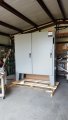
Then yesterday my panel arrived. The tractor was able to lift it off the trailer, no problem. I backed up and once free of the trailer, began to lower the skid and as I did, the tractor started to tip. Apparently the arc made by the front end loader extends outward as you go down, and this load was just at the ragged edge of what I can lift without counterweight/ballast. I quickly "dropped" the load to the ground before anything bad happened, and (beginner's luck) actually managed to do it gracefully and not destroy anything in front my client or flip the tractor. I did not anticipate the panel weighing so much. It's a big panel, but it's empty. Weight was about 1,600lbs but due to the construction of the skid, it was out on forks a bit. The next time I move this, it will be full of components and heavier. So next order of business is building a ballast weight for the 3pt hitch. Or, I'm considering making a forklift attachment for the 3pt hitch using a 3 stage mast off of a junk forklift.
 

Attachments

jpanhalt

Joined Jan 18, 2008
11,087
In my area, beet juice is used to load the rear tires. It doesn't cause corrosion if there is a leak, like calcium chloride will, is heavier than water, and resists freezing due to its sugar content. I have R4 tires (sort of half way between turf and ag tires) and the added weight gives me great traction even in 2-wheel drive.

I found it useful for doing exactly as you were doing. My pallets were loaded with split hardwood for furnace/fireplaces. With a full pallet, you could tell the back was light, but no tipping.
 

Thread Starter

strantor

Joined Oct 3, 2010
6,875
In my area, beet juice is used to load the rear tires. It doesn't cause corrosion if there is a leak, like calcium chloride will, is heavier than water, and resists freezing due to its sugar content. I have R4 tires (sort of half way between turf and ag tires) and the added weight gives me great traction even in 2-wheel drive.

I found it useful for doing exactly as you were doing. My pallets were loaded with split hardwood for furnace/fireplaces. With a full pallet, you could tell the back was light, but no tipping.
I wanted the R4 tires but because I wanted to leave with the one on the lot (vs. Ordering one to my specs) it would have cost extra. I wanted them because I didn't want to tear up my yard. But I got the Ag tires, and while I did tear up the yard (because it was saturated), I don't think I would have been successful with R4 tires. I think I would have gotten stuck.
 

Thread Starter

strantor

Joined Oct 3, 2010
6,875
This just popped up on Facebook. The article makes it sound as if I have a lot more freedom within the warranty than the OEM would like. But the article is pretty basic and more research is required.
 

jpanhalt

Joined Jan 18, 2008
11,087
Also in Post #3 here -- no need for Facebook. ;)

It's a developing story. As alluded to above, it hit the clinical laboratory industry in the early 1970's. Of course, the industry's response was "reagent rental." That is akin to current software rental schemes and equipment leasing. For a business, such approaches may be practical or even desirable. But for hobbyists (including hobby farmers),they become very expensive.

Of course, the exception is when warranty is provided free, but I don't see a problem with free service unless you simply don't trust the dealer or they try to tag on a "diagnostic" cost that isn't covered.
 
Last edited:
Thread starter Similar threads Forum Replies Date
Glenn Holland Sensor Design & Implementation 1
Top