Total resistance

Thread Starter

Dritech

Joined Sep 21, 2011
907
Hi all,

I am trying to calculate the total resistance at point X of the attached circuit.

I'm I correct if I calculate it as below:

R2 // R4 = ANS1

ANS1 // R1 = ANS2

ANS2 + R2 = ANS3

ANS3 // R5 = FINAL ANSWER

I know this should be easy, but I'm getting confused.
 

MikeML

Joined Oct 2, 2009
5,444
To find the equiv. Thevenin source resistance at X, Set the 5V node to 0V (Ground it). That eliminates R5 from the problem.

Note that you have two R2s, so rename the upper R2 to be R3. Now you have (R3//R1) in series with R2, or R3*R1/(R3+R1) + R2 = 10K*10K/(10K+10K) + 10K = 15K = Ru. That is the effective resistance looking up from node X.

Looking down from node X, you have Rd = 20K, which is in parallel with Ru = 15K, above. So Rx = Ru//Rd = Ru*Rd/(Ru+Rd) = 15K*20K/(15K+20K) = 300K^2/35K = 8571.

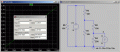
Note that I can use LTSpice to find the Thevenin Equiv of this circuit by connecting a current source to node X, and then sweeping the load current from 0μA to 100μA. Note that the Thevenin Equiv no-load output voltage occurs at I(I1)=0, which is shown at Cursor1 to be 1.42857V. The Thevenin Equiv output resistance of the network is the slope of the load line as the load current sweeps from 0μA to 100μA, which is computed automatically as the Difference between Cursor1 and Cursor2. The Slope is 8571.43 (Ω), which agrees with what I calculated algebraically, above...

Note that R5 has no effect on the Thevenin Equiv...

131.gif
 
Last edited:

MikeML

Joined Oct 2, 2009
5,444
Thanks a lot for your help :) That is still Thevenin's theorem right?
It is a step along the way to find the Thev. Equiv. open-circuit output voltage. As part of finding that, you need to know the voltage at Vout.
I used Kirchoff to sum the currents into the middle node, and went from there...
 
Top