Total energy lost while capacitor is discharging

Thread Starter

JennaShearer

Joined Sep 14, 2017
3
If you are given the current as a function of t how would you find the total energy lost while a capacitor discharges?

i(t)=(-Qo/RC)(e^(-t/RC)) during the time interval [t,t+dt] and Qo being the initial charge stored in the capacitor.
 

WBahn

Joined Mar 31, 2012
32,745
How is energy related to power?

How is power related to voltage and current?

How is voltage related to charge on a capacitor?

How is charge on a capacitor related to current?
 

WBahn

Joined Mar 31, 2012
32,745
Are you REALLY saying that you have never been taught the relationship between voltage and charge for a capacitor?

If you truly are at a point in your course work where you are being asked this kind of question (which is all about applying fundamental concepts) and have not been exposed to any of these fundamental concepts, then don't walk, run away from that institution and go find a real school.
 

wayneh

Joined Sep 9, 2010
18,092
If you are given the current as a function of t how would you find the total energy lost while a capacitor discharges?

i(t)=(-Qo/RC)(e^(-t/RC)) during the time interval [t,t+dt] and Qo being the initial charge stored in the capacitor.
Let's suppose you ignore the path for now and only consider the endpoints, at charge Q0 to start and ending at Qt. Can you calculate the difference in energy at these two points?
 

Thread Starter

JennaShearer

Joined Sep 14, 2017
3
Let's suppose you ignore the path for now and only consider the endpoints, at charge Q0 to start and ending at Qt. Can you calculate the difference in energy at these two points?

To be honest not really. I'm going to guess and use the only formula I have come across and say in Q0:(e)(i)=(i^2)(R)+i(Q0)/C and in Qt: (e)(i)=(i^2)(R)+i(Qt)/C.

I'm just a student trying to pass this module and I have had no guidance on how to do this problem hence why I am asking here. I don't want to waste anyone's time but I could really use some kind of explanation as to how I go about doing this problem.
 

WBahn

Joined Mar 31, 2012
32,745
Unfortunately, you seem to have dug yourself into a deep hole -- and it's certainly possible that it's through no fault of your own, but that doesn't change the situation. You are trying to solve a problem that requires that you understand a whole litany of fundamental concepts. What is energy? What is power? What is charge? What is current? What is voltage? What is capacitance? How do all of these relate to each other? These were almost certainly covered in prior modules, but you somehow managed to pass them without learning any of these concepts. Each time you did, you dug the hole deeper. If you pass this module, it will be deeper still. At some point, it will simply collapse and bury you.

When you find yourself in a deep hole, the first thing to do is stop digging.

You need to go back, however far you need to, and learn these concepts. Having someone show you how to work this problem will not accomplish that -- what it will most likely do is lure you into thinking you've learned something when you haven't. That's quite possibly how you've gotten to this position to begin with.

The good news is that it is salvageable. The bad news is that it will be frustrating and painful and possibly costly. But continuing to dig away is almost certainly going to be far more frustrating, painful, and costly in the long run.
 

RBR1317

Joined Nov 13, 2010
715
... Can you calculate the difference in energy at these two points?
But would that assume one knew the total energy stored in the capacitor at the beginning? It seems that the purpose of the assignment is to calculate that value as equal to the total energy dissipated in the resistor while the capacitor discharges. Where else would the energy in the capacitor go?
 

WBahn

Joined Mar 31, 2012
32,745
But would that assume one knew the total energy stored in the capacitor at the beginning?
Why is there a need to assume anything? You have a capacitance of C. You have Qo, which is "the initial charge stored in the capacitor". What more do you need?

It seems that the purpose of the assignment is to calculate that value as equal to the total energy dissipated in the resistor while the capacitor discharges. Where else would the energy in the capacitor go?
To do that, you need the circuit. That equation can apply to an infinite number of circuits -- namely any circuit that looks like a suitable Thevenin equivalent. But while that's good enough for the voltage and current relationships at the interface, it doesn't let you work power/energy problems within the equivalent circuit, only in the outside part of the circuit which, in this case, is just the capacitor.
 

WBahn

Joined Mar 31, 2012
32,745
So I would choose an easy circuit, and use that.
And then what? You've found the energy dissipated in some resistor in some circuit that you chose to use instead of the one that the question is asking about. Better to realize that the interpretation of the question that assumes it is asking for the energy dissipated in a resistor is suspect since you don't have the information needed to answer that question.
 

wayneh

Joined Sep 9, 2010
18,092
To be honest not really. I'm going to guess and use the only formula I have come across and say in Q0:(e)(i)=(i^2)(R)+i(Q0)/C and in Qt: (e)(i)=(i^2)(R)+i(Qt)/C.

I'm just a student trying to pass this module and I have had no guidance on how to do this problem hence why I am asking here. I don't want to waste anyone's time but I could really use some kind of explanation as to how I go about doing this problem.
A small amount of the reading you were likely assigned would reveal the answers. This isn't very hard if your math skills are decent but you first need the basic concepts of what a capacitor is, how it stores energy, and the definitions of the basic terms such as charge and capacitance. If your math is weak, then it gets a little harder but keep that problem separate from the understanding of the physical parameters. You should be able to get an understanding of the physics from as little as 10 minutes of reading. Working the math will take a bit longer if it doesn't come naturally for you. If you don't have a textbook that makes sense to you, there are abundant online resources here and elsewhere.
 

MrAl

Joined Jun 17, 2014
13,677
Hi,

The solution is actually a lot simpler than it may look at first. It's a matter of calculating the energy between two, i'll say time points to remain ambiguous, and since there is a well known electrical quantity associated with each point it's the difference in energy between those two points. We've all done this many times i'm sure.
I didnt want to be too specific yet, but i think we will have to do that soon.
 

WBahn

Joined Mar 31, 2012
32,745
It seems you are suggesting this should be solved as a physics problem rather than an electronics problem.
Not at all. I'm suggesting that if there are fifteen different circuits that could result in that discharge curve and all fifteen of them dissipate different total amounts of energy as the capacitor discharges, then it is unreasonable to interpret the question as asking for the energy being dissipated in some undefined and unknown part of the circuit if the only way you can get an answer is to pick one of the many possible circuits based on what you deem is somehow the "simplest" one and then declaring that that is the answer, implying that all fifteen circuits must dissipate that same total amount. It makes much more sense to interpret the question as asking something that is answerable based solely on the information given and that isn't affected by the particulars of the connected circuit.
 

RBR1317

Joined Nov 13, 2010
715
Not at all. I'm suggesting that if there are fifteen different circuits that could result in that discharge curve ...
But are there 15 different circuits that could result in the particular discharge curve which establishes that i(0)=(Qo/RC), and given the basic definition of capacitance C=Q/V or C=Qo/Vo means that i(0)=Vo/R?
 

WBahn

Joined Mar 31, 2012
32,745
But are there 15 different circuits that could result in the particular discharge curve which establishes that i(0)=(Qo/RC), and given the basic definition of capacitance C=Q/V or C=Qo/Vo means that i(0)=Vo/R?
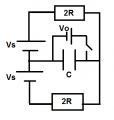
Consider the following circuit:

ThevC.png

As far as the capacitor is concerned, all it sees is a load resistance of R once the switch opens at t=0. In fact, if Vs = 0 V, that's just what you have.

So what is the total energy dissipated in R during the discharge of the capacitor when Vs = 0 V? What is it when Vs = 1000 V?
 

RBR1317

Joined Nov 13, 2010
715
OK, so this is a circuit that has a static or quiescent power provided by Vs and an objective power provided by Vo. Consider the case without the capacitor, since if the objective power can be found for any value of Vo then it can be integrated over a function of Vc to obtain the total energy.

Static power is around the outer loop as Ps = (2Vs)^2))/4R = (Vs^2)/R

Objective power in Req would be Po = (Vo^2)/R

Total power Pt = Ps+Po so objective power is also Po = Pt-Ps

Total power can also be found as the sum of the power in the upper loop and in the bottom loop:

Pt = Pu+Pb = ((Vs-Vo)^2)/2R + ((Vs+Vo)^2)/2R = (Vs^2 -2VsVo +Vo^2)/2R + (Vs^2 +2VsVo +Vo^2)/2R

Pt = (2Vs^2 +2Vo^2)/2R = (Vs^2)/R + (Vo^2)/R = Ps + Po

In summary, this is a circuit having a static power dissipation but otherwise behaves as a single resistor with value Req. Just subtract the static power.
 

WBahn

Joined Mar 31, 2012
32,745
But notice that, to find the total energy dissipated in the resistor, you needed to know the whole circuit. If I come up with another circuit that results in the exact same discharge behavior for the capacitor, you would need to know the details of THAT circuit to find the total energy dissipated in the resistor. So interpreting the question as asking about the total energy dissipated in the resistor is not a reasonable interpretation.
 

RBR1317

Joined Nov 13, 2010
715
If you think clearly about the original question, the whole circuit is only important to calculate the value of the equivalent resistance R - but that could be measured externally even without knowing the circuit (except that the circuit must satisfy the initial condition Io=Vo/Req). Total power dissipation is not relevant to solving the assigned problem, only the objective power is necessary. Whether the objective power is in a single resistor or in an equivalent resistance does not matter.
 
Top