To Cap or Not to Cap!

Thread Starter

Rkskaas

Joined Apr 3, 2024
3
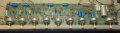
I just recently acquired a Peavey classic 410 musical amplifier and planned on replacing some of the caps. But I am a bit confused on cap selection. The caps in question are all in blue and the small silver.
4 - 100uf 40v
1 - 47uf 63v
7 - 2uf 50v
2 - 33uf 40v
In choosing the caps I find myself wondering how to replace the current caps with Identical caps. What matters most in cap replacement UF's, Volt's, and then you have tolerances % to deal with.
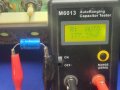
In the picture below is a picture of a Phillip 100uf 40v cap. If the tolerances @10% it's bad, @20% it's bad, @-10/+75 it's bad, @-10/+80 it's good!
The cap tolerances is not marked on this one so how do I know it's bad, or going bad?
Is going higher on voltage ok? what's safe?
And uf's tolerances are any uf's ok to use within the 20% range.

Thank you for any help,
Roger.
Cap test.jpg
Amp Chassis 2.jpg
 

Attachments

dl324

Joined Mar 30, 2015
18,328
Welcome to AAC!

Recapping is a newbie thing. Capacitors should only be replaced if they're defective.
What matters most in cap replacement UF's, Volt's, and then you have tolerances % to deal with.
All are important, as is temperature range (85C vs 100C).
In the picture below is a picture of a Phillip 100uf 40v cap. If the tolerances @10% it's bad, @20% it's bad, @-10/+75 it's bad, @-10/+80 it's good!
Some caps have a tolerance of -20%/+80%. A cap being -21% of the labeled value isn't necessarily bad. Again, it depends on how the capacitor is being used.
The cap tolerances is not marked on this one so how do I know it's bad, or going bad?
A capacitor that's going bad will exhibit symptoms. Those symptoms will depend on how it's being used.
Is going higher on voltage ok? what's safe?
Higher voltage is generally okay, but higher voltage capacitors will typically be larger than their lower voltage counterparts.

My advice - 'don't fix it if it ain't broke'.
 

MrChips

Joined Oct 2, 2009
34,813
I don't replace caps if the circuit is working. This is just a personal thing.
Do you have to match capacitance, voltage, tolerance, etc?
It depends on the function of the capacitor in the circuit.
In most cases, match the capacitance. Use the same or higher voltage. Most high value capacitances are 20% tolerance. I never get obsessed with capacitance tolerance.
Match the physical size and lead orientation, radial versus axial.

Edit: Dennis beats me to it. Don't replace caps unless it is causing a problem. Identify the problem first.
 

Papabravo

Joined Feb 24, 2006
22,082
In order to be safe, you should have a schematic of the circuit you are working with and an understanding of how changes in capacitor value may affect the operation of the circuit.

It is generally OK to use devices with a higher working voltage as long as the package will fit in the available space.

Generally speaking, there are at least two uses of capacitors where the value is critical and those are timing and filtering. In audio circuits capacitors used for coupling are not critical if their impedance is low at audio frequencies. Without a schematic I cannot speculate on the function of the board in the picture.
 

Thread Starter

Rkskaas

Joined Apr 3, 2024
3
I did attach or tried to attach a PDF schematic file, I couldn't get it to load as an image. I was able to call Peavey who is the MFG of the item I am working on and speak with one of their tech's and explain the symptoms I am having with the amp. the amp's treble circuit doesn't seem to have much change if any at all on the tone. This amp has two sets of volume controls, Master, Normal, and Bright, master controlling both normal or bright channels. When all the controls on the front panel are set to "0", I then set the master volume to 5, then I set either channel I use normal or bright also to 5, I get no sound from the amp, then when I use the bass tone it acts as a volume then sound is heard, I can do the same with the mid tone, but when I try to do this with the treble tone I get no sound at all. The PV tech gave me a few suggestions to try before recommending to send it in for repairs. Being the amp was made in 1973 the caps are 50+ yrs old and usually are the first thing they replace, they were known to leak. He also mentioned to check solder joints that it could be loss of ground. I was able to unsolder the treble potentiometer, disassemble it, clean/lube it and test it (250k tested @205), and put it back. So I believe the potentiometer is working as it should. I am not very good at troubleshooting circuits and is why I am here. I will try to find an image of the wiring schematic for this amp to upload. So I believe I have ruled out the potentiometer as a problem, and believe cap replacement is the next easiest thing to do.
 

MrChips

Joined Oct 2, 2009
34,813
Generally speaking, any type of audio circuit testing is immensely easier if you have the circuit schematics and an oscilloscope. If you do not have either of the above, all is not lost.

In your case, there are no ICs, only discrete components. This makes it easier to follow the circuitry.
The first step (if you do not have the schematics) would be to reverse engineer the board as best as you can.

The second step would be to trace the path of an audio signal from input to output. This is easier with an oscilloscope. Without and oscilloscope, use a simple audio amplifier such as a powered PC loudspeaker. Apply a sound signal, e.g. from an MP3 player, and follow the path of the signal along the board. Listen to the changes and effects as the pots are rotated.
 

dl324

Joined Mar 30, 2015
18,328
I did attach or tried to attach a PDF schematic file, I couldn't get it to load as an image.
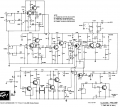
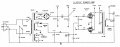
The schematic is in the PDF you attached.

Rotated for easier reading here:
1712244030461.png
1712244075151.png
Being the amp was made in 1973 the caps are 50+ yrs old and usually are the first thing they replace, they were known to leak.
You can tell if a capacitor leaked by the gunk/damage to the board.
believe cap replacement is the next easiest thing to do.
Doesn't mean it's the right thing to do. Most of us prefer to use troubleshooting skills instead of guessing, incurring unnecessary expense, and possibly causing more harm than good if your soldering skills aren't good.
When all the controls on the front panel are set to "0", I then set the master volume to 5, then I set either channel I use normal or bright also to 5, I get no sound from the amp, then when I use the bass tone it acts as a volume then sound is heard, I can do the same with the mid tone, but when I try to do this with the treble tone I get no sound at all.
Not likely to be an electrolytic cap since the other controls work and the caps around the treble adjustment are likely to be ceramic or polyester.

An oscilloscope would make troubleshooting easier.


Your post would be easier to read if you used paragraphs.
 
Last edited:

MrChips

Joined Oct 2, 2009
34,813
Having the circuit schematic makes life a lot easier.

You will notice that at almost every stage, there is a pair transistors. Too bad that there are no component identifiers which would allow us to describe specific sections of the circuit.

At each transistor pair, there is a signal input capacitor and an output capacitor.
Using your PC speaker, you can compare the signal at the input versus the signal at the output.
Use a 10μF capacitor to couple the signal into your PC speaker.
 

Thread Starter

Rkskaas

Joined Apr 3, 2024
3
Well! It's working! and all I did was reflow some solder joints that looked questionable, loosen the board mounting screws cleaned the chassis ground contact area, put it back together and BAM! It's working GREAT! Thank you all for your help.

I will take advise given here: My advice - 'don't fix it if it ain't broke'.

Not complaining because it now works. But the cap thing still has me scratching my head. 100uf cap reading 177uf why would this cap not be out of range or faulty?

I will be buying a decent oscilloscope and start learning this stuff "Recommendation?" Would like to keep it under $500. I currently have a PC based oscilloscope it a Velleman Instruments Model PUSGU250 I guess to learn the basics it will do.
 

dl324

Joined Mar 30, 2015
18,328
Well! It's working! and all I did was reflow some solder joints
Congrats! Saved yourself from replacing components unnecessarily.
But the cap thing still has me scratching my head. 100uf cap reading 177uf why would this cap not be out of range or faulty?
It depends on the cap tolerance. A 100uF with a tolerance of -20/+80 could be 80-180uF and still be within tolerance.

Whether more capacitance hurts depends on what the cap is being used for.
I will be buying a decent oscilloscope and start learning this stuff "Recommendation?" Would like to keep it under $500. I currently have a PC based oscilloscope it a Velleman Instruments Model PUSGU250 I guess to learn the basics it will do.
Don't spend $500 until you learn how to use what you have and where it doesn't satisfy your needs.
 
Top