TL284 Study

Thread Starter

Joester0064

Joined Jun 14, 2023
77
Hi All,

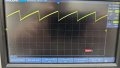
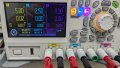
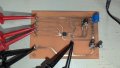
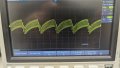
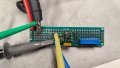
I am working to better understand how these SMPS controller ICs works so I can be better at fixing power supplies. I have on the bench a TL284 IC. So far, I have been able to achieve the sawtooth waveform with DC offset created by Vref, RT and CT on pin 4. However, it seems to jump around as can be seen on the video clip. I am not sure why this is.

5V
https://youtu.be/Wg6IQLJ8eHo?si=n-xjbRgBIjo2_u4e

15V
https://youtu.be/6xNzurg6Dlo?si=9z1ziOttYNSwT0pP

There are two videos here, one with Vcc at 5V and one at 15V, reason being, at 15V the IC gets very hot but only draws a few milliamps so I thought maybe that's why the sawtooth waveform was jumping around but it does this at 5V too so not sure.

My goal is to simply be able to observe the output of the gate driver on my scope for now. To the best of my knowledge, the following must be true in order to see this:

pin 1 - NC as this is the output of the error amplifier and this is just a test
pin 2 - 2.5V, injected from dc bench supply to simulate a normal output voltage condition
pin 3 - 0.3V, injected from dc bench supply to simulate a normal current draw
pin 4 - Sawtooth waveform with DC offset
pin 5 - ground
pin 6 - scope
pin 7 - 15V
pin 8 - 5V

Despite these conditions being true I still have to output from the IC. Any input would be greatly appreciated!

Thanks,

Joe
PXL_20240722_184802392.MP.jpg
PXL_20240722_184838605.MP.jpg
 

Papabravo

Joined Feb 24, 2006
22,058
I'm going to guess that things are jumping around because it is trying to compensate for the inputs it sees without apparent success. What exactly were you expecting?
 

Thread Starter

Joester0064

Joined Jun 14, 2023
77
I thought the sawtooth only controls the OSC freq. with the inputs to the error amplifier doing the compensation. I'm hoping to learn more about this IC and how to make a test circuit to test IC's like this. I need to better understand the conditions at the pins that give me the output that drives a MOSFET.
 

LesJones

Joined Jan 8, 2017
4,511
The oscillator frequency is set by your choice of C and R. As you are injecting a much lower voltage into the VFB input than the reference voltage the IC will be trying to output the highest duty cycle PWM wave form. It is trying to make the VFB input equal to the reference voltage but it can't do that as the feedback loop is not closed.

Les.
 
I started designing switching power supplies >40 years ago. Good layout is usually critical in the application of these switcher ICs. Unfortunately I think it will be difficult to get a good waveform representation without designing a real pcb for the IC running a real power converter around the IC. Fortunately some pcb fabricators are relatively inexpensive these days.
 

LesJones

Joined Jan 8, 2017
4,511
After reading more of the data sheet my assumption was that the block between the 5 volt reference output and the non inverting error amplifier was just a unity gain buffer seems to be wrong. I now think that block has a gain of 0.5 so your value of 2,5 volts to the VFB pin will be about correct. I dont know if the input to the ISENSE pin is correct. (I was assuming that it was for output current limiting but after reading a bit about current mode switching regulators I think I was wrong.) I found this information on current mode switching regulators https://www.ti.com/lit/an/snva555/snva555.pdf which should help your understanding.

Les
 

MrAl

Joined Jun 17, 2014
13,667
Hi All,

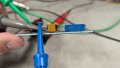
I am working to better understand how these SMPS controller ICs works so I can be better at fixing power supplies. I have on the bench a TL284 IC. So far, I have been able to achieve the sawtooth waveform with DC offset created by Vref, RT and CT on pin 4. However, it seems to jump around as can be seen on the video clip. I am not sure why this is.

5V
https://youtu.be/Wg6IQLJ8eHo?si=n-xjbRgBIjo2_u4e

15V
https://youtu.be/6xNzurg6Dlo?si=9z1ziOttYNSwT0pP

There are two videos here, one with Vcc at 5V and one at 15V, reason being, at 15V the IC gets very hot but only draws a few milliamps so I thought maybe that's why the sawtooth waveform was jumping around but it does this at 5V too so not sure.

My goal is to simply be able to observe the output of the gate driver on my scope for now. To the best of my knowledge, the following must be true in order to see this:

pin 1 - NC as this is the output of the error amplifier and this is just a test
pin 2 - 2.5V, injected from dc bench supply to simulate a normal output voltage condition
pin 3 - 0.3V, injected from dc bench supply to simulate a normal current draw
pin 4 - Sawtooth waveform with DC offset
pin 5 - ground
pin 6 - scope
pin 7 - 15V
pin 8 - 5V

Despite these conditions being true I still have to output from the IC. Any input would be greatly appreciated!

Thanks,

Joe
View attachment 327571
View attachment 327572
Hello,

Looks like an intermittent connection of some kind or noise injection from the test leads.
Try placing a 10k resistor in series with the test lead that connects to the RC junction. The 10k would go right at the end of the test lead and you may have to hold the other end of the resistor on the point to be tested or solder it there. This means you will have a 10k resistor between your board test point and the scope input lead.
Can't see what value bypass cap you have or even if that is a bypass cap. If you don't have one, add one, like 0.1uf at least. A parallel 10uf electrolytic would be good too. Power supply bypassing is always important, and right close to the chip.

Not sure if you are sensing current yet, but if so, you may need a small RC low pass filter on that. The RC filter helps prevent switching noise from affecting the current sense input.
 

Thread Starter

Joester0064

Joined Jun 14, 2023
77
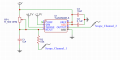
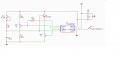
Thank you all for the valuable replys. I am very greatful for the input. I will be testing the below revised circuit soon based on the above input. I realize the Rt and Ct values are not typical but for my application I do not require kHz operation 1-500Hz is just fine. Please let me know if there are any other changes that should be made. Again, my goal is to simply be able to observe the output waveform from the internal gate driver.

1721737960819.png


I have 2 more questions:

1. Some PWM ICs like this have a dead time pin, this one does not, I will be needing to control the pulse width after I get a signal on the output.

2. Perhaps I should add a load resistor on the output? I should be able to see the waveform from the middle of the totem pole but perhaps I need a load from that point to ground?

Thanks again all.
 

bertus

Joined Apr 5, 2008
22,882
Hello,

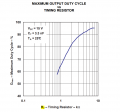
In the datasheet I see no timing resistors lower as 800 Ohms.
Take a fixed resistor of 1 K and a potmeter of say 10 K in series for the timing resistor.
You can adapt the timing capacitor to meet your frequency range.

Bertus
 

Thread Starter

Joester0064

Joined Jun 14, 2023
77
Excellent feedback, I did not think of this or notice this in the data sheet but very good to know!

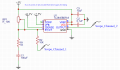
1721746145027.png
Here is the updated schematic with new Rt and Ct for 0.5 - 500Hz operation

1721747047069.png
 

Paul_Sock

Joined Apr 24, 2024
9
Hi All,

I am working to better understand how these SMPS controller ICs works so I can be better at fixing power supplies. I have on the bench a TL284 IC. So far, I have been able to achieve the sawtooth waveform with DC offset created by Vref, RT and CT on pin 4. However, it seems to jump around as can be seen on the video clip. I am not sure why this is.

5V
https://youtu.be/Wg6IQLJ8eHo?si=n-xjbRgBIjo2_u4e

15V
https://youtu.be/6xNzurg6Dlo?si=9z1ziOttYNSwT0pP

There are two videos here, one with Vcc at 5V and one at 15V, reason being, at 15V the IC gets very hot but only draws a few milliamps so I thought maybe that's why the sawtooth waveform was jumping around but it does this at 5V too so not sure.

My goal is to simply be able to observe the output of the gate driver on my scope for now. To the best of my knowledge, the following must be true in order to see this:

pin 1 - NC as this is the output of the error amplifier and this is just a test
pin 2 - 2.5V, injected from dc bench supply to simulate a normal output voltage condition
pin 3 - 0.3V, injected from dc bench supply to simulate a normal current draw
pin 4 - Sawtooth waveform with DC offset
pin 5 - ground
pin 6 - scope
pin 7 - 15V
pin 8 - 5V

Despite these conditions being true I still have to output from the IC. Any input would be greatly appreciated!

Thanks,

Joe

View attachment 327571
View attachment 327572
It's indeed a versatile chip with a wide range of applications. Understanding its characteristics and potential challenges is crucial for anyone working with it. What specific applications or projects are being worked on with the TL284, and are there any particular issues or unique findings encountered during its implementation?
 

Thread Starter

Joester0064

Joined Jun 14, 2023
77
Hi All,

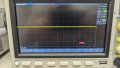
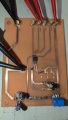
I had a chance to do up a pcb for this (I know not necessary, but I am working on perfecting my process of toner xfr for other projects) Please see attached pictures. I now have a stable RT/CT waveform but still no output. Circuit is per latest schematic, with the 5V,2.5V and 0.3V confirmed at the IC pins. There is still no output. Any thoughts are greatly appreciated.

Thanks!

Joe

PXL_20240814_021258451.MP.jpg
PXL_20240814_020808033.MP.jpg
PXL_20240814_021415238.MP.jpg
PXL_20240814_020840448.jpgPXL_20240814_020830598.jpg
 

Thread Starter

Joester0064

Joined Jun 14, 2023
77
I'm starting to think, as I have been told, that it is not as simple as just putting the right voltages on the right pins, going to try building the circuit per the open loop schematic in the data sheet but keeping the adjustable Rt:

TL284 Open Loop.png
 

sarahMCML

Joined May 11, 2019
695
Hi All,

I had a chance to do up a pcb for this (I know not necessary, but I am working on perfecting my process of toner xfr for other projects) Please see attached pictures. I now have a stable RT/CT waveform but still no output. Circuit is per latest schematic, with the 5V,2.5V and 0.3V confirmed at the IC pins. There is still no output. Any thoughts are greatly appreciated.

Thanks!

Joe

View attachment 329250
View attachment 329251
View attachment 329252
View attachment 329253View attachment 329254
You may have a short between pins 5 & 6?
 

Thread Starter

Joester0064

Joined Jun 14, 2023
77
I can see how you would think that based on the pic, but it is not when I check under the scope and with a meter.

So, big discovery for me today. Vcc has to be at least 17V for 5V to appear at Vref. Initially I had Vref confused as an input pin, as in needing to be supplied a 5V ref externally. This explains why I had a good rt/ct wave since there was 5V at Vref as I was providing it externally.

I realized on the data sheet that Vref is stated as an output plus looking at the block diagram of the ic this makes sense. I cut the trace at vref and tried again powering with 12V instead of 5V and got 0.4V at vref, then slowly brought up vcc until 5V appeared...this is very promising and a big step forward.

However, rt/ct wave now looks like this:

PXL_20240815_130020965.MP.jpg

I found this to be caused by rt still getting it power from vcc, wave is ok now. After reapplying the 0.3V at I sense, I now have an output signal. There is no output if that 0.3V is not there.

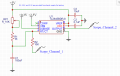
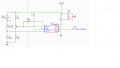
Current working schematic:

TL248 V3.png
 
Last edited:
Top