Facebook
 Google
 GitHub
 Linkedin

Some math to put it into perspective. You want an oscillator that is off 8 hours and on 29 seconds. The 29 seconds is easy, the 8 hours not so much.
So 8 hours = 28,800 seconds.
A 4060 is a 14 bit counter, with some of the bits missing on the leads, 2^14 = 16384 counts. If we use a 2 second time base it will count to 32767 seconds and recycle.
14,400 decimal = 11100001000000 (the Window's calculator is very handy for this function).
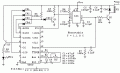
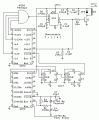
This means we need a 4 input AND gate on the ÷64 (Q7), ÷2048(Q12), ÷4096(Q13), and ÷8192(Q14) pins.
A quick look at the Fairchild data sheet shows this is doable. I prefer Fairchild's to TI's, it is clearer and has better application notes.
http://www.fairchildsemi.com/ds/CD/CD4060BC.pdf
The pinout even favors the diode connections.
A simple RC counter will take qty 1 4060, and qty 1 555.
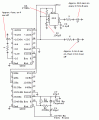
A crystal base will take an additional 4060 and a divide by 4 circuit (the stock 4060 with a 32768 crystal comes out with 2Hz).
I'll design a circuit for a 0.5 Hz (2 second) time base.
So 8 hours = 28,800 seconds.
A 4060 is a 14 bit counter, with some of the bits missing on the leads, 2^14 = 16384 counts. If we use a 2 second time base it will count to 32767 seconds and recycle.
14,400 decimal = 11100001000000 (the Window's calculator is very handy for this function).
This means we need a 4 input AND gate on the ÷64 (Q7), ÷2048(Q12), ÷4096(Q13), and ÷8192(Q14) pins.
A quick look at the Fairchild data sheet shows this is doable. I prefer Fairchild's to TI's, it is clearer and has better application notes.
http://www.fairchildsemi.com/ds/CD/CD4060BC.pdf
The pinout even favors the diode connections.
A simple RC counter will take qty 1 4060, and qty 1 555.
A crystal base will take an additional 4060 and a divide by 4 circuit (the stock 4060 with a 32768 crystal comes out with 2Hz).
I'll design a circuit for a 0.5 Hz (2 second) time base.
Last edited: