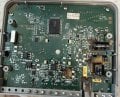
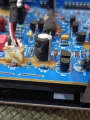
This is what Electrolytic capacitor end of life looks like

Thread Starter

schmitt trigger

Joined Jul 12, 2010
2,293
A lawn irrigation controller. IMG_2430.jpeg
Lasted 13 years, powered 24/365, on an environment where from April to October is at 100F or more, and sometimes reaches 115F in the middle of summer.IMG_2431.jpeg
 

Pyrex

Joined Feb 16, 2022
578
Is something wrong with the capacitors? It looks like a poor quality putty was used to stick them to the PCB. I've seen similar images on cheap Chinese radios or toys
 

nsaspook

Joined Aug 27, 2009
16,541
Is something wrong with the capacitors? It looks like a poor quality putty was used to stick them to the PCB. I've seen similar images on cheap Chinese radios or toys
That's what it looks like to me too.

1787678048752.png
Typical glue on board.
 
Last edited:

Thread Starter

schmitt trigger

Joined Jul 12, 2010
2,293
It is actually electrolyte leakage. I removed a couple and the capacitance value had dropped to almost zero.
Electrolyte leakage is a common occurrence when operating with applied voltage, high ripple current AND most importantly, elevated temperature for long periods of time.
I had mentioned earlier that the garage this equipment was located can be 115F in the summer. And the equipment operated for over 13 years.
Also, searching on the web, it appears that this is a common failure mechanism for this model.
 

nsaspook

Joined Aug 27, 2009
16,541
It is actually electrolyte leakage. I removed a couple and the capacitance value had dropped to almost zero.
Electrolyte leakage is a common occurrence when operating with applied voltage, high ripple current AND most importantly, elevated temperature for long periods of time.
I had mentioned earlier that the garage this equipment was located can be 115F in the summer. And the equipment operated for over 13 years.
Also, searching on the web, it appears that this is a common failure mechanism for this model.
It's possible to be both.
 
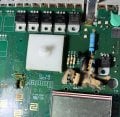
My Hunter lasted at least that long here in Phoenix and on the east side of the house exposed to the sun in the morning even. I replaced it for a WiFi model so I didn't have to go outside to program or change settings. :) OK, it is also great if you are working on your watering system so you can turn it on or off if you have a leak or just troubleshooting. I think I may even have the board from it when I just had to see what was inside... :) LOL, looks pretty close. BTW, in the area, that unit could get up to 118' in the summer on a warm day... Still worked until I removed it. ;-)
 

du00000001

Joined Nov 10, 2020
202
Ok - looks very much like the seals gave in. Not unexpected given your 13+ years (temperature not negligible but less influential).
Not that long ago I've been discussing capacitor lifetime expectation (for Al hybrid resp. Al poly caps) with a renowned manufacturer - just to learn that the lifetime expectation for these seals does not exceed 15 years under "reasonable" conditions.
 

Reloadron

Joined Jan 15, 2015
7,979
How many here recall the great Capacitor Plague?

Defective Chinese and Taiwanese capacitors—widely known as the "capacitor plague"—refer to a historical wave of premature aluminum electrolytic capacitor failures that occurred roughly between 1999 and 2007, alongside lingering quality issues in some modern cheap electronic components.


Causes of Failure
    • Stolen and Incomplete Formula: The crisis famously stemmed from industrial espionage where an incomplete, water-based electrolyte formula was stolen from a Japanese company and sold to various start-up and Taiwanese/Chinese manufacturers. [1]
    • Missing Additives: The copied formula lacked critical proprietary ingredients—specifically stabilizing depolarizers and phosphate inhibitors. [1, 2]
    • Chemical Breakdown: Without these additives, the water-based electrolyte became too alkaline, dissolving the internal aluminum oxide dielectric layer and generating hydrogen gas under heat. [1, 2]

Signs and Symptoms
    • Bulging or "Mushroom" Tops: The top vents of the metal can push upward or round out due to internal gas pressure.
    • Leaking Fluid: Crusty residue, glistening brown/clear oil, or dried electrolyte leaking from the top or bottom rubber bung.
    • Sudden Device Failure: Unexplained motherboard crashes, short-cycling, boot loops, or complete power supply failure in electronics from that era (like PCs, early Xbox consoles, and displays).
If you plan to steal a recipe, make sure you steal the whole recipe. I remember that whole mess very well.

Ron
 

Thread Starter

schmitt trigger

Joined Jul 12, 2010
2,293
I do remember it well, because in the company I was hired at the time had a Dell corporate account and had purchased hundreds of PCs.
I was hired at the tail end of the capacitor fiasco, but people would tell me about all sorts of nightmare situations which occurred as a result of this problem.
 

Thread Starter

schmitt trigger

Joined Jul 12, 2010
2,293
105C.
The way electrolytic caps are specified, is an amount of operating hours at their rated voltage, ripple current AND temperature.
FFor instance the Rubycon 25PX100MEFC5X11 is rated for 1000 hrs @ 105C, whereas the Rubycon 25YXJ100MT15X11 is rated for 5000 hrs @ 105C. Both are 100 uf, 25V from the same company.

Remember that temperature accelerates failures, and therefore expected life doubles with each 10C decrease from rated temperature.
 

wraujr

Joined Jun 28, 2022
268
Manufacturer should have used 125C rated (automotive grade), given outdoor use in hot climates including possibility of direct sun exposure. Military uses tantalum caps and never electrolytics for endurance. Its also construction and materials affect life.
 

AnalogKid

Joined Aug 1, 2013
12,299
Military uses tantalum caps and never electrolytics for endurance.
Last century, definitely. But the all-tantalum-all-the-time days ended in the 80's. Today - not so much.

Back when I retired, many of our MIL customers were phasing out the use to tantalum caps because of long-term reliability and fire hazard issues, shifting to high-rel electrolytics and high-value ceramics. To glue down the larger ones, we used a special version of RTV. I never was clear on why it was special; long-term performance, low out-gassing, flexibility and/or adhesion at low temperatures, whatever.

ak
 
Top