Thevenins theorem Query

Thread Starter

Kev 101

Joined Apr 7, 2014
19
i graspt the concept of mesh analysis, but how does it work with just the one voltage source, this is where my confusion lies.

sorry again for being a pest.
 

shteii01

Joined Feb 19, 2010
4,644
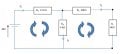
is this what you mean left loop mesh 1 and right loop mesh 2
Yes.
Now I am going to derive the equation for mesh 2, then you derive equation for mesh 1.

Mesh 2.
I am going to call the mesh current in Mesh 2: B.
10k(B)+6k(B)+4k(B-A)=0
10kB+6kB+4kB-4kA=0
-4kA+20kB=0
-4kA=-20kB
A=5k(B)

Now you do Mesh 1.
 

shteii01

Joined Feb 19, 2010
4,644
48v = 12k(A) + 4k(A)
48v = 12kA + 4kA
48v = 16kA
A= 48/16kA
A= 0.003
That is incorrect.

The 4k resistor is shared by two meshes. So each mesh current contribute to the current through 4k resistor. Your approach only accounts for the portion contributed by mesh current A. You did not take into account the portion contributed by mesh current B.
 

shteii01

Joined Feb 19, 2010
4,644
48v = 12k(A) + 4k(A+B)
48v = 12kA + 4kA+4kB
48v = 16kA + 4kB
A= 48/16kA + 4kB/16k
A= 0.003 + 0.25
A= 0.253
That is also incorrect.

The way you setup meshes in the first place is that both mesh currents A and B are clockwise. This means that when we examine current in 4k resistor, we see that mesh current A is pointing down, mesh current B is pointing up. Since the two currents point in opposite directions, they can not be added up together.

Examine my setup for Mesh 2. What did I do when I examined the 4k resistor?
 

Thread Starter

Kev 101

Joined Apr 7, 2014
19
the 4k resistor was made a negative value as in -4k ohms as you entered at the negative side of the resistor joining with mesh 1, once you had totaled up the total resistance of the second mesh and moved it over also making it a negative you divided it by the -4k
 

shteii01

Joined Feb 19, 2010
4,644
the 4k resistor was made a negative value as in -4k ohms as you entered at the negative side of the resistor joining with mesh 1, once you had totaled up the total resistance of the second mesh and moved it over also making it a negative you divided it by the -4k
I totaled the voltages.
 

shteii01

Joined Feb 19, 2010
4,644
I provided two examples, and some work on your problem. You, now obviously, not interested in learning. I respectfully bow out.
 

Thread Starter

Kev 101

Joined Apr 7, 2014
19
i am interested hence the fact i am still here and asking questions on which step it was i went wrong with the equation twice, and from that point where would i look at next .

i also mentioned that this is all new as i have only just started with most of this, but i am more than keen to learn.
 
Top