Facebook
 Google
 GitHub
 Linkedin
Hi, first post, glad to be here!
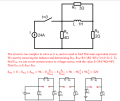
Have a hard time understanding Thévenin equivalent and this problem is not a exception. The question is "The inductor L is initially uncharged. Set up the expression for the current iL (t) through the inductor"
I understand the fact that Rth = R1 // R2+R3.
But when transformering the current source to voltage source, V=I*R we only calculate with the R2 resistor. From my perspective the current can flow in both branches and the voltage source should be V=I * R2 // R1+R3.
And I don´t understand the calculations of the voltage divider to get Vth. Would be thankful if someone could explain.
Best regards
Have a hard time understanding Thévenin equivalent and this problem is not a exception. The question is "The inductor L is initially uncharged. Set up the expression for the current iL (t) through the inductor"
I understand the fact that Rth = R1 // R2+R3.
But when transformering the current source to voltage source, V=I*R we only calculate with the R2 resistor. From my perspective the current can flow in both branches and the voltage source should be V=I * R2 // R1+R3.
And I don´t understand the calculations of the voltage divider to get Vth. Would be thankful if someone could explain.
Best regards