'The art of electronics' is a worthless piece of garbage! !!

Thread Starter

imbaine13

Joined Oct 6, 2013
67
I recently acquired The art of electronics and I have discovered it really wasn't worth it, especially considering it doesn't seem like a self study book (contrary to popular belief). It has been two years since I started learning electronics and I have built and prototyped a lot if circuits but I still can't go a page if this book (chapter 2) without thinking too hard and eventually giving up that section out of frustration. I am currently trying to learn how to build relatively good (thd <0.01) audio amps and I thought this book along with 'high power audio amplifier construction manual - G. Randy Slone' would do the trick but both have terribly disappointed me. Might anyone have any idea where to start with audio amplifiers (something simpler)? Perhaps an actual self study book and not something pretending to be one!
 

GopherT

Joined Nov 23, 2012
8,009
I recently acquired The art of electronics and I have discovered it really wasn't worth it, especially considering it doesn't seem like a self study book (contrary to popular belief). It has been two years since I started learning electronics and I have built and prototyped a lot if circuits but I still can't go a page if this book (chapter 2) without thinking too hard and eventually giving up that section out of frustration. I am currently trying to learn how to build relatively good (thd <0.01) audio amps and I thought this book along with 'high power audio amplifier construction manual - G. Randy Slone' would do the trick but both have terribly disappointed me. Might anyone have any idea where to start with audio amplifiers (something simpler)? Perhaps an actual self study book and not something pretending to be one!
Well, first, you should post your question on All the sub-forums instead of just two.
Then you should realize there are several types of books.

Some include,
How to - not much in terms of theory, they just show you how to get it done. Step by step
Reference Book (tables of data, and brief explanations, references of other texts where you can find more information)
General Textbook (kind of an introduction to a subject that gives you the vocabulary and basis to discuss more advanced topics)
Sub-topic specific textbooks (digs into the details without reviewing the basics)

The Art of Electronics is a hybrid of General Textbook and reference book all in one. My rule of thumb, tools that do more than one thing are ok at each but usually not great. Same applies to this book, but if you read the intro (or Foreward?), it specifically says it is intended for non-engineers (chemists, biologists, geologists, ...) to get them started in building (or even understanding the capabilities) of electronic measurement and testing. So definitely the wrong place to learn about mid-quality audio.

In general, it takes an expert to design an audio amp with 0.01 % thd. Recently, it has been suggested that it takes 10,000 hours of study and experimentation to become an expert (about 5 years of 40-hour weeks). In other words, the electronics companies don't hire hobbyists with 2-years of experience to design their consumer amps.
 

Brevor

Joined Apr 9, 2011
297
I own a copy of "The Art of Electronics" I borrowed someones copy for a few weeks and it was so good I bought my own. It's been several years since I last opened it so I don't remember exactly how the subject was presented, but I found it very useful. Perhaps already having an electronics education made it easier to use.

Edit: I pulled my copy off the shelf and looked through chapter 2. (transistors) To me it seems to explain the subject very well. Maybe you could try posting some of your questions here about the parts you don't understand. There are a lot of amplifier experts here.
 
Last edited:

sirch2

Joined Jan 21, 2013
1,075
Sell your cleverness and buy bewilderment.
Cleverness is mere opinion, bewilderment intuition. - Jalal al-Din Muhammad Rumi

Sometimes, when my views go against the opinions of the vast majority, just sometimes, occasionally, I wonder if they may be right and I may be wrong.
 

MaxHeadRoom

Joined Jul 18, 2013
30,876
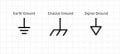
I had a couple of issues with the A of E. was the misuse of the power common displayed throughout the book by the use of the earth ground symbol instead of the more correct Logic or signal common symbol.
And also the fact that I could not find either recommended schematic layout methods or a list of electronic symbol definitions from any standard.
upload_2015-2-11_9-38-4.jpeg

Max.
 

AnalogKid

Joined Aug 1, 2013
12,287
Hmmm... We use your Earth Ground symbol for signal ground, your Chassis Ground symbol for Earth Ground, and your Signal Ground for negative power supply rails. If signal gnd is tied to earth gnd, the earth gnd symbol is used. In our systems the chassis always is earth grounded due to UL and MIL rules, but signal gnd often is floated from earth.

ak
 

MaxHeadRoom

Joined Jul 18, 2013
30,876
The symbols are clearly defined in various standards both N.A. and EC.
The problem as I see it is when a symbol is defined and the definition is disregarded, the symbol becomes meaningless.
It may not cause a problem when a circuit is confined to one isolated circuit, but when power circuitry is included such as a Earth grounded supply, it could be dangerous if the symbols are taken literally and wired as such.
There was an example here just over a week ago where someone had shown a circuit using the earth ground symbol, but it would have been catastrophic if the circuit had actually been referenced to earth ground.


upload_2015-2-11_10-37-21.png

Max.
 

cmartinez

Joined Jan 17, 2007
8,881
The symbols are clearly defined in various standards both N.A. and EC.
The problem as I see it is when a symbol is defined and the definition is disregarded, the symbol becomes meaningless.
It may not cause a problem when a circuit is confined to one isolated circuit, but when power circuitry is included such as a Earth grounded supply, it could be dangerous if the symbols are taken literally and wired as such.
There was an example here just over a week ago where someone had shown a circuit using the earth ground symbol, but it would have been catastrophic if the circuit had actually been referenced to earth ground.


View attachment 80316

Max.
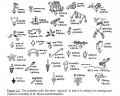
I liked the Grounds for Divorce icon...
 

Thread Starter

imbaine13

Joined Oct 6, 2013
67
I appreciate all you guy's input. sirch2, you might be right, but I have seen a number of noobies post a lot questions from AoE, which I'm confident proves my point. Why do so many electronics guys recommend the book to absolute beginners if it's so confounding anyway?
I do recognise the author's effort to write such an extensive book but I would appreciate it if the concepts were more elaborate. I'm the kind if person that wants to understand every detail of everything, and this book isn't cutting it.
Thanks Brevor. It's unfortunate I don't feel the same. I'm hoping things will eventually improve with time and more experience.
I'd appreciate more suggestions on audio amp books.
 
Top