apparently yes.
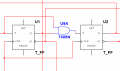
the thing is that i need to import my design to PCB in multisim and i cant with this black components.
didn't find any t flip flop datasheet
apparently yes.
the thing is that i need to import my design to PCB in multisim and i cant with this black components.
didn't find any t flip flop datasheet
It is because they are not as useful as the alternatives. What logic family are you using for the rest of the board? Please tell me it is not TTL, as would be indicated by the AND gate.
It is because they are not as useful as the alternatives. What logic family are you using for the rest of the board? Please tell me it is not TTL, as would be indicated by the AND gate.
The problem is that it is an obsolete technology. Nobody is making new parts, The existing inventory is moving to the gray market, prices can be expected to be volatile, and there is no guarantee of a reliable supply. Certain parts may now be completely unavailable. The other problem is that thru-hole parts are becoming obsolete as well. Most manufacturing of PC boards are done with surface mount parts. Is that enough to keep you up at night? I'm curious as to who wants you to do this and why?
The cheapest available JK flip-flop at Digi-key right now is a 74HC73 for just over $0.09 each in quantity. Similar parts are non-stock with a 45-51 week lead time. There are only nine manufacturers of JK flip flops left that are available on Digi-key.
If you are porting an ancient design to a modern technology you need access to competent engineering resources. A technicain or a guy who just does PCB layout has a very low probability of success. Don't take the fall for this if you don't have to.
There's no problem. It's typical for students to be required to use TTL and Multisim. For simulations, availability, cost, power consumption, etc are irrelevant. If you were planning to build the circuit, that's different.
I've seen students come here and be required to breadboard with TTL that the school provided.
First of all thank you for the help.
The board inst going to be printed.
with that said, i do need to present the circuit on PCB in multisim including simulation.
regarding to your question Dennis, might it be because the T-FF is just a JK-FF in another configuration?
AFAIK, the T-flip-flop may have originated as a pedagogical construct, or in an era where they were constructed of discrete parts. I don't think one was ever realized as an integrated circuit unless it was in RTL or DTL, before my time. It never occurred to me that a board layout might be required without the necessity of actually doing it. I see now that for training purposes it might be useful, but at the same time it would make more sense to use surface mount parts since that is the norm in industry.
AFAIK, the T-flip-flop may have originated as a pedagogical construct, or in an era where they were constructed of discrete parts. I don't think one was ever realized as an integrated circuit unless it was in RTL or DTL, before my time. It never occurred to me that a board layout might be required without the necessity of actually doing it. I see now that for training purposes it might be useful, but at the same time it would make more sense to use surface mount parts since that is the norm in industry.
Its a university project.
At first it was plan to build the design on a regular board at the lab, but due to thg he corona theyve changed the requeirments
Its a university project.
At first it was plan to build the design on a regular board at the lab, but due to thg he corona theyve changed the requeirments
Got it. I understand that university projects may not use the latest and greatest, but that's not your fault. You and your associates are just trying to cooperate to graduate. Rock on.
You can also make a toggle FF by connecting the Q-BAR output back to the D input on a D-flip-flop.
The other thing that was strange about the original schematic was that the SET and RESET inputs were left unconnected. Normally, in a real environment you would never, ever do that -- even if it "seemed" to work.
It has an input labeled "D" for Data, and a Clock. There are two outputs labeled Q and Q-BAR. Q-Bar is the complement of Q. On the rising edge of the clock the level on the D-input is transferred to the Q output. The complement of the D-input goes to Q-BAR.
When you run a wire from Q-BAR to D, and clock it you get a T-flip-flop

 Facebook
 Google
 GitHub
 Linkedin