Superposition:

Thread Starter

ELECTRONERD

Joined May 26, 2009
1,147
Hey Everyone,

You might call this a homework assignment, so I put it here. :)

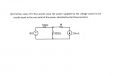
I'm having trouble solving Part B of this quiz, I hope someone can help me. I have three equations, do they look correct?

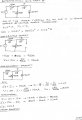
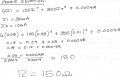
Equation 1: \(6I_1 = 100I_1^2 + 300I_2^2 + 0.02^2R\)

Equation 2: \(I_2 = I_1 - 0.02\)

Equation 3: \(I_1 = 0.015 + \frac{1.5 + 0.02R}{75}\)

Note that with equation 3, I "superimposed" \(I_1\) with sub-circuit 1 (voltage source) and sub-circuit 2 (current source).

I'd appreciate any help!

Austin
 

Attachments

hgmjr

Joined Jan 28, 2005
9,027
HINT 1: You need to find the voltage at the junction of R1, R2, and R3.
HINT 2: You do not need to know the value of R to find the voltage at the junction of R1, R2, and R.

hgmjr
 

nubelube

Joined Jan 3, 2010
16
Hey Everyone,

You might call this a homework assignment, so I put it here. :)

I'm having trouble solving Part B of this quiz, I hope someone can help me. I have three equations, do they look correct?

Equation 1: \(6I_1 = 100I_1^2 + 300I_2^2 + 0.02^2R\)

Equation 2: \(I_2 = I_1 - 0.02\)

Equation 3: \(I_1 = 0.015 + \frac{1.5 + 0.02R}{75}\)

Note that with equation 3, I "superimposed" \(I_1\) with sub-circuit 1 (voltage source) and sub-circuit 2 (current source).

I'd appreciate any help!

Austin
The second term of the RHS of Equation 3 looks suspicious. You know the total current through the parallel resistors, so I_1 (of sub-circuit 2) should be given by current division of known resistors.

I solved the problem differently. Using KCL, you can solve directly for the voltage at the resistor-junction. From there, you can write down the power absorbed by each element. This sums to zero by physics; but the sum of all terms except the current source is also zero, by the problem's constraint that voltage-source power equals sum of resistor powers. In other words, the voltage drop across the current source is zero (you can also conclude this by inspection and just replace the current source with the constraint that i_R=0.02A). Now you know the current through R and the voltage across it.
 

Thread Starter

ELECTRONERD

Joined May 26, 2009
1,147
Thanks for the help! I do have one question though: In the second sub-circuit (current souce), I can apply the current divider rule. However, That is only if I do 100Ω||300Ω. So technically, the input current won't equal I1 or I2 since currents in parallel will vary (the 20mA would be the output of the current divider).

I am thinking of solving for the voltage across R1 and R2 in both sub-circuits, then superimposing my result. Then, I can apply KVL to obtain the power through each resistor and calculate the resistance necessary for R.

Thanks,

Austin
 
Top