stuck with equivalent resistance

MrAl

Joined Jun 17, 2014
13,702
I really am paying attention but what is the #1 concern abut the parallels? There has been a lot of information and I am a bit mired down. Ill reread the posts in the meantime -
My component use in the 2 strings is the same type. Each string will be attached individually to the same Voltage source. I believe I have my power ratings calculated correctly. I have reduced he voltage source to 5V from 15V - although it wasn't clear that this needed to be done absolutely but I feel better about it.

What else do I need to address all of the parallel concerns.
Hello again,

In reference to paralleling two or more LED's.
If one LED has a characteristic voltage of say 3.1v and the other 3.2v, then the 3.2v LED will draw less current than the 3.1v LED when they are placed in parallel because the 3.1v LED will limit the voltage getting to the 3.2v LED and so the 3.1v LED gets hotter. How much hotter depends on what current you decide to run the pair at.
For example, since the pair together in the ideal case can draw twice the rated current of one, if you decide to run at 2 times the LED current (each LED just gets 1/2 of the total current) then one of them may be drawing more current than the other due to the difference in the LEDs. On the other hand, if you decide to drive them at the rated current of just ONE of the LEDs, then there is no problem because neither LED can get more than the rated current for one LED. There may be an issue of brightness however, where one appears brighter than the other.

In theory this isnt a concern unless of course you are using theory to design an actual circuit and then the theory would include the differences in LED's.

The main idea is that LED's are not like resistors they have differences that make a bigger electrical difference in a circuit then just the tolerance of some resistor would have.

I hope i have explained this better now but if not do not hesitate to ask about what is not clear.
 

WBahn

Joined Mar 31, 2012
32,823
The problem is that you can encounter what is known as thermal runaway.

Up until now, you have probably been under the assumption that an LED has a fixed voltage across it no matter how much current is passing through it. For many analysis and design calculations, this is more than good enough to get valid results.

But, in actuality, like all diodes, the voltage/current relationship for LEDs is such that, as you apply more voltage you get more current (or vice versa). It's nominally an exponential relationship such that if you increase the current by a factor of ten you increase the voltage by something around 100 mV to 200 mV, depending on the specifics of the LED construction. Furthermore, there are manufacturing variations from lot to lot and even diode to diode, so two diodes in parallel will seldom split the current equally and, because of the exponential relationship, one LED might have significantly more current than the other.

You now have two devices with the same voltage but one has more current. That means that the one with more current is dissipating more power, which in turn means it will heat up more than the other.

Here is where the real trouble starts. At higher temperatures, the amount of current that will flow in an LED is more than will flow at lower temperatures. This means that as the LED with more current gets hotter than the other one, the current in it will increase and the current in the other will decrease -- it will essentially hog the current. But this means that it is now dissipating even more power while the other one is dissipating less, leading to a further temperature difference, leading to more hogging. It's a vicious cycle which can result in one string hogging all of the current and the other strings getting none. With two strings, this means that one set of LEDs is getting about twice the current it was intended to, which likely won't cause it to burn out, so the only bad thing is that the other string goes dark, or nearly so. But let's say you parallel ten strings. Now one string might be getting something like ten times the current it was supposed to and this might be enough to cause it to fail, almost always as an open. That means you now have nine strings sharing the current that was meant for ten and the same process happens again, only faster, and another string burns out. You can end up with cascading failures that will destroy all of you LEDs in short order.

In practice, there are some things that can mitigate this. LEDs are seldom true diodes in that they often have a significant resistive component to them -- it's like they have a built in resistor (it was not intended, it's just an artifact of how it was constructed). If many situations this can be enough to stop the hogging before it destroys things, but you still often get a pretty severe current imbalance between LEDs. Some cheap devices rely on this behavior to enable them to run lots of LEDs in parallel connected directly to a battery having a fairly significant internal resistance.
 
Last edited:

eetech00

Joined Jun 8, 2013
4,705
Hello again,

In reference to paralleling two or more LED's.
If one LED has a characteristic voltage of say 3.1v and the other 3.2v, then the 3.2v LED will draw less current than the 3.1v LED when they are placed in parallel because the 3.1v LED will limit the voltage getting to the 3.2v LED and so the 3.1v LED gets hotter. How much hotter depends on what current you decide to run the pair at.
For example, since the pair together in the ideal case can draw twice the rated current of one, if you decide to run at 2 times the LED current (each LED just gets 1/2 of the total current) then one of them may be drawing more current than the other due to the difference in the LEDs. On the other hand, if you decide to drive them at the rated current of just ONE of the LEDs, then there is no problem because neither LED can get more than the rated current for one LED. There may be an issue of brightness however, where one appears brighter than the other.

In theory this isnt a concern unless of course you are using theory to design an actual circuit and then the theory would include the differences in LED's.

The main idea is that LED's are not like resistors they have differences that make a bigger electrical difference in a circuit then just the tolerance of some resistor would have.

I hope i have explained this better now but if not do not hesitate to ask about what is not clear.
Hi MrAL

Just a suggestion...but I think is would help the TS is you drew a picture of the LED configuration your describing to help eliminate confusion. There's been so much discussion on "parallel this", and "series that", and "parallel/series this" in previous posts, that it will be easy to confuse the TS.
 

ebeowulf17

Joined Aug 12, 2014
3,307
I really am paying attention but what is the #1 concern abut the parallels? There has been a lot of information and I am a bit mired down. Ill reread the posts in the meantime -
My component use in the 2 strings is the same type. Each string will be attached individually to the same Voltage source. I believe I have my power ratings calculated correctly. I have reduced he voltage source to 5V from 15V - although it wasn't clear that this needed to be done absolutely but I feel better about it.

What else do I need to address all of the parallel concerns. It may be the writing on the wall to go with total series if possible.
If you stick with an arrangement like you have in post 38 (and many of your other posts,) you'll be totally fine. The problems with parallel LEDs only apply when the LEDs themselves are paralleled. Your arrangement shows two series strings with two LEDs and a resistor per string, and then those two strings are in parallel. Since there is a separate resistor in each of the two strings, everything is fine.
 

MrAl

Joined Jun 17, 2014
13,702
Hi MrAL

Just a suggestion...but I think is would help the TS is you drew a picture of the LED configuration your describing to help eliminate confusion. There's been so much discussion on "parallel this", and "series that", and "parallel/series this" in previous posts, that it will be easy to confuse the TS.
Hello there,

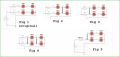
Yes good idea. See attachment.
I also like to keep an eye on the threads i post in so i can answer more questions if needed.

Fig 1 is the original circuit.
Fig 2 has just LED2 and LED4 in parallel.
Fig 3 has the two series strings in parallel.
Fig 4 has LED2 in parallel with LED4, and has LED1 in parallel with LED3.
Fig 5 has the two series strings in parallel and powered with just one resistor. The resistor has to be 1/2 of what it was before in order to keep the same current in both LED strings.

Note because of the LED paralleling problem that 83 Ohm resistor should really be higher so we can never see more than the target 15.3ma through any of the LEDs. If we made that resistor 166 Ohms we could never see more than the target current through any of the lEDs, but then the brightness would drop by about 50 percent (although the life of the LED would go up by a high amount). A nice compromise might be 120 Ohms or something like that.
 

Attachments

MrAl

Joined Jun 17, 2014
13,702
I really am paying attention but what is the #1 concern abut the parallels? There has been a lot of information and I am a bit mired down. Ill reread the posts in the meantime -
My component use in the 2 strings is the same type. Each string will be attached individually to the same Voltage source. I believe I have my power ratings calculated correctly. I have reduced he voltage source to 5V from 15V - although it wasn't clear that this needed to be done absolutely but I feel better about it.

What else do I need to address all of the parallel concerns. It may be the writing on the wall to go with total series if possible.
Hello again.

Also see the post just before this one there are some drawings that might help.
 

MrAl

Joined Jun 17, 2014
13,702
Hello,

Perhaps the attached PDF might help.

Bertus
I like what they say about the mismatched LEDs and how when one fails the rest get more current than designed for.
I've seen this actually happen. I had a Streamlight flashlight with those small LEDs and one started blinking, then went out, then the others went one by one. I played with the resistor values but got fed up with it and chucked it.
It was a nice flashlight when it worked, before any LEDs blew out. It doesnt take long though, maybe a couple months of on and off usage.
 

Thread Starter

clangray

Joined Nov 4, 2018
261
Fig 5 has the two series strings in parallel and powered with just one resistor. The resistor has to be 1/2 of what it was before in order to keep the same current in both LED strings.
Fig 5 cleared up a major issue I had with the single resistor (83 ohm) that is 1/2 of the value (166 ohm) of resistor in the string. The single resistor is actually is an actual resistor! Not just a calculation. The single resistor is substituting the circuit resistors in parallel (fig.5)
Note because of the LED paralleling problem that 83 Ohm resistor should really be higher so we can never see more than the target 15.3ma through any of the LEDs.
The inclusion of the single 83 ohm resistor in place of what is twice its value (two 166 ohm resistors) resolved a lot of misunderstanding on my part. I knew how to calculate the parallel resistors into a single one, but I didn't know the single results could be an actual resistor replacing 2 parallel's with the single one. The diagram is clear: first circuit with 2 x 166-ohm ballast resistors, second minus 166-ohm ballast. This is clearly demonstrated in attachments of post #45.
 
Last edited:

WBahn

Joined Mar 31, 2012
32,823
But keep in mind that Fig 5 is NOT equivalent to the original circuit. It is equivalent to a modified circuit where a wire has been placed as in Fig 3. Either case (as well as Figs 2 and 4) are inviting the thermal runaway conditions that have been described. You may get away with it having just two strings of paralleled LEDs, but it is a poor design decision.
 

MrAl

Joined Jun 17, 2014
13,702
Fig 5 cleared up a major issue I had with the single resistor (83 ohm) that is 1/2 of the value (166 ohm) of resistor in the string. The single resistor is actually is an actual resistor! Not just a calculation. The single resistor is substituting the circuit resistors in parallel (fig.5)

The inclusion of the single 83 ohm resistor in place of what is twice its value (two 166 ohm resistors) resolved a lot of misunderstanding on my part. I knew how to calculate the parallel resistors into a single one, but I didn't know the single results could be an actual resistor replacing 2 parallel's with the single one. The diagram is clear: first circuit with 2 x 166-ohm ballast resistors, second minus 166-ohm ballast. This is clearly demonstrated in attachments of post #45.
Hello again,

I am happy that helped.

The only catch though is as WBaln brought up again. That is the PRACTICAL side of the circuit.
In theory we can do things that we never can do in practice, or should not do in practice.
For example, in pure theory we can draw an infinite current from a voltage source, but in practice this would blow out the power supply or blow the fuse and so we would never get an infinite current.
With the two parallel resistors (or 2 strings of in parallel) the circuit with the 83 Ohm resistor is exactly equivalent to the original circuit but ONLY when the LEDs are matched perfectly, or at least the two strings of 2 each are matched, and we sometimes think of it that way when we are working in the theoretical because it allows us to understand things we could not understand as easily as if we were to work in the practical world.. The pure theory is like a measuring tool, it is perfect in every aspect. That means all perfect circuit elements or how we like to refer to them as "ideal".
"ideal" simply means that the parts do not have any secondary characteristics that would make the circuit implausible for a real life circuit. Since LED's have some side issues, when we go to apply the theoretical circuit to the practical world we have to remember there may be restrictions. For the circuit in Fig 5 this is the case because as mentioned now several times the LED's are not perfect so they may encounter some problems if that circuit is actually built and tested. In theory though the circuit makes it simpler to understand the basics behind parallel resistances and how current splits and all that.

I hope this doesnt confuse you this is a finer point about electrical circuits and what is often referred to as "theory vs practice".
 

Tonyr1084

Joined Sep 24, 2015
9,744
what is the #1 concern abut the parallels?
I think is would help the TS is you drew a picture of the LED configuration your describing to help eliminate confusion.
On the very subject of multiple LED's in parallel all on a single resistor: The video is intended to show that you CAN run a bunch of LED's in parallel from a single resistor. The caveat is that all the LED's must be very very close to the same Vf. Notice in the video what happens when I put mis-matched LED's parallel. The RED LED's have a Vf of 1.95 (average). Out of 100 red LED's, the max Vf and min Vf measured was 1.95 & 1.92 with a standard deviation of 0.01Vf. In other words, they're dang close to the same Vf. I also used a green LED with 2.92Vf (average). The RED draws all the current and the green extinguishes. But when I remove the red LED's the green glows brightly. I then demonstrate blue LED's with Vf of 2.82 (2.80 min / 2.83 max / Std Dev 0.01). As with the red's they're dang close. So in the video they all work.

What others have said about paralleling LED's is wise to say the least. From the video you can concur that if two LED's of the same color but of different Vf's, the one with the lower Vf will hog all the current. It might burn out. If it does then it can subject the second LED to max current, which will likely also burn out. It's called cascading failure. When one blows the rest will begin to overheat. When a second blows the rest will heat even faster. When a third blows, likely the rest will blow out faster than you can react to shut down the circuit. So it's always wise to not parallel LED's. However, I just wanted to prove a point, so I made this video:
 

Tonyr1084

Joined Sep 24, 2015
9,744
I want to swap the indicator LED with an illuminated push-button power switch. I am looking in the 5V range. Would this be okay to put the push-button in a series configuration with the circuit, or is some other configuration warranted?
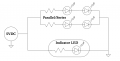
Some other configuration is warranted. With a 5V source the power is so low that adding additional voltage drops may render your approach DOA. You don't want to put the indicator LED in series with the other LED's. Rather, it's just another parallel circuit as shown below.
1660604784626.png
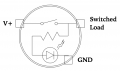
It's very likely that the push button illuminated switch has its own built in resistor. That's why the indicator in my drawing is in it's own bubble. Also likely an illuminated switch will have three leads; one from the main power source (5V this instance), one switched lead and one ground lead. The switch when active provides power to your circuit. It also provides power to the internal SRLED (series resistor LED). My drawing doesn't show a separate ground, but a ground would be needed for such a switch.

Muddy yet?
 

Tonyr1084

Joined Sep 24, 2015
9,744
Likely the illuminated switch is something like this:
1660605542345.png
You can swap the V+ and the "Switched Load". In that case the switch will be illuminated any time there's power supplied to the switch. The switch will still function to turn the load on and off. But if you swap the V+ and Load the LED will only tell you the power is available. Will mean nothing as for the IR LED's. So the best way to achieve what you want is to wire the PB Switch the way shown in the illustration. It is its own parallel circuit to the load.
 
Top