Spectrum analyzer and probes

Thread Starter

Johnny1010

Joined Jul 13, 2014
96
Hi everyone,
I am using a spectrum analyzer with the input impedance of 50 ohm. But the probe I have is a common oscilloscope probe rigol rp1100 which has the common 1x and 10x options. So would using this probe effect my measurements and how please explain. And what could be the solution for it.
Cheers.
 

MrChips

Joined Oct 2, 2009
34,630
A scope probe is intended to be used with a scope with input impedance of 1MΩ.

Use a 50Ω coax cable such as RG-58/U.

What are you probing?
 

Thread Starter

Johnny1010

Joined Jul 13, 2014
96
Thanks for the reply. I am trying to analyze the output of a square wave amplifier. For using a 50 ohm coax the output impedance of my amplifier would have to be quite low?
 

MikeML

Joined Oct 2, 2009
5,444
Thanks for the reply. I am trying to analyze the output of a square wave amplifier. For using a 50 ohm coax the output impedance of my amplifier would have to be quite low?
How about using a voltage follower such as a common drain NFET or common collector NPN as a buffer? The transistors would introduce some roll-off of frequency response. How much depends on the fundamental frequency of the square wave.
 

Thread Starter

Johnny1010

Joined Jul 13, 2014
96
@Mike Ml. Yes that is a really good suggestion but I have an already designed PCB at hand in which this amplifier is one part of the circuit and I am to perform frequency analysis on only the output of amplifier so right now implementing a voltage follower won't be possible.
 

MikeML

Joined Oct 2, 2009
5,444
Well, just make a custom one-of preamp for the specturm analyser. It just has to have a 50Ω output impedance (and a high input impedance so that it doesn't load your generator), and then you can use any length of RG-58 cable between the preamp and the analyzer.

The RG58 must be terminated at both ends by 50Ω (by the preamp's output impedance at the source end, and by the 50Ω input inpedance of the analyzer itself) to prevent reflections on the cable from screwing up your measurement...

The preamp could be powered by a small battery.
 

alfacliff

Joined Dec 13, 2013
2,458
what does it matter if the level is off? impedance mismatch will reduce the level, but not the difference in levels of harmonics and such. even just holding the probe near the circuit wll give you the frequency and relative levels of the signals present.
 

Thread Starter

Johnny1010

Joined Jul 13, 2014
96
@alfacliff that was actually my basic question that how my readings would be affected in terms of dBm. Figuratively the results would be right but measured values won't be correct.
 

Thread Starter

Johnny1010

Joined Jul 13, 2014
96
Guys if you could explain that why we want to keep the impedance of the probe equal to that of the input impedance of the spectrum analyzer. Don't we want the combined impedance of the probe and measuring device to be very large to negate the loading effect?
 

MikeML

Joined Oct 2, 2009
5,444
Guys if you could explain that why we want to keep the impedance of the probe equal to that of the input impedance of the spectrum analyzer. Don't we want the combined impedance of the probe and measuring device to be very large to negate the loading effect?
We dont!

We want the input impedance of the preamp to be high enough so that it doesn't load your generator. Only you know how high that needs to be. We are presuming that 50Ω is too low.

So that you dont have multiple reflections (due to improper terminations and resulting high SWR on the 50Ω RG58 cable) between the preamp and the analyzer, the output impedance of the preamp must be 50Ω.
 

MrChips

Joined Oct 2, 2009
34,630
Presumably you are measuring signals with high frequency content. Even a 1kHz square wave will have high frequencies.

If you are going to probe a signal you need a probe which means using a coax cable of some sort. A coax cable is a transmission line. If there is a mismatch in the impedance of the transmission line with the signal driver and the receiving end you will end up with signal reflections. If you want to maintain the fidelity of the signal then you have to match the impedances.

The spectrum analyzer was designed to use a 50Ω cable and that is why it came with 50Ω input impedance.
 

Thread Starter

Johnny1010

Joined Jul 13, 2014
96
Thanks guys things are pretty clear now. Just a few more confusions
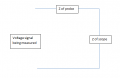
Let us consider a scenario where I use my probe to measure a signal and connect the other end of probe to oscilloscope now I want the impedances of my probe and scope to match to avoid signal reflections but wouldn't the measured signal be facing a voltage divider formed by the probe and scope impedance and at the end I would get half the signal of that being measured at my scope?
 

Attachments

MrChips

Joined Oct 2, 2009
34,630
A proper oscilloscope probe has a 10x setting which will increase the probe input impedance to 10MΩ. The output of the attenuator is still matched to the 1MΩ input impedance of the scope.

Yes, you will observe a 10x reduction on the scope. On older scopes you have to take this into account and mentally adjust the VOLTS/DIV scale.

Modern scopes take this into account. On a digital scope, you set the input attenuation and the digital readouts account for this. On some scope/probes the scope automatically senses the 1x/10x setting of the probe.

As a general rule, I use my probes on the 10x setting.
 

bance

Joined Aug 11, 2012
315
The RG58 must be terminated at both ends by 50Ω (by the preamp's output impedance at the source end, and by the 50Ω input inpedance of the analyzer itself) to prevent reflections on the cable from screwing up your measurement...
Mike explained this....

OOPPS didn't realise there was more than one page.....
 

alfacliff

Joined Dec 13, 2013
2,458
how many terminations do you want? the source, the load , and the scope? if the scope has a high input impedance, like a 10 x probe, it will still measure the voltage across the load, without disapating any of the power.
 

Thread Starter

Johnny1010

Joined Jul 13, 2014
96
@MikeML the max square wave frequency is 50MHz and I am interested in the 11th or the 5th odd harmonic which would make it around 550MHz.
 
Top