Speaker Protection

Thread Starter

Metalfan1185

Joined Sep 12, 2008
185
Hi all,

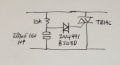
Trying to come up with a decent speaker protection circuit to protect some older vintage speakers I have. I would like it to be external to any amp I decide to use (amps powered from both single polarity power and dual polarity power rails). Cookie-cutter solutions I've seen seem to be built around one or the other but never both. I took pieces from a few different ones and came up with this I was hoping you might give me some feedback/suggestions on it to make it better (or to make it work in the first place lol). I will be prototyping it soon. Thanks!
 

Attachments

MrChips

Joined Oct 2, 2009
34,810
You can put an incandescent light bulb in line with the speaker. Try an automotive 12 V bulb, wattage depends on the speaker wattage.

At low power, the resistance of the light bulb is low. At higher power, the bulb gets hot and the resistance increases, protecting the speaker.
 

crutschow

Joined Mar 14, 2008
38,505
Or don’t hook it up to any amp it cannot handle.
May not be sufficient if an output transistor shorts and connects the speaker directly to the amp supply.
And generally you want an amp with a high power rating to handle high music transients without distortion, that may be above the speaker's average max power rating.

I prefer nsaspook's suggestion of adding a fuse in series with the speaker connection.
It's simple and reliable, and a has low resistance under normal operation, to maintain a good speaker damping factor, but should protect the speaker against any sustained over power event.
 

BobTPH

Joined Jun 5, 2013
11,515
I have been playing with audio amps and speakers, commercial and home-built, for about 60 years and have never incorporated protection and never damaged a speaker. Any decent commercial amp should have a fuse that would blow if the output transistor shorted.
 

Thread Starter

Metalfan1185

Joined Sep 12, 2008
185
Or don’t hook it up to any amp it cannot handle.
I have been playing with audio amps and speakers, commercial and home-built, for about 60 years and have never incorporated protection and never damaged a speaker. Any decent commercial amp should have a fuse that would blow if the output transistor shorted.
Not very helpful. Ideally I'd like to use them with amps I build myself, or even play with some of these newer Class D amps that are seeming to pop up everywhere (I know, I know...but being a technician it's good to familiarize yourself with even the "bad" stuff). Most of the amps I own or have seen contain speaker protection relays or a circuit of some sort.

May not be sufficient if an output transistor shorts and connects the speaker directly to the amp supply.
And generally you want an amp with a high power rating to handle high music transients without distortion, that may be above the speaker's average max power rating.

I prefer nsaspook's suggestion of adding a fuse in series with the speaker connection.
It's simple and reliable, and a has low resistance under normal operation, to maintain a good speaker damping factor, but should protect the speaker against any sustained over power event.
If you believe this would be enough protection I can try this method, it sure seems easy enough. How would one calculate the fuse value needed? My guess is to use at least a 120/250V rated fuse since a speaker is an inductive load. I was looking at a Class-D amp I wanted to try that has a 48VDC power supply input, so the most the output could be in a 100% efficient world is 48V. It says the output is 300W (supposedly 150+150, but idk if I believe that) I usually listen to music at lower volumes anyways. My speakers are rated for 200W or 250W each I think? I have to double check. I know the impedance is 8 ohms each. There's a crossover inside too (3 way speakers).

I appreciate the input!
 

Ian0

Joined Aug 7, 2020
13,131
Hi all,

Trying to come up with a decent speaker protection circuit to protect some older vintage speakers I have.
What are you protecting your speakers from?
From yourself, and turning the volume up too loud?
Or from something going wrong in the amplifier?
 

nsaspook

Joined Aug 27, 2009
16,322
What's the difference?
The electronics are perfectly OK but the speakers (not electronics but electromagnetic transducers) are blown (or the fuses blew before the speakers were damaged) because of Jr. and his house party.
1761496155186.png

Back in the day (as a kid in HS, working at a Radio-shack that did repair) I must have fixed scores of audio electronics with blown circuit protection fuses the didn't harm the speakers and more scores of speaker driver replacements from even lowed powered amps that were over-driven, electronics didn't fail, but sent clipped signals to smoke the drivers, with scores of mixtures of both.
 
Last edited:

MisterBill2

Joined Jan 23, 2018
27,514
To provide serious protection against such accidents as a feedback bust or a dropped microphone, you will need BOTH a "fast-blow" fuse AND groups of shunt power diodes. Enough diodes in each direction so that they are biased into conduction when the voltage comes close to the speaker power rating. THAT will take some basic math, and a bit of experimenting. Power diodes start to conduct closer to 0.6 volts forward bias and reach about 0.7 volts in full conduction. You will need to use diodes rated at a high enough current to assure the series fuse fails before the diodes. This scheme is probably both the simplest and the most reliable. BUT it will cause serious distortion as an over-power signal arrives. It is similar to a shunt-zener-diode voltage regulator.
 

Thread Starter

Metalfan1185

Joined Sep 12, 2008
185
What are you protecting your speakers from?
From yourself, and turning the volume up too loud?
Or from something going wrong in the amplifier?
Not so much turning the volume up too loud, I prefer less volume and better quality most of the time, and clipping has the added audible alert of sounding awful. I don't trust class D amps yet, and if I build an AB with LM3886's or something down the line that's on probation too until it proves itself LOL.

The speaker power is I²R so the maximum current is √(200/8) = 5A.
You may want to use a fuse some smaller than that for safety.
I see. I think it may be better to assess the fuse's value according to each amp's output as opposed to the speaker ratings, right? So if the amp wattage is 150W (one channel), it would be sqr(150/8) = 4.33A. Maybe a 3.5A fuse would be a good conservative choice? Imagining a scenario where a smaller amplifier output might go full DC, not be enough to open the fuse but still heat up the coils to uncomfortable levels...It's easy to do some quick math and swap the fuses in these cases.
 

BobTPH

Joined Jun 5, 2013
11,515
I think it may be better to assess the fuse's value according to each amp's output as opposed to the speaker ratings, right? So
No. Not if it is the speaker you are trying to protect.

Say your speaker is rated at 100W and the amp at 500W. A fuse at 500W is not going to protect the speaker.
 

Thread Starter

Metalfan1185

Joined Sep 12, 2008
185
No. Not if it is the speaker you are trying to protect.

Say your speaker is rated at 100W and the amp at 500W. A fuse at 500W is not going to protect the speaker.
Well yeah I know that much, I meant if the amp power is lower than the speaker power rating. I'm not one to connect lower wattage speakers to higher wattage amps.
 

BobTPH

Joined Jun 5, 2013
11,515
I'm not one to connect lower wattage speakers to higher wattage amps.
Then what are you worried about? If you connect a 50W peak amp to that 100W speaker, it is not going to be damaged unless something fails in the amp and it puts out over 100W. In the case of most commercial amps, the power supply could not even do that even if there was a short.
 

Ian0

Joined Aug 7, 2020
13,131
Class D has one advantage over Class AB in that there is a 2nd order filter on the output. That would protect the speaker from any high frequency oscillations and high order harmonics from clipping.

The main danger would be from a failed power transistor which introduces DC on to the output. This circuit would protect the speaker from a DC offset.
IMG_2018.jpeg
 

MisterBill2

Joined Jan 23, 2018
27,514
Nobody yet has mentioned the actual accidental amplifier ultimate power. All decent amplifiers are rated by the power level at some very low distortion level, like 0.1% total distortion. Sony car stereo systems were rated at 10% total harmonic distortion, while my old MARANTZ-2235 was rated at 0.5% THD. Of course the Sony car stereo systems would be about 1% THD at the 8 watt output, the high distortion was at the 40 watt level.
The CROWN DC150 was very low distortion at150 watts, but it could easily destroy 200 watt speaker systems when seriously over driven.
SPEAKER protection demands limiting the feed to a bit less than the specified power rating.THAT is why I suggest the diode clamp in both directions. Don't try to figure out triggering a triac, use power diodes that conduct when the voltage rises above 0.65 volts. (full conduction about 0.7 volts.) .
The biggest source of that power blast often is when somebody tries to plug in a mic or instrument when the system is already powered on and working at a high power setting . That momentary blast of noisy mains frequency sometimes is followed by silence of blown out speakers..
 
Top