Facebook
 Google
 GitHub
 Linkedin

Hi
I need to fined i(t) for te following circuit.
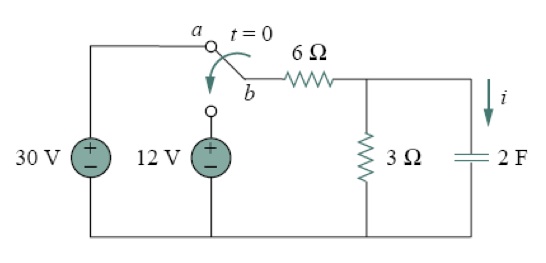
I think I know what I'm doing, I'm just a little stuck on using
I(t) = V/R + C (dv/dt)
so this is what I have so far-
V(0-) = 30V(3Ω/(6Ω + 3 Ω) = V(0) = V(0+)
= 10V
Removing the capacitor
Rth = 6Ω + 3 Ω
\(\tau\) = Rth x C = 2 x 9
At t>0
V(∞) = 12V(3Ω/9Ω)
V(t) = V(∞) + [V(0) - V(∞)]e^(t/\(\tau\))
= 4 + [10 - 4]e^(t/18)
= 4 + 6e^(t/18)
this is were i started getting confused.
so I(t) = V(0)/Rth + C (dv/dt) right??
= (10/9) + 2(d/dt (4 + 6e^(t/18)))
=10/9 + 2((6)(1/18)e^(t/18))
=10/9 + (2/3)e^(t/18)
dose that look right?
looking at an example, it looks like its on the right path... but I dont understand the rule that was used in the differentiation in the example.
isn't
d/dx ke^x = k((d/dx)x)e^x ?
thanks a bunch guys
I need to fined i(t) for te following circuit.
I think I know what I'm doing, I'm just a little stuck on using
I(t) = V/R + C (dv/dt)
so this is what I have so far-
V(0-) = 30V(3Ω/(6Ω + 3 Ω) = V(0) = V(0+)
= 10V
Removing the capacitor
Rth = 6Ω + 3 Ω
\(\tau\) = Rth x C = 2 x 9
At t>0
V(∞) = 12V(3Ω/9Ω)
V(t) = V(∞) + [V(0) - V(∞)]e^(t/\(\tau\))
= 4 + [10 - 4]e^(t/18)
= 4 + 6e^(t/18)
this is were i started getting confused.
so I(t) = V(0)/Rth + C (dv/dt) right??
= (10/9) + 2(d/dt (4 + 6e^(t/18)))
=10/9 + 2((6)(1/18)e^(t/18))
=10/9 + (2/3)e^(t/18)
dose that look right?
looking at an example, it looks like its on the right path... but I dont understand the rule that was used in the differentiation in the example.
isn't
d/dx ke^x = k((d/dx)x)e^x ?
thanks a bunch guys