soo stuck :/ distances in a circuit!

Thread Starter

champ01

Joined Aug 22, 2012
10
Hey guys, I have this question that was in a lecture slide.. I have no clue where to start for question a) :/
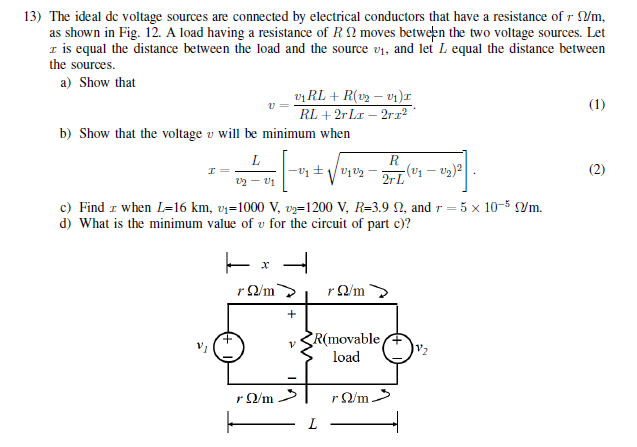


I know that the r ohms/m is the resistance of the wires per m..thus they give you lengths of x and L.. but where do i go from here? I was thinking super position and neglecting v2 or something then vice versa for v1?

Thankss heaps!
 

panic mode

Joined Oct 10, 2011
5,226
draw a circuit, label everything and you will get three resistors in series (wire1, load, wire2). then calculate voltage drop on load.
 

t_n_k

Joined Mar 6, 2009
5,455
No you aren't heading in the right direction.

In the original diagram the "sliding" resistor R forms a bridge across the lines at the point of connection to the lines.

If the sliding R is a distance x from source V1 then the line resistance in each line conductor from V1 to the connection point is x*r Ω. The line resistance in each line conductor from source V2 to the point of connection is (L-x)*r Ω.

Redraw the schematic with the line elements replaced with those equivalent resistances and with R bridging the lines at the connection points. You'll end up with a two loop network which you can then analyze using standard DC circuit analysis techniques.
 

t_n_k

Joined Mar 6, 2009
5,455
For your current annotations I would think

I2=I1+I3

where

I2=V/R

Rather than what you have for I2.

I1 & I3 correct as you have them.
 

Thread Starter

champ01

Joined Aug 22, 2012
10
oh okay, thanks! but then I am not including the distance L in? as when I work that equation out after changing I2, I don't get to the equation they want :S just about to go over it again to see if I did any arthimetic errors..
 

t_n_k

Joined Mar 6, 2009
5,455
If you start with ...

\(I_2=I_1+I_3\)

or

\(\frac{V}{R}=\frac{V_1-V}{2xr}+\frac{V_2-V}{2\(L-x\)r}\)

and work through the somewhat complex algebra to make V the subject of the equation then you will arrive at the correct answer.
 

panic mode

Joined Oct 10, 2011
5,226
just multiply last equations by 2xr(L-x) and solve in terms of V and you get the answer to first part. for second part you need to solve dV/dx=0 and rest is just plugging in numbers
 
Top