Small price tag display, who makes it?

Thread Starter

ronsimpson

Joined Oct 7, 2019
4,823
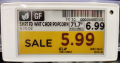
I am working on Home Automation. I am looking for who makes this display. It is all over Walmart and the grocery stores. There is a red LED that blinks when you search for that product in the store. I have seen the workers program the display from a phone application. There is "PRO" printed on the case.
There must be a million (+/-) things we can do it they can be programmed from a central computer. I did not measure the size, but the height might be 3cm. It runs on batteries and sticks to the wall.
1791042273543.png
 
I have wondered about those. Walmart buys them by the store-full so they can't be that expensive. AliExpress has e-ink displays, but they're not yet down to AliExpress "cheap" where I'll buy a handful just to play.

I believe Washington State is talking about banning them – concerns about "demand pricing" and the price being displayed not being the price you actually pay. In my experience – with one local hardware store in particular – is that paper shelf price tags are the bigger issue. Something rings up at a higher price than the shelf tag, and when challenged the response is "The price has been changed in the system, the tags haven't been changed yet." Yes, I'm the guy who will argue until they honor the price on the shelf under threat of calling the attorney general. Yes, thank you, I do live in a woke blue state with strong consumer protection laws.

I do believe that electronic shelf labels are a good idea, but prices should only be updated when a store is closed. The price displayed when I pick an item should be the price I pay (or less).

[No, stop ranting about store "e-coupons" that only show up after you hit the pay button.]
 
Here is some info from Perplexity AI. Yes, it is an AI response but it provides links to various resources, so it may be helpful. The short answer seems to be that grocery store tags are usually a pretty well locked down proprietary system and any reuse of the tags will be very difficult (as you would expect – imagine the results of a Hack-A-Day post "Using Walmart Shelf Tags in 3 Easy Steps").
 

Thread Starter

ronsimpson

Joined Oct 7, 2019
4,823
Now that I know what to search for, Walmart has a package of 8 for $120.
"2-1-Inch-Electronic-Price-Tag-ESL-TFT-Screen-Display-No-Messy-Writing-Bluetooth-Connect-Management-for-Android-APP-8Pcs" They appear to be B&W (not color) bluetooth. One year battery.
 
This being WalMart with enormous purchasing power, my guess would also be this particular display a custom made device with a proprietary system.

Similar devices may be available
 

Thread Starter

ronsimpson

Joined Oct 7, 2019
4,823
Most of the little displays I see talk only bluetooth.

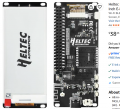
"Heltec ESP32-S3 Wireless Paper E-Ink 2.13 Inch SX1262, LoRa WiFi Bluetooth" Is more like what I want because it will talk LoRa or WiFi or Blue. It probably will not work on battery. (1 watt) The price is more than I wanted.
1791076004763.png
 

WBahn

Joined Mar 31, 2012
33,218
I am working on Home Automation. I am looking for who makes this display. It is all over Walmart and the grocery stores. There is a red LED that blinks when you search for that product in the store. I have seen the workers program the display from a phone application. There is "PRO" printed on the case.
There must be a million (+/-) things we can do it they can be programmed from a central computer. I did not measure the size, but the height might be 3cm. It runs on batteries and sticks to the wall.
View attachment 371908
I don't know how useful they would be for individual small projects. They are intended to be used as part of a rather sophisticated centralized system using proprietary software to manage them using encrypted and authenticated protocols. I think most of the new ones have moved to using Bluetooth BLE 5.4, which was specifically developed for ESL (electronic shelf labels). But I don't know enough about them to know if they are adaptable to the kind of applications a hobbyist or other person might have in mind. Having said that, I can think of many projects that something like this could be useful for that are, individually, pretty small scale but would have a lot of users overall, so they might have made the system pretty flexible. I would also imagine that there are different systems using the same basic technology that are intended for small-scale use that are available (or will be, if not already).
 

WBahn

Joined Mar 31, 2012
33,218
I have wondered about those. Walmart buys them by the store-full so they can't be that expensive. AliExpress has e-ink displays, but they're not yet down to AliExpress "cheap" where I'll buy a handful just to play.

I believe Washington State is talking about banning them – concerns about "demand pricing" and the price being displayed not being the price you actually pay. In my experience – with one local hardware store in particular – is that paper shelf price tags are the bigger issue. Something rings up at a higher price than the shelf tag, and when challenged the response is "The price has been changed in the system, the tags haven't been changed yet." Yes, I'm the guy who will argue until they honor the price on the shelf under threat of calling the attorney general. Yes, thank you, I do live in a woke blue state with strong consumer protection laws.

I do believe that electronic shelf labels are a good idea, but prices should only be updated when a store is closed. The price displayed when I pick an item should be the price I pay (or less).

[No, stop ranting about store "e-coupons" that only show up after you hit the pay button.]
They're not particularly cheap. Something like $10 each in bulk for those color tags. That doesn't sound like much, but the average Walmart has around 60,000 shelf tags, so it adds up real fast. Then there's the cost replacing the batteries, both the physical cost and the labor involved down the road when they start needing to be replaced several hundred a day. But that's several years away and they are already talking about going to low-voltage rails in the shelves with battery-less labels, so they might have gotten to the point where they replace them with the new system before the batteries in these die on a large scale.

The savings to the merchants isn't really in the cost of having employees replacing paper tags. That's actually pretty marginal because it's down at the same time that the products are restocked. There are several advantages that they benefit from that are much more significant. By having the tags and the registers managed from a single database, they eliminate the need to price-match when a shelf tag doesn't get changed even though the price actually did. That alone saves them more than just the price difference, it save quite a bit of time by not having to have a someone called to go do a price check and then overriding the system price, all while the line of other customers is being held up. Another convenience is when you are looking for a product, either using their app or by asking an employee, they can get the tag to flash to show you exactly where the item is supposed to be. Then consider being reshelving items that were taken off the shelves but not purchased. The person putting them back can scan the UPC label and then the shelf label can flash showing them right where to stock it. Similarly, when someone is picking items for an online order, the tag can flash showing them right where it is, which not only speeds up the process but reduces the chance of picking the wrong item. So there are some real, legitimate benefits to everyone.

As for the fears over "demand pricing", that's readily addressed by legislation saying what practices merchants must or must not adhere to.
 
Top