Did they define the stiffness required for the current source?One was how to implement a 30 uA current source in a scope (early 1970's, solid state chassis with a CRT).
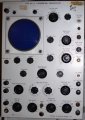
I once had a _really_ old Tek scope. It started with 800 volts regulated it to 400 volts and then used a resistor to charge a cap to get the "linear" horizontal sweep sawtooth. The sweep was 20 volts p-p.When I was in school, Tektronix was on campus recruiting, and came with a short quiz with some real-world problems. One was how to implement a 30 uA current source in a scope (early 1970's, solid state chassis with a CRT). The answer they were looking for was a single 10 M resistor to the regulated +300 V plate supply.
ak

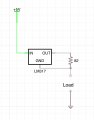
For super easy, just use an LM317 and a resistor.Hi,
i already found a few circuits but i really need it to to be small.
Similar to this
Any suggestions?
Thanks!

I've crawled around in a lot of gear in many different industries, and *nothing* compares to Tek power supplies. Those boys were just plain strange. And it wasn't just their scopes - their broadcast pulse and test gear were just as weird. Diagnosing a Tek scope supply was a graduate course in circuit analysis.I once had a _really_ old Tek scope. It started with 800 volts regulated it to 400 volts and then used a resistor to charge a cap to get the "linear" horizontal sweep sawtooth. The sweep was 20 volts p-p.
I can attest to that, having recently fixed the power supply in my Tek 2225 scope.I've crawled around in a lot of gear in many different industries, and *nothing* compares to Tek power supplies. Those boys were just plain strange. And it wasn't just their scopes - their broadcast pulse and test gear were just as weird. Diagnosing a Tek scope supply was a graduate course in circuit analysis.
ak
The oddest circuit I can think of is in the FG504 -- a 40MHz function generator. It uses a dual differential pair inside a CA3102 to make a voltage comparator . That part makes sense.I've crawled around in a lot of gear in many different industries, and *nothing* compares to Tek power supplies. Those boys were just plain strange. And it wasn't just their scopes - their broadcast pulse and test gear were just as weird. Diagnosing a Tek scope supply was a graduate course in circuit analysis.
ak