Small amount of hum on Class D amp when preamp is plugged in

Thread Starter

Meerkat 67

Joined Jan 29, 2015
36
I recently completed a Class D amp and I am getting some hum.. When I test the amp with no input and speakers connected it is quiet as a mouse.

I believe these amps are susceptible to stray fields, I have carefully kept the AC away from the output boards using twisted leads but the small transformer for the speaker protection board is in the area as are the 12 volts lines.

Anyone have any ideas on the problem

Thanks

Wayne.
 

crutschow

Joined Mar 14, 2008
38,674
If there is no hum with no input, then it would seem that the problem is from your audio source or a ground loop between the two.
What is your audio source?
 

dendad

Joined Feb 20, 2016
4,641
It is usually important to only have one point where the 0V connects to the chassis. Otherwise induced currents have a complete circuit via the more than on ground point and cause hum. I generally have the ground point only at the input connectors. Just a couple of days ago I too assembled a class D amp, but from pre-built modules. One channel has a low level noise a bit like wind noise on a microphone, not hum. This is my first class D amp so it will be interesting to see how it works out.
 

Marley

Joined Apr 4, 2016
519
The hum is either a ground loop or poor filtering or screening in the pre-amp. It is not a fault of the class D power amp.
Professionals use isolating transformers on the inputs of power amplifiers. Otherwise you have to be very careful with earthing. Preferably with only a single common earth point.

The low-level noise like wind noise is caused by a poor connection somewhere in the pre-amp. Could be a bad solder joint or possibly a faulty semiconductor device - transistor or IC - that has a bad connection internally on one of its lead-out wires.
 

dendad

Joined Feb 20, 2016
4,641
The hum is either a ground loop or poor filtering or screening in the pre-amp. It is not a fault of the class D power amp.
Professionals use isolating transformers on the inputs of power amplifiers. Otherwise you have to be very careful with earthing. Preferably with only a single common earth point.

The low-level noise like wind noise is caused by a poor connection somewhere in the pre-amp. Could be a bad solder joint or possibly a faulty semiconductor device - transistor or IC - that has a bad connection internally on one of its lead-out wires.
Thanks. I'll have to have a look at the board. It is a pre built one and I've done nothing with it yet but mount it in an old graphic equalizer along with a BIG power supply (toroidal transformer) and speaker protection unit. When I get time I'll investigate the construction of the amp and may upgrade caps and things. I do hope I can track down the noise. I've a second power amp board somewhere so may try a swap first. It does sound like a noisy semi to me.
 

schmitt trigger

Joined Jul 12, 2010
2,172
I also believe, like the other posters have mentioned, that it may be related to ground loops.

A personal experience, which may or may not be applicable.
Back in the full analog days, I was called to help to locate the hum source at a recording studio.

To make a long story short: we found that by connecting the AC plug of reverb unit from one receptacle to another receptacle about a foot away would completely cure the problem, which BTW was intermittent.

Normally what one would do after solving the problem, one would leave the problem like that, but my curiosity was piqued. I could see with my (analog) voltmeter that there was a voltage difference between the two ground plugs, but that difference would come and go.
I was wondering what could cause the effect, when someone yelled: "Mary, can you make some document copies?" Then I saw the voltage difference jump.
Turns out that the electricians wiring the control room had run out of circuit breaker slots in the main panel, and they still required to have a couple additional outlets in the control room. So they looked which breaker had the lowest load, and it turned out it was the one where the big Xerox copier was plugged to, way back in the main office!!
So they ran out a line from the office to the control room to power those outlets.
 

Thread Starter

Meerkat 67

Joined Jan 29, 2015
36
If there is no hum with no input, then it would seem that the problem is from your audio source or a ground loop between the two.
What is your audio source?
My audio source is the preamp/tuner of my AR1500.. I will reconnect the preamp back and see if the hum is still there.. I will let you know

Thanks Wayne
 

Thread Starter

Meerkat 67

Joined Jan 29, 2015
36
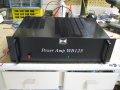
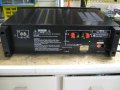
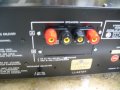
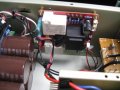
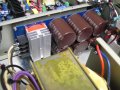
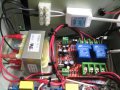
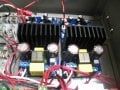
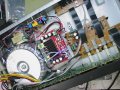
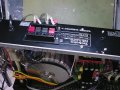
Back again. I reconnected the preamp section back to the amp and it is fairly quiet.. I suspect the audio cables I was using were not shielded well enough. Will look into that as well. Have included a few photos of the completed amp, Let me have your opinion on the layout etc.. I have done a previous amp on a Dynaco 120 chassis, this one was on a Nikko Alpha 130 that was in bad shape.

Cheers

Wayne
 

Attachments

crutschow

Joined Mar 14, 2008
38,674
...........I have done a previous amp on a Dynaco 120 chassis
That you gutted a Dynaco 120 makes me a little sad. :(
My old 120 that I built in the 70's is still working, powering my computer speakers (HSU HB-1's) with a great sound, clean and transparent (except occasionally when a bad contact requires me to bang it a little to get it back).
 

Thread Starter

Meerkat 67

Joined Jan 29, 2015
36
That you gutted a Dynaco 120 makes me a little sad. :(
My old 120 that I built in the 70's is still working, powering my computer speakers (HSU HB-1's) with a great sound, clean and transparent (except occasionally when a bad contact requires me to bang it a little to get it back).
Just to male you feel better, I did not gut the 120, it came to me in pieces all nicely removed and packaged.. I do plan on putting it back to original as I have found another 120 that is not working.. Not sure what is wrong with the existing unit, but I want to bring it back to life with a full restoration, new pc boards which I can make if necessary.Once I get it finished I will send you some photos

Cheers Wayne
 

crutschow

Joined Mar 14, 2008
38,674
Just to male you feel better, I did not gut the 120, it came to me in pieces all nicely removed and packaged.. I do plan on putting it back to original as I have found another 120 that is not working.. Not sure what is wrong with the existing unit, but I want to bring it back to life with a full restoration, new pc boards which I can make if necessary.Once I get it finished I will send you some photos
Great. I'm looking forward to seeing the pictures.

Mine is original except for one electrolytic coupling capacitor I had to replace.
I have the manual with schematics (which I see is available on the web).

I've read some reviews about the 120 that complain about crossover distortion due to too little output stage bias, but I've never heard any with mine. It always sounds very clean and transparent, even at low levels.
I compared it to an old Sony high-end stereo receiver I had and the 120 definitely sounded much cleaner.
 

Thread Starter

Meerkat 67

Joined Jan 29, 2015
36
Great. I'm looking forward to seeing the pictures.

Mine is original except for one electrolytic coupling capacitor I had to replace.
I have the manual with schematics (which I see is available on the web).

I've read some reviews about the 120 that complain about crossover distortion due to too little output stage bias, but I've never heard any with mine. It always sounds very clean and transparent, even at low levels.
I compared it to an old Sony high-end stereo receiver I had and the 120 definitely sounded much cleaner.
No problem, do not know when I will get to this project as seller is wavering on the price..

If the sale goes south, will keep looking.

Have a great Memorial Day weekend

Cheers

Wayne.
 

dendad

Joined Feb 20, 2016
4,641
I've been playing around with class D amps too.
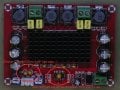
TPA3116 D2 120W+120W from Ebay.
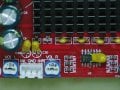
They were VERY noisy, and I tracked it down to less than ideal input coupling 2u2F 50V electrolytic capacitors. Tossing them and installing Tantalum caps fixed it.
I found, for at least my application as the inputs come from a pot to ground, the caps were installed reversed polarity. That may have been all the problem was.
I also added a 10uF tant across the pre-amp supply.
TPA3116 D2 120W+120W.JPG

CapMods.JPG

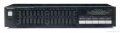
This is installed in a Technics SH-Z250 graphics equalizer. This sort of device if readily available as junk or at yard sales.
technics_sh-z250_stereo_graphic_equalizer.jpeg
SH-Z250 Mod.JPG
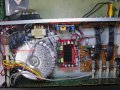
I will stack the second amp on top of the first as the added power supply has plenty of headroom. It is a bit overkill but "Nothing Exceeds Like Excess"!
This will give my son a 4 channel amp for his PA work.

EDIT:
I added the other board so now it is 4 channels. At the moment, it is running on olny 2 inputs but I may change that.

2AmplifierBoards.JPG


2AmplifierBoards2.JPG
 
Last edited:
Top